qʰa-____ is pretty old in Jargon
“hihi-pʰikcha” by Tyla LaGoy, on page 13 of Lane Community College’s magazine “Chinuk Wawa” #2, has the expression qʰa-ikta (literally ‘where-thing’), ‘whatever’…
And, although that’s not a well-known expression, this got me thinking that the phrase structure qʰa-___ is pretty old in the Jargon.
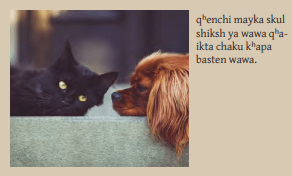
Image credit: “hihi-pʰikcha” by Tyla LaGoy at the link below
(Download / print “Chinuk Wawa” #2 for free from this link.)
The reason I think qʰa-___ is old, is that it shows up in both the (older) Southern Dialect & the (younger) Northern Dialect of Chinuk Wawa.
I think it’s inherited in the north, from a more lively existence in the south. Like a number of other structures, such as reduplication, we find lots more going on in the south, much of which was “forgotten” in the north.
In the north, we have one expression of this form. It’s qʰa-san (literally ‘where-day’, spelled ka san in the Chinuk Pipa of Kamloops Wawa) — and it means simply ‘when’ or ‘whenever’. Aside from pus (which also means ‘if’), it’s the only way we know in the north to express ‘when’.
In the south, we have qʰa-san (in the distinct sense ‘some day’), plus at least one more qʰa-___ expression:
- qʰa-ikta ‘whatever; nothing definite’ (literally ‘where-thing’)
I should say, there are additional expressions noted in the 2012 Grand Ronde Tribes dictionary under qʰa, but I don’t see those as having developed into new, non-predictable meanings. However, qʰa-iwa ‘which (one)?’, literally ‘where-other’, might be considered in this light.
Long story short, it would seem qʰa-___ expressions started out in the south some time ago. This must have been prior to the generation of Grand Ronde elders who were born around 1900, who Henry Zenk worked with. We can say this confidently, because at least one qʰa-___ is already found in the north by the 1890s, and is curiously prominent there. So qʰa-san looks to have arrived with the rest of the Jargon in the wave of 1858+ gold rushers.
One reason I find the qʰa-___ expressions interesting is that they look to be yet another example of a “grammaticalization” in Chinuk Wawa. Meaning, a case where an existing word (for ‘where’) takes on a new and productive use, losing much of its original meaning, becoming a marker of a grammar function (in this instance, a kind of logical indefiniteness).
In this way, qʰa-___ is a lot like the Jargon’s t’ɬunas- (literally ‘maybe’) plus a WH-question word, which I translate as ‘gosh knows who/what/where/etc.’ That, too, is an expression common to both dialects of the language, so it also must be old.
