1896: Recalling “some jargon” from K’alapuya people
Just after the frontier era, non-Natives in the Grand Ronde (Oregon) area still had a vivid grasp of local Chinook Jargon.
Settlers were able to imitate how Native people spoke the language, which makes a lot of sense, because it’s from Indigenous folks that the newcomers learned to speak it.
Here’s a very fine example, not necessarily trying to be an exact quote, but giving a solid representative sample:
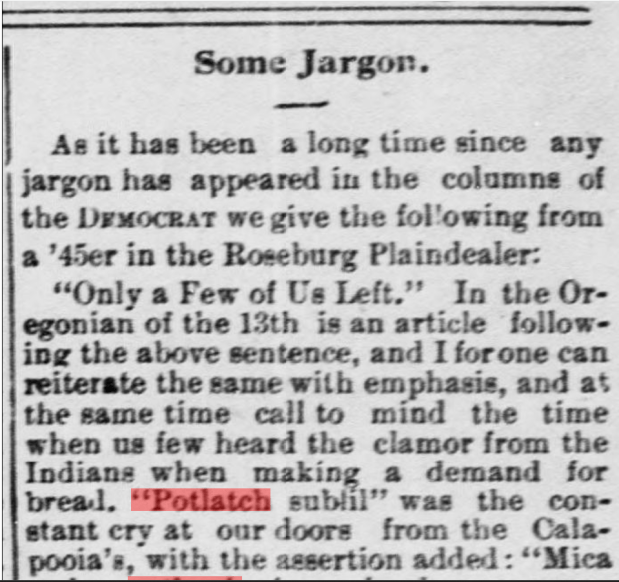
Some Jargon.
As it has been a long time since any jargon has appeared in the columns of the DEMOCRAT we give the following from a ’45er in the Roseburg Plaindealer:
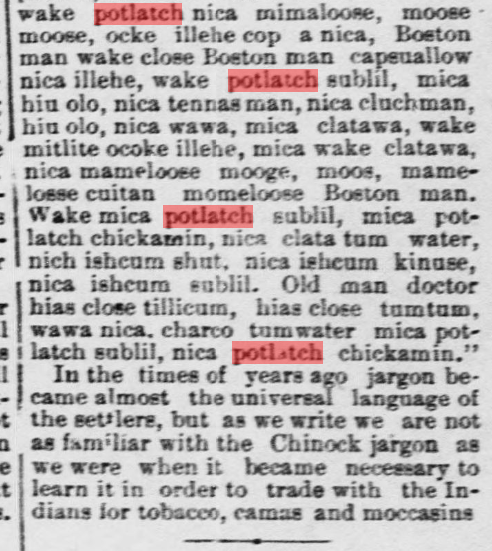
“Only a Few of Us Left.” In the Oregonian of the 13th is an article following the above sentence, and I for one can reiterate the same with emphasis, and at the same time call to mind the time when us few heard the clamor from the Indians when making a demand for bread. “Potlatch sublil” was the constant cry at our doors from the Calapooia’s, with the assertion added: “Mica wake potlatch nica mimaloose, moose moose, ocke illehe cop a nica, Boston man wake close Boston man capsuallow nica illehe, wake potlatch sublil, mica hiu olo, nica tennas man, nica cluchman, hiu olo, nica wawa, mica clatawa, wake mitlite ocoke illehe, mica wake clatawa, nica mameloose mooge, moos, mamelosse cuitan momeloose Boston man. Wake mica potlatch sublil, mica potlatch chickamin, nica clata tum water, nich ishcum shut, nica ishcum kinuse, nica ishcum sublil. Old man doctor hias close tillicum, hias close tumtum, wawa nica. charco tumwater mica potlatch sublil, nica potlatch chickamin.”
In the times of years ago jargon became almost the universal language of the settlers, but as we write we are not as familiar with the Chinock [Chinook] jargon as we were when it became necessary to learn it in order to trade with the Indians for tobacco, camas and moccasins.
— from the Albany (OR) State Rights Democrat of February 21, 1896, page 4, column 9
Potlatch sublil = pá(t)łach saplél = ‘give (some) bread’.
Here’s a closer look at the extensive “assertion” that follows it. I’ll try to break it down into individual clauses to help you make sense of it. I can say up front that it puts a somewhat pidginized Chinook Jargon into Native people’s mouths, and it bears traces of Settlers’ English-influenced CJ. So it’s not going to be a perfect picture of Indigenous speech…
Mica wake potlatch
mayka wík pá(t)łach [1]
‘You don’t give (anything)’
nica mimaloose, moose moose,
nayka míməlus [2] músmus
‘I’ll kill cattle’
ocke illehe cop a nica,
úkuk ílihi kʰupa nayka
‘This country belongs to me’
Boston man wake close
bástən-man wík-łúsh
‘White people are bad’
Boston man capsuallow nica illehe,
bástən-man kapshwála nayka ílihi
‘White people stole my land’
wake potlatch sublil,
wík pá(t)łach sablél [3]
‘Not giving bread’
mica hiu olo,
nayka hayu(-)úlu [4]
‘I’m very much hungry’
nica tennas man, nica cluchman, hiu olo,
nayka tənəs-mán, nayka łúchmən hayu(-)úlu
‘My son(s) (and) my wife are very much hungry’
nica wawa,
nayka wáwa
‘I said’
mica clatawa,
mayka łátwa
‘You (should) go!’
wake mitlite ocoke illehe,
wík míłayt Ø úkuk ílihi
‘Don’t stay in this country’
mica wake clatawa,
mayka wík łátwa
‘You don’t go’
nica mameloose mooge, moos, [5]
nayka míməlus músmus
‘I’ll kill cattle’
mamelosse cuitan
míməlus kʰíyutən
‘Kill horses’
momeloose Boston man.
míməlus bástən-man
‘Kill White people’
Wake mica potlatch sublil,
wík mayka pá(t)łach sablél
‘You don’t give bread’
mica potlatch chickamin,
mayka pá(t)łach chíkʰəmin
‘You give (some) money’
nica clata tum water,
nayka łátwa Ø tə́mwáta
‘I’ll go to Oregon City’
nich ishcum shut,
nayka ískam shát
‘I’ll get a shirt’
nica ishcum kinuse,
nayka ískam k’áynuł
‘I’ll get tobacco’
nica ishcum sublil.
nayka ískam sablél
‘I’ll get bread’
Old man doctor hias close tillicum, hias close tumtum, wawa nica.
úl-man dákta [6] hayas-łúsh tílixam, hayas-łúsh tə́mtəm, wáwa nayka
‘The old doctor, who was an excellent person, very good-hearted, said to me’
charco tumwater
cháku Ø tə́mwáta [7]
‘Come to Oregon City’
mica potlatch sublil,
nayka* [8] pá(t)łach sablél
‘You give bread’
nica potlatch chickamin.
nayka pá(t)łach chíkʰəmin
‘I’ll give money’
Notes:
mayka wík pá(t)łach [1] ‘You don’t give (anything)’ — This I take as a conditional, expressed without Chinuk Wawa’s pus ‘if’. This way of phrasing is reminiscent of Chinese Pidgin English, that other West Coast pidgin language that Settlers were very familiar with. It seems to me that this structure is repeated later in this same text; see if you agree.
nayka míməlus [2] músmus ‘I’ll kill cattle’: What seems Settler-ish, or pidgin-ish, to me about this is, we don’t hear the quoted speaker saying mamuk-míməlus, the normal, Causative form meaning ‘to kill’. The word míməlus by itself in normal Jargon just means ‘to die’, but English-speaking Settlers often confused the two forms.
wík pá(t)łach sablél [3] ‘Not giving bread’ — the “most charitable interpretation” rule that I try to follow, to do minimal violence to difficult Chinook texts, leads me to put this in English as a tenseless verb, a participle. This is due to the lack of a stated subject e.g. yaka ‘he’.
nayka* hayu(-)úlu [4] — Settlers often freely jumbled hayas- ‘very’ and hayu ‘a lot’ into each other. I suspect that’s what’s going on in today’s text.
mooge, moos, [5] — This spelling suggests to me an attempt at showing a K’alapuyan “accent” in Jargon. Compare the repeated ishcum below!
úl-man dákta [6] — Hey, you don’t suppose this “old doctor” could be the Hudson Bay Company’s John McLoughlin (1784-1857), do you? He was known by that nickname by some. And he had a home at Oregon City. He was also famous for his generosity. What do you think?
tə́mwáta [7] ‘the waterfall’ is the Jargon name of Oregon City.
nayka* [8] pá(t)łach — Here I think the word mica ‘you’ is a mis-print for nica ‘I’. We constantly find exactly this confusion in old published bits of Chinuk Wawa.
In summary, I feel like today’s quoted speech is decently representative of Grand Ronde-area K’alapuyan use of Chinuk Wawa at the time. But it sure does bear the scars of being brought to us via a Settler’s mind!
