Didactic dialogues in CW dictionaries, Part 4R (Gibbs 1863 ex phrases/sentences)
This installment is the last of our George Gibbs sentences from the Fort Vancouver region in the frontier eera.
(All installments in this mini-series.)
Here we have “the leftovers” from Gibbs, a miscellany of useful phrases, and it’s no surprise that guns & salmon are prominent.
You’ll also see my comments on Gibbs’s sentence…
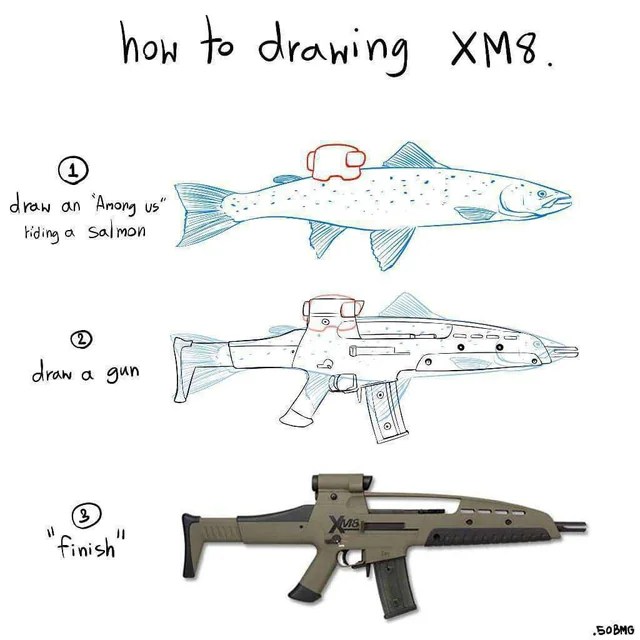
Guns & salmon (image credit: Reddit)
- Kah mika mahkook okook calipeen? ‘Where did you buy that rifle?’
(qʰá mayka mákuk úkuk kálapín?) - Mitlite kopa house. ‘He is in the house.’
(míɬayt kʰupa háws.
— Actually, because this sentence lacks yaka ‘he’, it sounds like it’s using “silent IT” (Ø) for its subject: ‘It’s in the house.’ - Mitlite hyiu salmon kopa mika? ‘Have you plenty of salmon?’
(míɬayt háyú sámən kʰupa mayka?
— Literally ‘Is there plenty of salmon with you [singular]?’) - Wake mika nanitsh? ‘Did you not see [it]?’ [Answer] Nawitka. ‘I did not.’
(wík mayka nánich (Ø)? nawítka.
— Again, using a “silent IT”, here for the object of ‘see’.) - Hyas youtl yakka tum-tum. ‘His heart is very glad; he is much puffed up.’
(hayas-yútɬiɬ yaka tə́mtəm.
— Literally, ‘very-glad is his heart’, with the subject ‘heart’ of the Stative [intransitive] verb placed at the end, as usual.) - yukwa kopa okook house ‘this side of that house’
(…yakwá kʰupa úkuk háws…, literally, ‘(towards) here from/on/at that house’.)
