1875, “Tacoma Reservation”, WA: Letter from an Indian boy
Literacy was still new and rare among Native people of this area in 1875…
…And it’s not a major surprise that one of the few writing did so in English mixed with Chinook Jargon.
And that his written English, like his Jargon, reflects actual ways folks talked.

I’m not sure, but Peter Stanup may be in this photo:
“1881 or 1882 photo of 12 male students from the Puyallup tribal agency who were attending the Forest Grove Indian School. The first group of students admitted to the school in February 1880 included Jerry Meeker and Peter Stanup.
From the archives of Friends of Historic Forest Grove.”
Peter C. Stanup (1858?-1893) was a high achiever; he became an outspoken advocate for his Puyallup tribe.
Here’s a remarkable letter from him.
Locals needed no translation of the Jargon words, but I’ll add one afterwards.

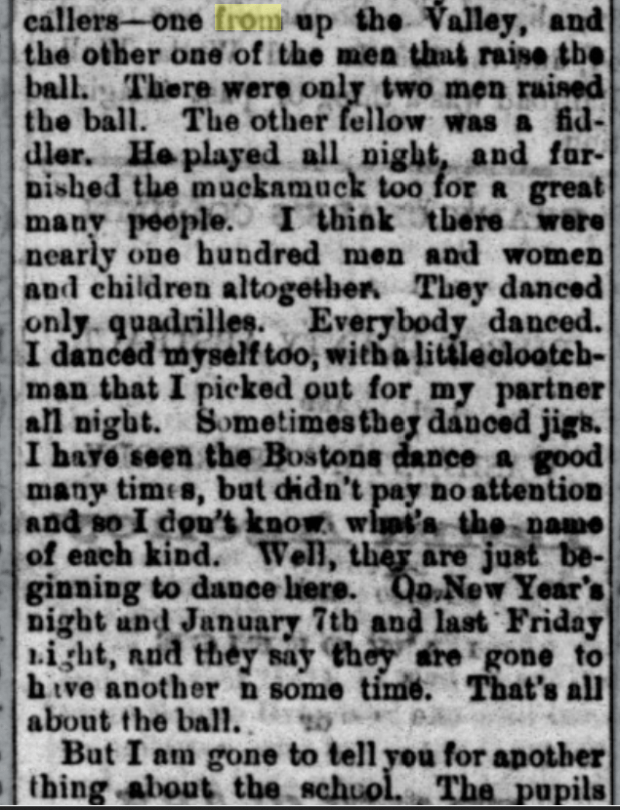

Letter from an Indian Boy.
TACOMA RESERVATION, Feb. 22d.
MY FRIEND TRIBUNE PRINTER IN TACOMA:
Sir — I send you this kind letter to
make your copy out of.The Indians here had a ball last Fri-
day night, Feb. 19th. The dance com-
menced at 8 o’clock P.M., and at 11
o’clock they had their muckamuck; the
dance quit at 5 o’clock A.M. They had
the dance at our house. Our house is
about 40 feet long by 20 feet. And we
fixed a partition across it, and the larg-
est room was about 24 by 20 feet. The
bigger room was used for the dance
that night. We kept a little stove in
the little room and a fire burning there
all night. The house was just full of
Indians, except the place where the
dance was open. The first dance was
quadrille, as they called it — four men
and four women. And they had two
callers — one from up the Valley, and
the other one of the men that raise the
ball. There were only two men raised
the ball. The other fellow was a fid-
dler. He played all night, and fur-
nished the muckamuck too for a great
many people. I think there were
nearly one hundred men and women
and children altogether. They danced
only quadrilles. Everybody danced.
I danced myself too, with a little clootch-
man that I picked out for my partner
all night. Sometimes they danced jigs.
I have seen the Bostons dance a good
many times, but didn’t pay no attention
and so I don’t know what’s the name
of each kind. Well, they are just be-
ginning to dance here. On New Year’s
night and January 7th and last Friday
night, and they say they are gone to
have another n some time. That’s all
about the ball.But I am gone to tell you for another
thing about the school. The pupils
are 45, both day scholars and boarding
scholars. There are 10 girls in school;
they are boarders. About every even-
ing the school girls and boys go to sing
the old Indian songs, and the Indians
don’t allow the children to do the old
Indian custom. And last Sunday, on
church, the Indian chief got up to talk
about children. He say that he don’t
want the school boys to sing that song
again. And the sheriff said, “and the
school girls; we don’t want them to
sing again, and the school boys, tenas
men, too.” That chief means the school
boys, and the sheriff he means the
school girls. Yours truly,PETER C. STANUP.
— from the Tacoma (Washington Territory) Weekly Pacific Tribune of March 5, 1875, page 3, column 4
- muckamuck = mə́kʰmək = ‘food’
- clootchman = łúchmən = ‘lady’
- Boston = bástən = ‘White people’
- tenas men = tənəs-mán = ‘boys’

So glad you chose to highlight Peter Stanup! Stanup sprinkled jargon in his published writing in English every so often, beginning in 1875. (Since his audience was largely white, did he insert jargon for some local color? A sense of authenticity? To fit in a bit more?) Stanup started as a printer’s devil for a settler newspaperman in the early 1870s, and that brought him the opportunity to publish a number of brief reports about early reservation life in the Puget Sound area, where he described social gatherings, sporting events, and Indigenous people harvesting hops near Puyallup. His skill with alphabetic literacy and multiple languages helped elevate his status in both Native and settler communities, and he became a significant mediator for the Puyallup in tribal-Tacoma area affairs, especially regarding land ownership. His writing continued, and he began work on a novel sometime in the late 1880s, supposedly publishing a first chapter or two in a newspaper or periodical. (It remains unclear where he published his fiction; it may be under a pseudonym.) After he died in 1893 (some argue that he was murdered) relatives discovered among his papers a written plan for a “university” for his Puyallup people. Thanks for this example!
PS As to the photo, I believe Peter Stanup is the man seated, fourth from the left. See link for another photo. https://digitalcollections.lib.washington.edu/digital/collection/tacomacomm/id/260
LikeLiked by 1 person
Wow! Robert, thank you so much for adding all of this background information about a remarkable man.
Dave Robertson
LikeLike