Learning from the Lane learners (Part 9: ‘it means’ and ‘when’)
Today, I want to share some things from Rianna Robertson-LeVay’s article…
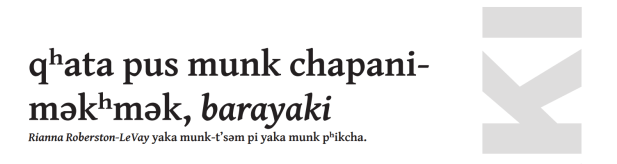
…It’s titled “qʰata pus munk chapani-məkʰmək, barayaki“ (“How to Make a Japanese Dish, barayaki“).
It’s on page 23 of the Chinuk Wawa magazine, edition 2, from Lane Community College’s excellent Chinuk Wawa program.
(Download / print it for free from this link.)
- I appreciate how ‘it means’ is expressed here:
X kʰapa chinuk wawa, Y ukuk,
which literally is saying ‘X [some Japanese word] in Chinuk Wawa, that’s Y’.
So: “bara kʰapa chinuk-wawa, munk-lepʰuwel ukuk”
= ‘bara in Chinuk Wawa is munk-lepʰuwel (‘to fry’)”.
In the Northern Dialect, ‘it means’ is commonly expressed as X, kakwa pus wawa Y (‘X, as if to say Y’). - pus = a synonym of qʰə́nchi ‘when’, same as in Northern Dialect (which lacks qʰə́nchi), in step 5 of the recipe:
pus lisayu chaku-t’łimin, munk-lapʰuwel uk musmus-iłwəli pi kʰanawi puyu,
‘When the onions get soft, fry the beef and all of the sauce.’
