Boas 1892: Many discoveries in a short article (Part 17: ‘to roast’)
Okay, class, settle down.
To quote Oingo Boingo, “I know what’s on your mind, but it’s not what you think it is!”
(Click here for the previous installments in this series.)
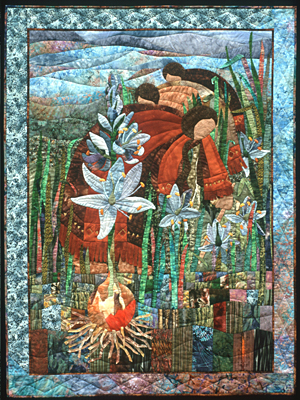
Camas, the thing most often roasted in Chinook Jargon stories (image credit: Discover Lewis & Clark)
Here’s today’s word from a scholarly piece that’s of outsized importance, Franz Boas’s 1892 one-pager, “The Chinook Jargon“:

‘to roast’
Boas’s phonetics here would convert to a modern Grand Ronde spelling of p’ə́nəs —
— But, as we’ve found true of other words in this particular article, the typesetters may have fouled things up a bit. It’s very highly likely that the author intended < p’e′nis > or < p’ē′nis > here, i.e. what would be p’ínəs in today’s G.R. alphabet.
And that is a recognizable variant of the 2012 Grand Ronde dictionary’s p’íʔns ‘to bake in ashes; to bake’.
That’s a very old word, by Chinuk Wawa standards. We know it as far back as the Demers, Blanchet, and St Onge 1871 dictionary (and catechism etc.; it uses circa 1838 data), < mamuk ppens >, ‘to cook under the ashes’.
We also find this word in the Grand Ronde elders’ speech published by anthropologist Melville Jacobs in his 1936 “Texts in Chinook Jargon”, likewise with the vowel /i/ in this root.
The etymology of p’íʔns, it should be clarified, is certainly SW Washington Salish. The reason I’m at pains to say so is, the 2012 G.R. dictionary describes it as “of uncertain origin”, even while showing definitely related words of Cowlitz & Upper Chehalis.
I’d add that those Salish words involve a root vowel /ə/ (schwa). And yet, in none of the documented uses of this word in Chinook Jargon do we see that vowel. Only /i/. Hmmm.
Well now, if we extend our search within SW Washington Salish, we find no similar word in Quinault. In the Lower Chehalis language (which is the demonstrable source for the great majority of Salish words in Jargon), we haven’t yet found a cognate…But, perhaps crucially, Lower Chehalis alone has a unique tendency of mutating a stressed /ə́/ into /í/ for apparent emotional affect.
So from a linguistic specialist’s point of view, I view the most likely source of p’íʔns as Lower Chehalis Salish.
