Lempfrit’s legendary, long-lost linguistic legacy (Part 17)
The 17th pair of pages in this precious document again brings us plenty of stuff worth knowing about Chinook Jargon.
Where you see me underlining stuff here, it’s material that was added by the manuscript’s writer HT Lempfrit, from his good personal knowledge of the Jargon.
“[SIC]” shows that someone mis-wrote a word. It wasn’t necessarily Lempfrit, since he was copying from someone else’s manuscript, Modeste Demers’ now-lost original to be exact.
So, where I’m showing differences between Lempfrit & somebody else, it’s Alphonse Pinart’s “Anonymous 1849” copy that I’ve been able to compare with.
Where you see [le]tters in square brackets, they’re not visible on the page copy that I’m working from, but we infer that they really are there!
By the way, the notation ___ means that the preceding entry is repeated in that position, along with some additional word(s).
There aren’t so many new discoveries in today’s installment, but this material does show us nice evidence that complex expressions already existed in early-creolized (southern-dialect) Chinuk Wawa by 1849.
See if you recognize words in these unusual spellings!
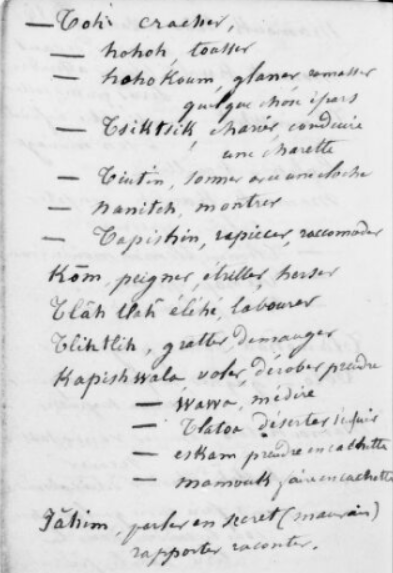
___ Toh̃, cracher ‘spit’
(Apparently mamouk toh̃, literally ‘make spitting’; modern Grand Ronde CW just says t’ux̣)
___ hohoh, tousser ‘cough’
(Apparently mamouk hohoh, literally ‘make coughing’; modern Grand Ronde CW just says ʔohoʔoho)
___ hohokoum, glaner, ramasser quelque chose épais ‘glean, pick up something thick’
(Apparently mamouk hohokoum; I’m guessing hohokoum is a garbled version of x̣uqʰuməɬ ‘to gather’, and it implies an interesting, previously unknown SW Washington Salish inflection of the same root)
___ Tsiktsik, char[r]ier, conduire une charette ‘carry (by wagon), drive a cart’
(Apparently mamouk tsiktsik)
___ Tintin, sonner ou* une cloche ‘to ring or* a bell’
(Apparently mamouk tintin, but ‘bell’ is just tintin)___ Nanitch, montrer ‘to show’
(I.e. mamouk nanitch)
___ Tapishin, rapiécer, raccomoder ‘to patch, to patch up’
(I.e. mamouk tapishin)
Kōm, peigner, étriller, herser ‘to comb, curry (a horse), harrow’
(I.e. mamouk kōm)
Tlah̃ tlah̃ éléhé, labourer ‘to plow’
(Apparently mamouk tlah̃ tlah̃ éléhé, literally ‘make torn torn earth’)
Tlihtlih, gratter, demanger ‘to scratch, to itch’
(I.e. mamouk tlihtlih)
Kapishwala, voler, dérober, prendre ‘to steal, rob, take’
___ wawa, médire ‘to speak ill (of)’
(I.e. kapshwala wawa, literally ‘steal talk’; I’ve previous pointed out that most kapshwala- phrases have been replaced by ipsət- phrases.)
___ tlatoa, déserter, s’enfuir ‘to desert, flee’
(I.e. kapshwala tlatoa, literally ‘steal go’)
___ eskam, prendre en cachette ‘to take in secret’
(I.e. kapshwala eskam, literally ‘steal take’)
___ mamouk, faire en cachette ‘to do in secret’
(I.e. kapshwala mamouk, literally ‘steal do’)
[___] Iăhim*, parler en secret (mauvais), rapporter, raconter ‘speak in secret (bad), report, tell’
(I.e. kapshwala iăhim, literally ‘steal report’)

Tsokeyen, ruer, donner des coups de pieds ‘to kick out, kick’
Watch, faire sentinelle, garder ‘keep watch, guard’
Tshipé, se tromper, se méprendre, manquer le but, s’égarer*, donner à côté (il s’emploi aussi au moral) ‘to make a mistake, to misunderstand, to miss the point, to go astray, to miss the mark (it is also used for the moral)’
Aihwalh, emprunter ‘borrow’
Tlak*Tlkōp oihat, couper le chemin ‘take a shortcut’
(Presumably mamouk tlkōp oihat, literally ‘cut the path’ as also in French — a neat phrase to discover!)
Kipouet, coudre ‘sew’
(Surely meant as mamouk kipouet, literally ‘make needle’)
iakessilh, affiler, aiguiser ‘to sharpen, hone’
(I.e. mamouk iakessilh)
pat, battre le grain ‘to thresh the grain’
(I.e. mamouk pat)
pŏ, éteindre une chandelle ‘to extinguish a candle’
(I.e. mamouk pŏ)
pō, tirer un coup de fusil, péter ‘to fire a gun, to fart’
(I.e. mamouk pō)
Patlash, donner, payer ‘to give, to pay’
Tchakō-Kō [SIC], échouer ‘to fail’
(Perhaps a mis-writing of chaku-hilu ‘get used up, extinguished’ etc.?)
Mamouk tel, peser ‘to weigh’
(Literally, ‘make heavy’)
___ peint, peindre, peinturer ‘to paint, to daub’
(I.e. mamouk peint)
Tlkop, couper ‘to cut’
(Presumably mamouk tlkop)
mamouk wam, chauffer ‘to heat’
(Literally ‘make warm’)
___ Kōl, refroidir ‘to cool’
(I.e. mamouk kōl, literally ‘make cold’)
