“Less familiar words” in the Northern Dialect (Part 2C: Le Jeune 1924: other districts)
Continuing to sift through one of the on-the-spot reports about the differences between the 2 big Chinuk Wawa dialects…
We’re still looking at JMR Le Jeune’s 1924 “Chinook Rudiments“, where page 30 collects a “List of words used in other districts”, by implication not around Kamloops.
This is an informative list — and amusing.
I expect we’ll figure out which previously published dictionaries (I’m sure more than one) Father Le Jeune was working from, mainly by looking at the spellings cited here. (To some extent, also by the translations given.)
The first column, where Jargon words are written in an English-style but sorta phoneticky alphabet, suggests Le Jeune was only guessing at pronunciations. The second column, in the more phonetic Chinuk Pipa alphabet, confirms this. So for instance word #1, for ‘strawberries’, shows Le Jeune misreading older English-oriented dictionaries’ spelling “a-mo-te” as having just 2 syllables.
Pretty strong confirmation that these words really were foreign to northern-dialect speakers!
Also wacky is how Le Jeune sometimes misunderstands the meanings of these unfamiliar Jargon words — like with words #4&5, where he reverses the genders of the grandparents!
Nonetheless, I’ll try to underline any words that, despite Le Jeune’s listing them here, I’ve found in actual common use in the north…Just kidding, literally none of these words has much presence in surviving data from the Northern Dialect!
The typical Northern Dialect pattern of vocabulary evolution shows strongly here:
Older words of the Southern Dialect from Nuuchahnulth/Nootka Jargon, Chinookan, and Coast Salish tended to be dropped in large numbers.
Newer words from locally spoken English got taken in, in similar quantities.
The result is a dialect that “feels” pretty different from what was spoken at Fort Vancouver, or at Grand Ronde.

amo’t, amut, strawberries,
aya-wl, aiawil, to borrow,
cheet-woot, chītwut, black bear,
cheetish, chītish, grand father [SIC!],
chōp, chop, grand mother [SIC!],
chotup, chotyup, a flee [flea], [the shorthand letter “yu” often stands for a schwa sound]
chuckkin, chyukkin, to kick,
eh’kanam, ihkanam, a story,
ek-keh, ikkih, brother in law,
elahan, ilahan, alms,
esalht, isaɬt, indian corn,
howh, hawh, hurry,
howkwētl, hawkwitl, unable,
hul-lel, hyullil, shake,
hoonl-kek, hunlkik, knotty, crooked,
haikwa, haikwa, shell money,
itlan, itlan, fathom,
itlokom, itlokom, gamble,
kalakwatai, kalakwatai, inner bark of cedar,
kamas, kamas, roots,
kamosek, kamosik, beads,
katsak, katsak, middle,
[sitkom is normal in the north]kawak, kawak, to fly,
kowkawak, kawkawak, yellow,
keh-lok, kihlak, swan,
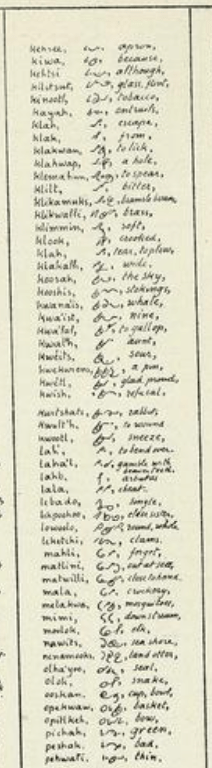
kehsee, kisi, apron,
kiwa, kiwa, because,
kehtsi, kihci, although,
kilitsut, kilitsut, glass, flint,
kinootl, kinutl, tobacco,
kayah, kaiah, entrails,
klah, tlah, escape,
klak, ɬak, from,
klakwan, tlakwan, to lick,
klahwap, tlhwap, a hole,
klemahun, tlimaun, to spear,
klilt, tlilt, bitter,
klikamuks, tlikamuks, bramble berries,
klikwalli, klikwalli, brass,
klimmin, tlimin, soft,
[This word does appear in “Kamloops Wawa”, but primarily just in Bible stories, where a more southern-style, older Jargon is used]klook, kluk, crooked,
klah, tlah, tear, to plow,
klakalh, ɬak’at, wide,
koosah, kusa, the sky,
kooshis, kushish, stokings [stockings],
kwana’is, kwanais, whale,
kwa’ist, kwaist, nine,
(This and the variant kwaits got replaced by nain in Northern Dialect.)
kwa’lal, kwalal, to gallop,
kwal’h*, kwalh, aunt,
kwe’its, kwic, sour,
kwekwiens, kwikwiins, a pin,
kwe’tl, kwitl, glad, proud,
kwish, kwich, refusal,
kwitshati, kwitshati, rabbit,
kwult’h, kwulth.h, to wound,
kwootl, kwutl, sneeze,
lah’, lah, to bend over,
laha’l, lahal, gamble with beaver teeth,
(Funny that this is said to be uncommon in BC Jargon, since the word is preserved in the Indigenous languages, and we know it in Northern Dialect songs.)
lahb, lab, arbutus,
lala, lala, cheat,
lebado, libado, single [shingle],
likpoohoo, likpuhu, elder sister,
lowoolo, lowullo, round, whole,
leketchi, lkichi, clams,
mahli, maɬi, forget,
matlini, matlini, out at sea,
matwilli, matwilli, close to hand,
mala, malah, crockery,
melakwa, mlakwa, mosquitoes,
mimi, mimi, downstream,
moolok, mulak, elk,
(Remarkably enough, elk declined in the historical period in southern interior BC, so there was little need for a word to name them.)
nawits, nawic, sea shore,
nenamooks, ninamuks, land otter,
olha’yoo, olkayu, seal,
olok, olok, snake,
(Replaced by snik in the Northern Dialect.)
ooskan, uskan, cup, bowl,
opekwaw, opikwaw, basket,
opitlkeh, opitlkih, bow,
pichah, pichah, green,
peshak, pishak, bad,
pehwati, phwati, thin,

petlelh, piɬti, pliɬt, thick,
pō’, po, to blow,
(In the Northern Dialect, the similar word pu only means ‘shoot’.)
pawitch, pawich, crab apple,
salal, salal, a berry,
shelokom, shilokom, mirror,
shooh, shuh, rattle,
shooh oopoots, shuh upuc, rattle snake,
shwakook, shwakuk, frog,
siam, siam, grizzly bear,
sa’ipa, saipa, straight,
siskiyoo, siskiyu, bobtail horse,
sīks, sīks, friend,
(Note that siks is indeed a word of the Northern Dialect, but it means ‘6’!)
solemaï, solimai, cranberry,
spo-o, spoo, faded,
stoh, stoh, untie,
stotkin, sottkin, eight,
statchen, statchin, sturgeon,
sookwalah, sikwalash, gun,
tanem, tanim, to measure,
tepa, tipa, quills, wing of a bird,
toh, toh, to spit,
tot, tot, an uncle,
towah, towah, bright,
tshike, chiki, soon, at once,
tsiatka, ciatka, ghost who roams at night,
tish, tish, to sharpen,
tsōlpat, colpat, shot pouch,
tsolo, colo, wander in the dark,
tekwilla, tikwilla, nets [nuts],
tupshin, tapshin, needle,
waki, waki, tomorrow,
whim, hwim, fell, throw down,
winapaï, winapai, by and by,
yahool, iahul, name,
yakeselh, iakisiɬ, sharp,
yootskat, yutskat, short.
Stay tuned for more!
