Culture lessons: Things Chinuk Wawa doesn’t do (Part 8: keep it simple, stupid)
K.I.S.S.: Keep It Simple, Stupid! This can’t be stressed enough.
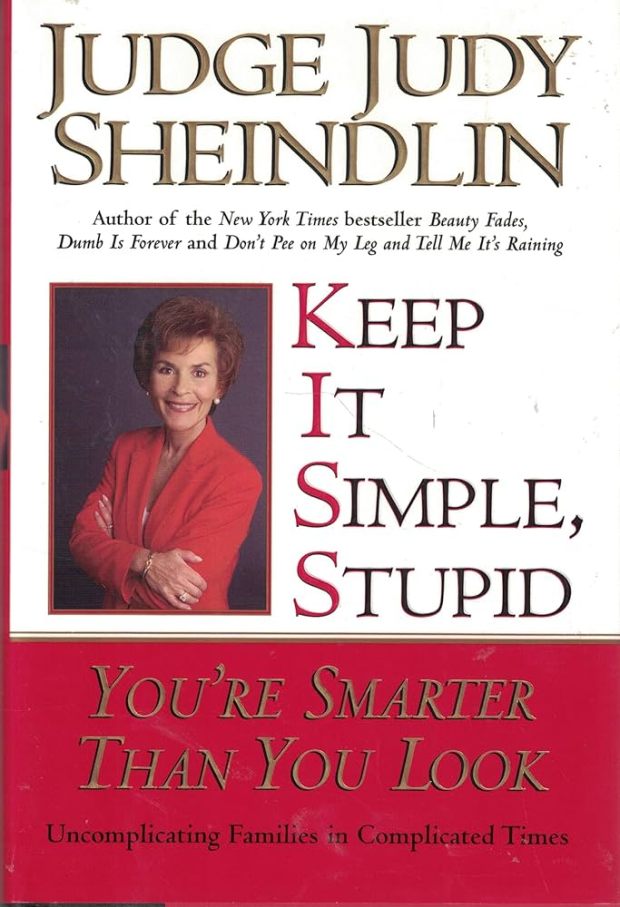
Image credit: Amazon)
Chinuk Wawa, as we have it documented from actual fluent speakers, does not say long or complicated sentences.
Lest you leap from this point to some idea that the Jargon is a “primitive” or “insufficient” language, let me stop you in your tracks. This language is highly expressive, and people are able to say what’s on their minds with it.
But Chinook Jargon is a language with very little in the way of a literary tradition — and written language is what I identify as the biggest factor in encouraging folks to think of a large number of words as being acceptable in a single utterance.
What I’m telling you is, Chinuk Wawa is a real language, a spoken one, like the speech habits of 7 billion people on Earth in their daily lives.
Trust me (or audio-record yourself for a day) — you, my friend, talk simple almost all of the time, regardless of your language.
To the linguists: chill out. I’m not claiming CW lacks “embedding” or “recursion”. I prefer a simple distinction between main & subordinate clauses, but we’re all talking about the same thing, and the Jargon does indeed have it. What may be interesting to realize is, Chinook Jargon perhaps does less subordinating of clauses than some languages, and this is probably especially true of particular kinds of subordinating. And this again may have to do with nothing more obscure than the way humans normally talk their 7,000 languages IRL. (In real life.)
When talking — or especially when writing — Chinuk Wawa, my advice is: slow down a little, and say one idea at a time.
The most consistent weakness that I see in us, as we write and often when we speak in CW, is that a lot of us spend far more time reading than speaking this language!
What the doctor calls for (I’m literally a Doctor of Linguistics) is — talk more Jargon, listen more to folks talking Jargon. Conversations, as well as the style of monologue that’s involved in storytelling, demand that you express things clearly & in reasonably few words.
In time, I have no doubt, some actual literary style of Chinook Jargon will come into being. But it doesn’t exist yet. And nobody’s gonna understand you, if you try writing or talking in that nonexistent style!
Bonus fact:
Even as I tried to phrase today’s post in an exemplary way that you might follow, I noticed myself habitually using a number of “written English” structures that you definitely don’t want to be using in Jargon.
For example,
- strings of attributive adjectives like in “long or complicated sentences”,
- subordinated “be” clauses like in “think of a large number of words as being acceptable“,
- appositive comments like ” — or especially when writing –“,
- and gerunds like in “subordinating of clauses”.
