1889, Comox, BC: A Siwash Santa Claus
Christmas-themed, if you squint 🤣
(Click here for many, many more Xmas-related posts on ChinookJargon.com!)
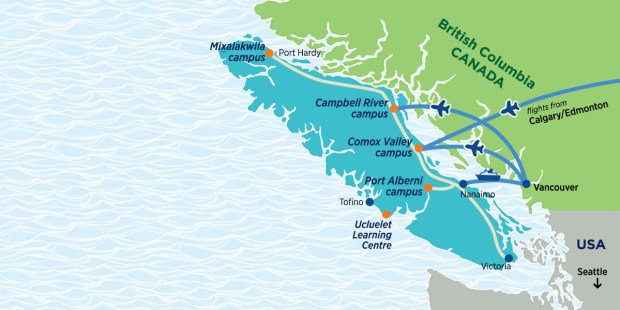
Image credit: North Island College
“A Siwash Santa Claus” was originally printed in the Victoria (BC) Colonist…
I take this letter as having been written in accurate locally spoken English that includes the occasional Chinook Jargon word, by someone “scribing” on behalf of the up-island (Vancouver Island) elder, probably from his originally Jargon words.
(Unless Captain Jim was talking in his tribal language to the rare literate Indigenous person of that era before schooling was a common experience.)
Captain Jim may have been either Sliammon Salish or Kwakwaka’wakw, given the Comox location. Any of my readers know?
The quoted letter from Captain Jim is a strong, concise, self-assured argument for potlatching in a Settler colonial environment that had become hostile to that Indigenous tradition. The infamous “potlatch ban” had been enacted into law in 1885…
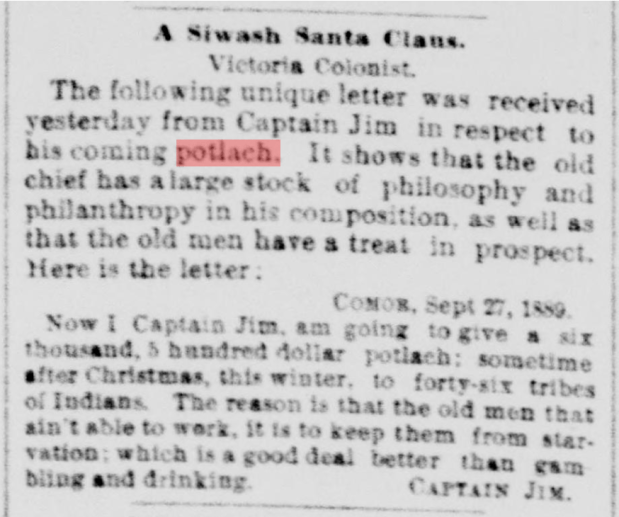
A Siwash Santa Claus.
Victoria Colonist.
The following unique letter was received
yesterday from Captain Jim in respect to
his coming potlach. It shows that the old
chief has a large stock of philosophy and
philanthropy in his composition, as well as
that the old men have a treat in prospect.
Here is the letter:COMOX, Sept 27, 1889.
Now I Captain Jim, am going to give a six
thousand, 5 hundred dollar potlach; sometime
after Christmas, this winter, to forty-six tribes
of Indians. The reason is that the old men that
ain’t able to work, it is to keep them from star-
vation; which is a good deal better than gam-
bling and drinking.CAPTAIN JIM.
— from the Seattle (WA) Post-Intelligencer of October 17, 1889, page 4, column 3

An earlier article in the Seattle P-I (Oct. 13, 1889) describes Captain Jim as a “war chief” at Fort Rupert decades earlier, when the village was bombarded, and Captain Jim was taken “hostage.” He’s also listed in a 1868 article as “chief” in Fort Rupert. So it seems likely he was Kwakwaka’wakw. A Nanaimo Daily News article from 1938 notes the death of his niece, and gives his name as “Chief Heenagalla (Captain Jim) who gave valuable aid to the British Navy in surveying the West Coast of Vancouver Island.” Agreed on the scribal composition of the letter, then submitted to a newspaper. By this time, an increasing number of Indigenous leaders throughout the region (BC and WA) seemed to be doing this. But given the potlatch ban, why go public with this kind of announcement? What did it do in terms of status, relation building and maintenance, etc.? Thanks for the example! Happy Holidays to all.
LikeLike