Lempfrit’s legendary, long-lost linguistic legacy (Part 16)
The 16th pair of pages in this precious document again brings us plenty of stuff worth knowing about Chinook Jargon!
Where you see me underlining stuff here, it’s material that was added by the manuscript’s writer HT Lempfrit, from his good personal knowledge of the Jargon.
“[SIC]” shows that someone mis-wrote a word. It wasn’t necessarily Lempfrit, since he was copying from someone else’s manuscript, Modeste Demers’ now-lost original to be exact.
So, where I’m showing differences between Lempfrit & somebody else, it’s Alphonse Pinart’s “Anonymous 1849” copy that I’ve been able to compare with.
Where you see [le]tters in square brackets, they’re not visible on the page copy that I’m working from, but we infer that they really are there!
By the way, the notation ___ means that the preceding entry is repeated in that position, along with some additional word(s).
There aren’t so many new discoveries in today’s installment, but this material does show us nice evidence that complex expressions already existed in early-creolized (southern-dialect) Chinuk Wawa by 1849.
See if you recognize words in these unusual spellings!
This project has been beneficial for me, bringing me to spot a large number of mistakes in RV Grant’s (1946) readings of the Alphonse Pinart copy of this document.
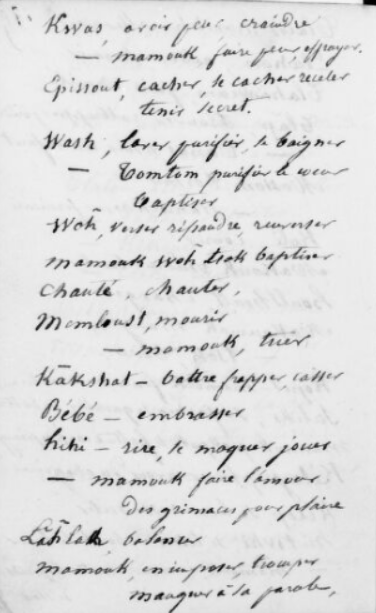
Kwas, avoir peur, craindre ‘to fear, be afraid’
___ mamouk, faire peur, effrayer ‘frighten, scare’
(I.e. mamouk kwas, literally ’cause to be afraid’)
Epissout, cacher, se cacher, recéler,* tenir secret ‘hide (something), hide (oneself), conceal, hold secret’
Wash, laver, purifier, se baigner ‘wash, purify, bathe’
___ Tomtom, purifier le coeur, baptiser ‘purify the heart, baptize’
(Literally ‘wash the heart’)Woh̃, verser, répandre, renverser ‘pour, spill out, spill’
Mamouk woh̃ tsok, baptiser ‘baptize’
(A new expression for us? Literally, ‘pour water (on)’)Chanté, chanter ‘sing’
Memloust, mourir ‘die’
___ mamouk, tuer ‘kill’
(I.e. mamouk memloust, literally, ‘make die’)
Kākshat, battre, frapper, casser ‘beat, hit, break’
Bébé, embrasser ‘kiss’
hihi, rire, se moquer, jouer ‘laugh, mock, play’
___ mamouk, faire l’amour, [faire] des grimaces pour plaire ‘make love, make faces to entertain’
(I.e. mamouk hihi, literally ‘make laugh’; I figure ‘make love’ here is in the old-fashioned sense of ‘flirting, courting’)
Lăh̃lak, balancer ‘to swing’
___ mamouk, en imposer, tromper, manquer à la parole ‘impose, deceive, break one’s word’
(I.e. mamouk lăh̃lak, literally ’cause to swing’?)
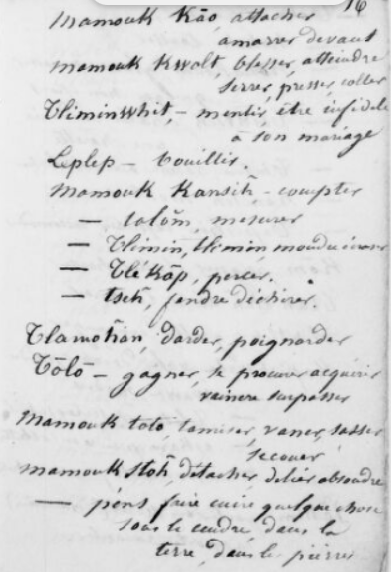
Mamouk kāo, attacher, amarrer devant ‘to tie, moor in front of’
(Literally, ‘make tied’)
Mamouk kwolt, blesser, atteindre, serrer, presser, coller ‘to hurt (someone), reach, squeeze, press, stick (something onto)’
(The first 2 meanings reflect Grand Ronde-style q’wə́ɬ ‘hit, strike, knock’;
the last 3 meanings reflect a different word, the Grand Ronde-style qʰwə́ɬ ‘hang’;
literally, ‘make struck’ and ‘make hung’ respectively)Tliminwhit, mentir, être infidele à son mariage ‘to lie, be unfaithful to one’s marriage’
Leplep, bouillir ‘to (be at a) boil’
Mamouk kansih̃, compter ‘to count’
(Literally, ‘to make how many’)___ talŏm, mesurer ‘to measure’
(This is a nifty find, the well-known word t’ánəm in an alternate Native-style pronunciation with “L”; literally, ‘to make measurement’)
___ Tlimin, tlimin, moudre, écraser ‘grind, crush’
(Literally, ‘make mushy-mushy’)___ Tlékōp, percer ‘to pierce’
(Literally, ‘make cut (up)’)___ tseh̃, fendre, déchirer ‘to split, tear’
(Literally ‘make torn’)Tlamoh̃an, darder, poignarder ‘to dart, stab’
(Is ‘to dart’ = ‘throw a dart / spear at’?)
Tōlō, gagner, se procurer, acquérir, vaincre, surpasser ‘win, obtain, acquire, conquer, surpass’
Mamouk toto, tamiser, van[n]er, sasser*, secouer ‘sift, winnow, shake’
(Literally, ‘make shaken’)Mamouk stoh̃, détacher, délier, absoudre ‘detach, unbind, absolve’
(Literally, ‘make untied’)___ péns, faire cuire quelque chose sous la cendre, dans la terre, dans les pierres* ‘cook something under the ashes, in the ground, in stones’
(Literally, ‘make roasted-in-ashes’)
Again, no gigantic new discoveries this time, but we have lots of excellent Fort Vancouver-era Chinuk Wawa here from a fluent speaker!
