“Less familiar words” in the Northern Dialect (Part 2B: Le Jeune 1924, “Hudson Bay french words”)
There’s more than one list highlighting “less familiar words” in JMR Le Jeune’s wonderful 1924 booklet, “Chinook Rudiments“, from Kamloops, BC.
Le Jeune’s perspective, as a daily speaker and writer of Chinuk Wawa for decades, is valuable.
At the same time, I find sometimes he’ll call a word rare even though it’s common in his writings and those of First Nations people in his area.
This happens in the following sample, where I’ll underline any words that are actually not rare.
Still, his tally of
“Hudson Bay french words introduced into the early Chinook hardly ever used now”,
on pages 14-15, is a valuable portion of our evidence that (Métis/Canadian) French had declined in importance as a component of the Jargon’s northern dialect, since Fort Vancouver times.
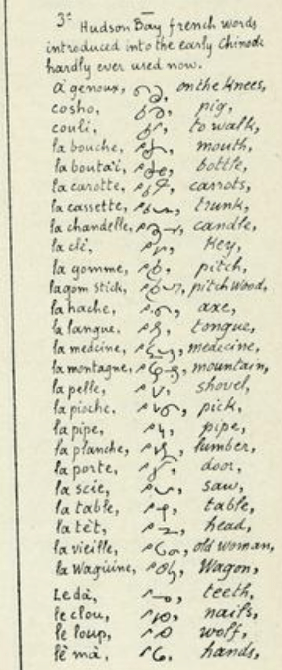
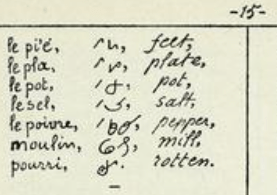
- à genoux, ashnu, on the knees,
(actually a verb in northern Jargon, ‘to kneel’; quite common in the Catholic setting of Kamloops Wawa)
- cosho, kosho, pig,
- couli, kuli, to walk,
(Le Jeune accurately shows us that this verb just meant ‘to travel around’ in the northern dialect — not ‘run’ as in the south)
- la bouche, labush, mouth,
(common in Northern Dialect)
- la bouta’i, labutai, bottle,
(mostly replaced by botl in the north)
- la carotte, lakarot, carrots,
- la cassette, lakasit, trunk,
(replaced by boks in the north)
- la chandelle, lashantil*, candle,
(typically replaced by kandl(s) in the north)
- la clè, lakli, key,
(replaced by ki in the north)
- la gomme, lagom, pitch,
(replaced by pich in the north)
- lagom stick, lagom stik, pitch wood,
- la hache, lahash, axe,
(common in Northern Dialect)
- la langue, lalan.g, tongue,
(common in the N.D.)
- la medcine, lamidsin, medecine,
(common in the N.D., also alternating with the more English midsin/mitsin)
- la montagne, lamontang, mountain,
(replaced by English mawntin in the north, which mostly means ‘the bush, the backwoods’)
- la pelle, lapil, shovel,
- la pioche, lapiosh, pick,
(becoming replaced by pik in the north)
- la pipe, lapip, pipe,
(replaced by paip in the north)
- la planche, laplansh, lumber, (actually laplash)
(common in the Northern Dialect)- la porte, laport, door,
- la scie, lasi, saw,
(this word had probably become uncommon in southern Jargon, too, before 1900;
northern Jargon says so ‘saw’)
- la table, latab, table,
(common in the N.D.)
- la tèt, latit, head,
(common in the N.D.)
- la vieille, lamiai, old woman,
(mostly replaced by ol kluchmin in the north)
- la waguine, lawagin, Wagon,
(in fact this word is typical of northern Jargon, coming from Métis French)
- Ledà, lida, teeth,
(seemingly a rare word in the north, getting replaced by the English word)
- le clou, liklu, nails,
(replaced by nils in the north)
- le loup, lilu wolf,
(seems to be mostly replaced by English wolf in the north)
- lèmà, lima, hands,
(common in the N.D.)
- le pi’e, lipii, feet,
(common in the N.D.)
- le pla, lipla, plate,
(doesn’t seem to be terribly uncommon in the N.D.)
- le pot, lpot, pot,
(actually pretty common in the spelling lipot)- lesel, lsil, salt,
(I’m not convinced this word was ever very common in Jargon; but it’s known in the Indigenous languages of the Kamloops region, due to Métis presence)- le poivre, lpwawar, pepper,
(I don’t think this was ever common in Jargon either;
I find pipir instead, in the Kamloops Wawa newspaper)
- moulin, mulan, mill,
(actually mula in southern Jargon — a word that means ‘mule’ in the north, from Spanish instead of French!
- pourri, puli, rotten.
(not uncommon in northern Chinook Jargon, but we find it mostly in the Biblical style of talking)
You can see the general trend of older, southern-dialect words getting replaced by newer, locally English-sourced words in the northern dialect of Chinook Jargon.
