Learning from the Lane learners (Part 6: horses and more)
I’m so happy we have reached a stage where we can learn from the learners of Chinuk Wawa!
All of today’s pointers are in “Chinuk-Wawa: Leyn-Skul, Buk 2”, a wonderful magazine created by Lane Community College’s learners of Chinook Jargon.
Therefore, we have the southern dialect here, FYI.
(Download / print it for free from this link.)
On page 12 we have a fine and informative article, “kʰíyutən kʰapa úkuk íliʔi” (Horses in this Region), by Romy Bennett.
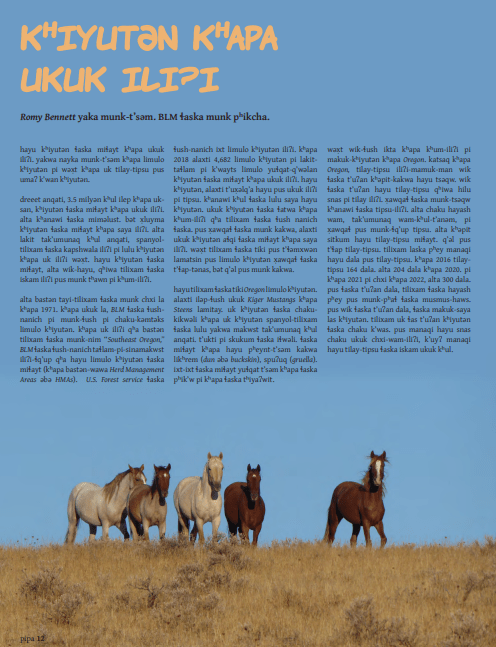
A couple of things stuck out in it that I think will be fun to discuss:
An excellent new expression:
…BLM ɬaska ɬush-nanich taɬlam-pi-sinamakwst iliʔi-ɬq’up, qʰa hayu limulo kʰiyutən ɬaska miɬayt…
‘…the Bureau of Land Management takes care of 17 parcels of land, where a lot of wild horses live…’
(That’s literally a ‘land-slice’. In the northern dialect, we seem to just say an ilihi, ‘a place, a territory’.)
A phrase that’s well-established in the southern dialect by now:
ɬaska miɬayt kʰapa hayu pʰeynt-t’səm kakwa likʰrem (dun əbə buckskin), spuʔuq (gruella).
‘They come in (exist in) lots of colors such as cream (“dun” or “buckskin”) and grey (“gruella”).’
(Literally, ‘paint-marks’. In the northern dialect, we find kolor(s).)
Some illustrative uses of hayash ‘big’:
alta chaku hayash wam, tak’umunaq wam-kʰul-t’anem… (this is a nice bit of trochaic hexameter 😁)
‘Then comes high heat, a hundred degrees…’
(Literally, ‘a big heat’; this phrase works in all dialects.
I also want to point out the smart Grand Ronde neologism, wam-kʰul-t’anem — literally ‘heat-cold-measure’, for ‘degree(s)’; in the northern dialect we have t’səm for degrees, meaning ‘mark’ on a thermometer. )
tilixam ɬaska hayash pʰey…
‘people pay a lot…’
(This is literally ‘greatly pay’, a way of putting it that correlates with the very old and established Jargon expressions hayash-makuk ‘expensive’ [‘dear’ in old dictionaries, literally ‘greatly buy’] and tənəs-makuk ‘affordable, cheap’.)
And, for comparison, from page 19’s article “wayam təmwata” by Francis Anderson Blankenship:
uk imaɬ yaka palach manaqi hayu pi ikta pus məkʰmək. wəx̣t ɬaska hayash kimtəks uk imaɬ.
‘The river gives more than something to eat. People also greatly honor the river.’
(This here is some very beautiful Chinuk Wawa! It speaks carefully and with fluency. We don’t normally refer to inanimate things with the pronoun yaka, but here the student writer makes you understand that the Columbia River is a natural force that we traditionally respect as something alive.
The phrase hayash kimtəks ‘greatly honor’ is quite simple — and therefore quite effective — southern dialect CW. In the northern dialect, we don’t have kimtəks, and instead, people say mamuk-tayi ‘treat as a chief; honor; respect; worship’ and mamuk-hayas(h) ‘treat as someone great; honor; respect’.)
It’s well worth your time to read what the Lane Community College students have been writing in Chinuk Wawa. It gives you plenty to think about.
