1910: Calling dances in Coquitlam George’s language 😁
One neat variation on our “party invitations and menus in Chinook Jargon” file is a 1910 dance card!
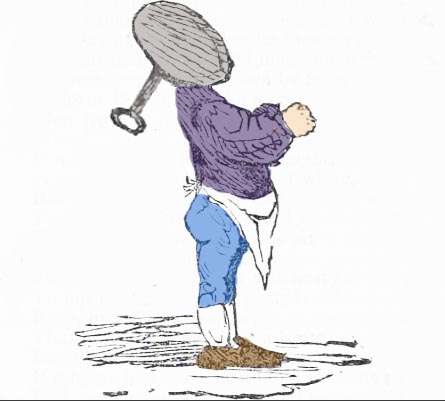
Old Dan Tucker washed his face with a frying pan (image credit: Mama Lisa)
At an annual gathering of British Columbia’s “Native Sons” organization, there was…

An Unusual Program.
Added to the many interesting features introduced at this event was the program, which to the un[in]itiated seemed to have got somewhat mixed in the printing. But the old-timers
who knew the language of Coquitlam George smiled and were happy. Here are the names of the dances which the guests were called upon to execute:Grand March, “Waltz ….. Hyas Kloosh Cooley [‘very nice going about’]
Dan Tucker ….. Pelton Cooley [‘crazy going about’]
Two-Step ….. Mox. Cooley [‘two goings about’]
Waltz … Kelapie Cooley [‘turning going about’]
Lancers ….. Hee Hee Cooley [‘fun going about’]
Waltz ….. Kelapie Cooley
Two-Step (Post Members and Native Daughters only.)
Military Schottische ….. King George Cooley [‘British going about’]
Waltz ….. Kelapie Cooley
Two-Step ….. Mox Cooley
Waltz ….. Kelapie Cooley
Supper ….. Klatawa Muck-a-Muck [‘go eat’]
Extras —
(1) Waltz ….. Kelapie Cooley
(2) Two-Step ….. Mox Cooley
(3) Waltz ….. Kelapie Cooley
Waltz ….. Kelapie Cooley
Dan Tucker ….. Pelton Cooley
Two-Step ….. Mox Cooley
Waltz ….. Kelapie Cooley
Three-Step …. Klone Cooley [‘three goings about’]
Two-Step ….. Mox. Cooley
Waltz ….. Kelapie Cooley
Two-Step ….. Max Cooley
Waltz ….. Klatawa Copa Mika House [‘go to your home’]
— from the New Westminster (BC) Daily News of February 1, 1910, pages 1 (column 4) and 4 (column 3)
Comments:
It’s weird to me that the Native Sons didn’t use the Chinuk Wawa word dans / tanis, which means ‘dance’! Their Jargon isn’t excellent, but come on, anyone could look up that word in a dictionary in 1910.
But I feel like I can grasp why they called each dance a kuli, which means ‘going about, running around’ in Northern Dialect — i.e. ‘stepping out’. A bonus from this line of thinking is, it reinforces what I always say about N.D. kuli never meaning ‘to run’, unlike its meaning in the Southern Dialect.
“(Old) Dan Tucker” is a circle dance also known as “The Wild Irishman”, which might explain the Jargon translation as ‘crazy’.
The recurring spelling “Mox.”, with a period, possibly indicates a sense that the word for ‘2’ ends in a stop sound, as we see in the Grand Ronde spelling makwst.
“Lancers” is clearly “Les Lanciers“, a square dance, and maybe it’s specifically “The Kitchen Lancers”, which is said to be a “more boisterous” version — compare the Jargon translation as “Hee Hee” (‘fun’).
I don’t see why the “Schottische” wasn’t translated with the Jargon word Skoch-man.
Anyway…
Compare the above with the social dance list in Jargon from “1897: Tacoma Redmen“. Those folks translated ‘dance’ as < tans >, the way we’d expect. Here’s what we have from that article, in similarly awful but fun Jargon:
Grand March … Mamuk Haiyu Klatawah [‘make much/many go’]
Lancers … Mamuk Klemahwin Sopenah Tans [‘make spear jump dance’]
Waltz … Mamuk Haiyas Sopenah Tans [‘make big jump dance’]
Polka … Mamuk Haiyak Sopenah Tans [‘make fast jump dance’]
Minuet … Mamuk Mithwit Sopenah Tans [‘make stand jump dance’]
Schottische … Mamuk Toto Sopenah Tans [‘make shake jump dance’]
Comas … Mamuk Haiyas Sopenah Tans [‘make big jump dance’]
Quadrille … Mamuk Lakit Sopenah Tans [‘make four jump dance’]
Spanish Waltz … Mamuk Klawa Sopenah Tans [‘make slow jump dance’]
Two Step … Mamuk Moks Klatawa Sopenah Tans [‘make two go jump dance’]
