Myron Eells’s hymn book (Part 2: “Jesus Loves Me”)
This installment #2 in our mini-series was a really popular song in the Pacific NW, so we have audio of ancestors singing it…
(Here’s a link to all installments in this mini-series.)
From Myron Eells’s little book, “Hymns in the Chinook Jargon Language“, the superior 2nd edition (Portland, OR: David Steel, 1889), we have this simple ditty.
I’ve only heard verses #1 and #3, and the chorus, sung before, though. Perhaps community members forgot #2, which might tend to validate Eells’s comments (see Part 1 of this mini-series) about folks’ memories for these songs.
We can take note of the “song pronunciations”, kwánisim ‘always’ & diléyt ‘truly’. These are what I’ve heard in the audio recordings of this song. They’re employed to keep the lyrics closely glued to the melody. Compare typical spoken pronunciations, kwánsəm & dléyt.

No. 2 Tune, “Jesus Loves Me.”
1. Kwanesum Jesus hias skookum,
kwánisim djísəs* hayas(h)-skúkum, (‘Jesus is always powerful’)
(Repeat twice.)
Kahkwa yaka papeh wawa —
kákwa yaka pípa wáwa — (‘as his writing says’)
Chorus —
Delate, nawitka —
diléyt, nawítka — (‘Really, it’s true’)
(Repeat twice.)
Kahkwa yaka papeh wawa.2. Jesus kumtuks nika tumtum,
djísəs* kə́mtəks nayka tə́mtəm, (‘Jesus knows my heart’)
Kahkwa, etc.Chorus. —
3. Jesus nanitch konoway kah,
djísəs* nánich kʰánawi-qʰá, (‘Jesus sees everywhere’)
Kahkwa, etc.Chorus. —
Compare the above analysis with Eells’s own presentation of his Jargon words’ meaning:
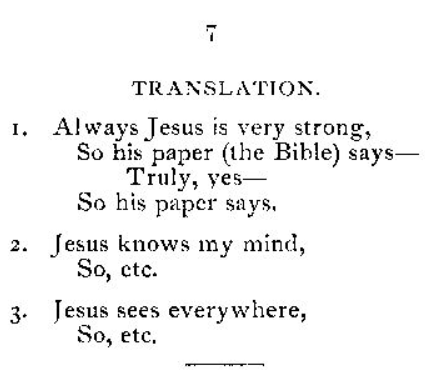
1. Always Jesus is very strong,
So his paper (the Bible) says —
Truly, yes —
So his paper says.2. Jesus knows my mind,
So, etc.3. Jesus sees everywhere,
So, etc.
As with the first hymn we looked at, we have today a very brief text from Eells, not much data to base a judgment on.
But the words are perfectly fluent, not influenced by Settlers’ English.
Better still, Eells uses an established Indigenous metaphor, ‘Jesus knows my heart’ — meaning ‘he understands what I’m thinking’, etc.
