Lempfrit’s legendary, long-lost linguistic legacy (Part 15)
The 15th pair of pages in this precious document again brings us plenty of stuff worth knowing about Chinook Jargon.
Where you see me underlining stuff here, it’s material that was added by the manuscript’s writer HT Lempfrit, from his good personal knowledge of the Jargon.
“[SIC]” shows that someone mis-wrote a word. It wasn’t necessarily Lempfrit, since he was copying from someone else’s manuscript, Modeste Demers’ now-lost original to be exact.
So, where I’m showing differences between Lempfrit & somebody else, it’s Alphonse Pinart’s “Anonymous 1849” copy that I’ve been able to compare with.
Where you see [le]tters in square brackets, they’re not visible on the page copy that I’m working from, but we infer that they really are there!
By the way, the notation ___ means that the preceding entry is repeated in that position, along with some additional word(s).
There aren’t so many new discoveries in today’s installment, but this material does show us nice evidence that complex expressions already existed in early-creolized (southern-dialect) Chinuk Wawa by 1849.
See if you recognize words in these unusual spellings!
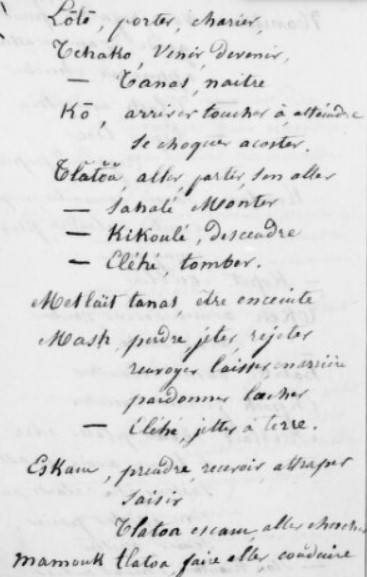
Lōlō, porter, charier ‘carry, cart’
(RV Grant 1946/Alphonse Pinart 1849 has chasser for the 2nd French gloss)
Tchako, venir, devenir, ‘come, become’
___ Tanas, naitre ‘be born’
(Literally, ‘become a child’)
Kō, arriver, toucher à, atteindre, se choquer*, ac[c]oster* ‘arrive, touch at, reach, shock*, accost’
Tlatŏă, aller, partir, s’en aller ‘go, leave, go there’
___ sahalé, Monter ‘rise’
(Literally, ‘go up’)
___ Kikoulé, descendre ‘go down’
(Literally, ‘go down’)
___ Eléhé, tomber ‘fall’
(Literally, ‘go (to) the ground’)
Metlaït tanas, être enceinte ‘be pregnant’
(Literally, ‘have a child’ / ‘there is a child’)
Mash, perdre, jeter, rejeter, renvoyer, laisser en arrière, pardonner, lacher ‘lose, throw away, reject, send away, leave behind, forgive, let go’
___ Eléhé, jetter à terre ‘throw to the ground’
(Literally, ‘throw (to) the ground’; the phrase also shows up at Grand Ronde meaning ‘put into (a hole in) the ground’, e.g. as a punishment for an offense)
Eskam, prendre, recevoir, attraper, saisir ‘take, receive, catch, seize’
Tlatoa escam, aller chercher ‘fetch’
(Literally, ‘go seize’)
Mamouk tlatoa, faire aller, conduire ‘make go, drive (away)’
(Literally, ‘make go’)

Tlatoa nanitch, aller voir ‘go see’
(That’s what it literally says)
Elahān, aider, secourir ‘help, rescue’
Tlah̃awiam, faire charité [SIC] ‘take pity’
Tlăp, trouver, s’attrapper, joindre ‘find, catch, join’
(RV Grant 1946: rattrapper)
___ Tanas, avoir un enfant ‘having a child’
(Literally ‘catch a child’)
Mossŏm, Dormir ‘sleep’
___ nanitch, rêver, fornicari ‘dream, have sex [SIC]‘
(Literally, ‘sleep-see’; this phrase only means ‘dream’ in Jargon as known to us from other sources, so I believe Lempfrit has simply mis-placed his Latin gloss fornicari — it should be next to plain Mossŏm, a word long used as a euphemism for ‘sex’.)
Koli, courir ‘run’
Makouk, vendre, traiter ‘sell, trade’
houllhoull [SIC], changer [SIC] ‘(ex)change’
(The position of this word in the list, following ‘sell, trade’, suggests that huyhuy ‘to exchange, to barter, to trade’ was meant.)
Makoumak, manger, ‘eat’
___ tsok, boire ‘drink’
(Literally, ‘eat water’)
Kopet-mamouk, finir, achever, terminer ‘finish, complete, end’
(Literally, ‘finish doing’)
Saliks, se facher, se quereller, se battre ‘get angry, quarrel, fight’
Mamouk pokpok, se battre à coup(s) de poing ‘fight with fists’
(Literally ‘make hitting’)
Kilaye, pleurer, avoir du chagrin ‘cry, grieve’
Kétop, se lever, ressusciter ‘get up, revive’
Mitwhi [SIC], se tenir* de bout [SIC], se lever ‘stand up, get up’
___ mamouk, écraser, mettre les pieds dessus ‘crush, put the feet on’
(Literally, ‘standing working’; this expression seems not to have made it into the publication of Demers, Blanchet, and St Onge 1871, so it’s a bit of a new expression for us.)
No great new discoveries today, but it’s valuable to have this previously unavailable document of Fort Vancouver-era Chinuk Wawa!
