1880: Another Lord’s Prayer, Grand Ronde style
Out of the many Chinook Jargon versions of the Christian “Lord’s Prayer”, this one from the Grand Ronde, Oregon area stands out for its unique spellings…
That’s a trait that typically indicates someone’s original words in Chinuk Wawa, rather than something copied from a separate written source.
I don’t reckon I’ll get into any deep analysis of the CW in this version today. In brief, it’s not great. There’s another trend for you: whenever we find a text in Jargon that’s been translated from some other language, it’s usually poor-quality Jargon that results.
There are 2 reasons for that.
#1 = the fact that it’s always a Settler doing the translating. Settlers on average spoke less fluent CJ than other folks did.
#2 = the fact of the dependency of the translation on the source text. Folks who were familiar enough with some text to value it & want to “Chinook” it were real, real reluctant to make any changes that they’d perceive as messing with the original. Unfortunately, the Jargon is structurally a very different language from English, in many dimensions.
I’ve collected such a quantity of “Chinook Lord’s Prayer” versions that an entire comparative study can be done. That’s one of the projects that I need to keep on my back burner for now. But maybe a motivated grad student, or other scholar, will want to get onto that study. I’ll be happy to collaborate!
Here’s today’s find:
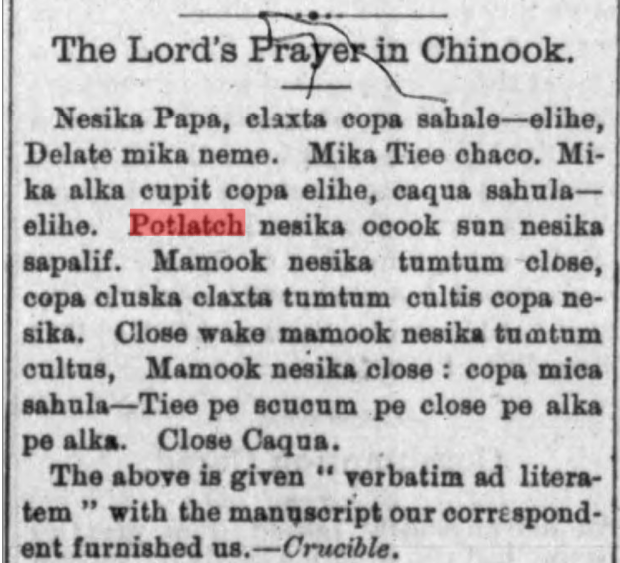
The Lord’s Prayer in Chinook.
Nesika Papa, claxta copa sahale-elihe,
Delate mika neme. Mika Tiee chaco. Mi-
ka alka cupit copa elihe, caqua sahula-
elihe. Potlatch nesika ocook sun nesika
sapalif. Mamook nesika tumtum close,
copa cluska claxta tumtum cultis copa ne-
sika. Close wake mamook nesika tumtum
cultus, Mamook nesika close: copa mica
sahula-Tiee pe scucum pe close pe alka
pe alka. Close Caqua.The above is given “verbatim ad litera-
tem” with the manuscript our correspond-
ent furnished us . — Crucible.
— from the Monmouth (OR) Pacific Christian Messenger of March 12, 1880, page 3, column 3
Bonus fact:
I need to cram yet another version of the Lord’s Prayer in somewhere, so here it is:
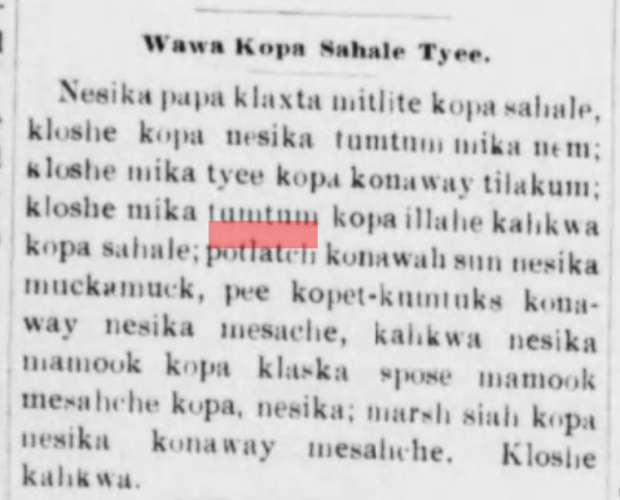
Wawa Kopa Sahale Tyee.
Nesika papa klaxta mitlite kopa sahale,
kloshe kopa nesika tumtum mika nem;
kloshe mika tyee kopa konaway tilakum;
kloshe mika tumtum kopa illahe kahkwa
kopa sahale; potlatch konawah sun nesika
muckamuck, pee kopet-kumtuks kona-
way nesika mesache, kahkwa nesika
mamook kopa klaska spose mamook
mesahche kopa, nesika; marsh siah kopa
nesika konaway mesahche. Kloshe
kahkwa.
— from the Tillamook (OR) Headlight of March 16, 1893, page 4, column 4
This version is less original, being a wording that was popular and much shared.
