1903: An 1856 Oregon memory
A saltcellar (shaker) that belonged to President Madison’s wife Dolly; famous Oregon pioneer Joe Meek’s rifle; and a Grand Ronde-area Chinuk Wawa story…what do they have in common?
They’re all featured in an article, “Relics of Pioneer Days“, telling of an Oregon museum’s acquisitions.
Mrs. Sarah A. Turpin Martin’s daughter donated the two physical objects, and contributed her mom’s frontier-era story of being visited by a Native man who asked her to make him some bread…

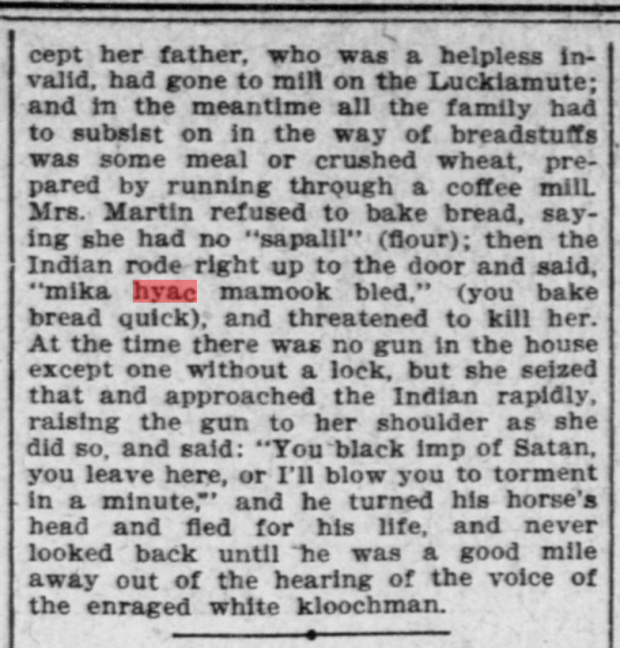
Mrs. Martin was imbued with the true
pioneer spirit, and was equal to any
emergency which might arise. The family
settled near Corvallis, Lane County, when
first coming to Oregon In 1853, and a little
later removed to the vicinity of what is
now Cottage Grove. One day in 1856 an
Indian came to the house and ordered
Mrs. Martin to bake him some bread. At
the time there was no flour in the house,
and all the men around the place, ex-
cept her father, who was a helpless in-
valid, had gone to mill on the Luckiamute;
and in the meantime all the family had
to subsist on in the way of breadstuffs
was some meal or crushed wheat, pre-
pared by running through a coffee mill.
Mrs. Martin refused to bake bread, say-
ing she had no “sapalil” (flour); then the
Indian rode right up to the door and said,
“mika hyac mamook bled,” (you bake
bread quick), and threatened to kill her.
At the time there was no gun in the bouse
except one without a lock, but she seized
that and approached the Indian rapidly,
raising the gun to her shoulder as she
did so, and said: “You black imp of Satan,
you leave here, or I’ll blow you to torment
in a minute,”‘ and he turned his horse’s
head and fled for his life, and never
looked back until he was a good mile
away out of the hearing of the voice of
the enraged white kloochman.
— from the Portland (OR) Morning Oregonian of December 15, 1903, page 12, columns 1 & 2
Extremely interesting to see here: an early (or anyways a remembered) distinction between sapalil for ‘flour’ and a more specific, newer English loan bled for ‘bread’. This is totally in parallel with how the English additions to Northern Dialect worked, a few decades later than the anecdote’s events.
The Native man’s words are mayka ayaq mamuk bled, in a modern Grand Ronde spelling.
And of course kloochman is ‘woman’.
