Circa 1850: I was quite a Siwash linguist!
“Rambling Notes on Olden Times” is the headline on a sometimes humorous piece by W.L. Adams in 1875.
Image credit: Reddit
It appeared in Portland, Oregon, during the frontier era but already reminiscing about fairly early pioneer times.
Its opening words are “From twenty to twenty-seven years ago”, so I place the following around 1850.
Telling about ten days spent crossing the Cascades Mountains of northern Oregon by wagon:
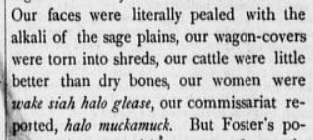
Our faces were literally pealed [SIC] with the
alkali of the sage plains, our wagon-covers
were torn into shreds, our cattle were little
better than dry bones, our women were
wake siah halo glease, our commissariat re-
ported, halo muckamuck.
Wake siah halo glease = wik-saya hilu-klis = ‘almost no fat’ = effectively ‘skin and bones’.
In the Oregon City area, at Dr. Locey’s house:
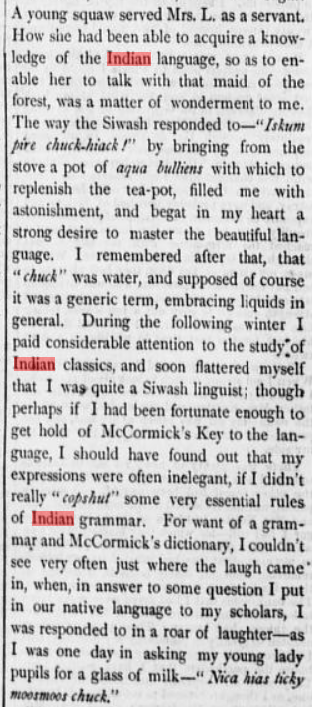
A young squaw served Mrs. L. as a servant.
How she had been able to acquire a know-
ledge of the Indian language, so as to en-
able her to talk with that maid of the
forest, was a matter of wonderment to me.
The way the Siwash responded to “Iskum
pire chuck-hiack” by bringing from the
stove a pot of aqua bulliens [boiling water] with which to
replenish the tea-pot, filled me with
astonishment, and begat in my heart a
strong desire to master the beautiful lan-
guage. I remembered after that, that
“chuck” was water, and supposed of course
it was a generic term, embracing liquids in
general. During the following winter I
paid considerable attention to the study of
Indian classics, and soon flattered myself
that I wa quite a Siwash linguist; though
perhaps if I had been fortunate enough to
get hold of McCormick’s Key to the lan-
guage, I should have found out that my
expressions were often inelegant, if I didn’t
really “copshut” some very essential rules
of Indian grammar. For want of a gram-
mar and McCormick s dictionary, I couldn’t
see very often just where the laugh came
in, when, in answer to some question I put
in our native language to my scholars, I
was responded to in a roar of laughter as
I was one day in asking my young lady
pupils for a glass of milk — “Nica hias ticky
moosmoos chuck.”
— from the Portland (OR) West Shore of August 1, 1875, page 4, columns 3 & 4 (the story continues on page 8)
Iskum pire chuck-hiack = ískam páya tsə́qw áyáq = ‘fetch cooked water (!) quickly’. Not the greatest Chinuk Wawa 😁 Most folks would use the word liplip ‘boiled; boiling’. And the adverb ayaq would most often go at the start of the phrase.
copshut = kákshət = ‘break’. Why the “p”?
Nica hias ticky moosmoos chuck = nayka hayas-tíki músmus-tsəqw = ‘I’d love some cow-water’! No problem here grammatically, but the normal word for milk would be tutush.
