More humor in Chinuk Wawa: Published at Chinook House
Okay, this installment of fun is not in Chinook Jargon, but it’s from “the Chinook paper”…
…Which got reanimated by its editor during World War 1, no longer in “shorthand” Chinuk Wawa but in typewritten and handwritten French and English.
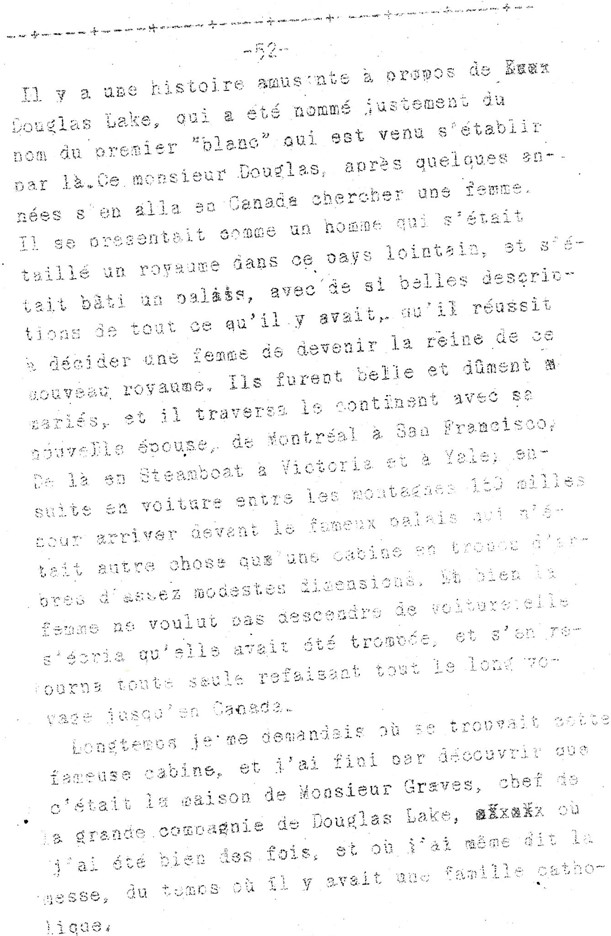
Il y a une histoire amusante à propos de Douglas Lake, qui a été nommé justement du nom du premier “blanc” qui est venu s’établir par là. Ce monsieur Douglas, après quelques années s’en alla en Canada chercher une femme. Il se présentait comme un homme qui s’était taillé un royaume dans ce pays lointain, et s’était bâti un pais, avec de si belles descriptions de tout ce qu’il y avait, qu’il réussit à décider une femme de devenir la reine de ce nouveau royaume. Ils furent belle et dûment mariés, et il traversa le continent avec sa nouvelle épouse, de Montréal à San Francisco; de là en Steamboat à Victoria et à Yale; ensuite en voiture entre les montagnes 180 milles pour arriver devant le fameux palais qui n’était autre chose que une cabine en troncs d’arbres d’assez modestes dimensions. Eh bien la femme ne voulut pas descendre de voiture; elle s’écria qu’elle avait été trompée, et s’en retourna toute seule refaisant tout le long voyage jusqu’en Canada.
Longtemps je me demandais où se trouvait cette fameuse cabine, et j’ai fini par découvrir que c’était la maison de Monsieur Graves, chef de la grande compagnie de Douglas Lake, où j’ai été bien des fois, et où j’ai même dit la messe, du temps où il y avait une famille catholique.
‘There is an amusing story about Douglas Lake, which was aptly named after the first “white man” who came to settle there. This Mr. Douglas, after a few years went to [eastern] Canada to look for a wife. He presented himself as a man who had carved out a kingdom for himself in this distant country, and had built himself a kingdom, with such beautiful descriptions of all that was there, that he succeeded in convincing a woman to become the queen of this new kingdom. They were beautifully and duly married, and he crossed the continent with his new wife, from Montreal to San Francisco; thence by steamboat to Victoria and Yale; then by carriage through the mountains 180 miles to arrive in front of the famous palace, which was nothing else than a cabin made of tree trunks of rather modest dimensions. Well, the woman wouldn’t get out of the carriage; she exclaimed that she had been deceived, and returned alone, making the long journey back to Canada.
For a long time I wondered where this famous cabin was, and I ended up discovering that it was the house of Mr. Graves, chief of the great [Cattle] company of Douglas Lake, where I’ve been many times, and where I’ve even said mass, when there was a Catholic family there.‘
— Kamloops Wawa #254 (September 1915), page 52
(Cf. Akrigg and Akrigg (1997), British Columbia Place Names. Vancouver: UBC.)
Bonus fact:
I shouldn’t say there’s no Jargon at all in these World War 1 editions of Kamloops Wawa.
In them, Le Jeune sometimes signed off with an apparent Chinuk Wawa name for his tiny news office:
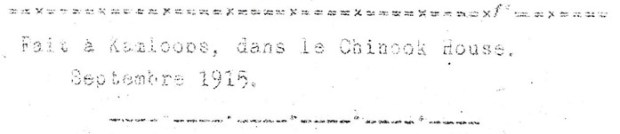
“Fait à Kamloops, dans le Chinook House.”
(‘Made at Kamloops, in the Chinook House’)
— page 60
Why do I think Chinook House is Jargon here?
Well — why would Le Jeune interrupt his French to switch into English?
And why would he assign French masculine gender to le House, when it’s feminine la Maison in French?
It’s more likely, in my view, that we have here the legitimate (newly discovered!) grammatical Chinuk Wawa compound, chinúk-hàws!
Evidently, just as the massively multilingual newspaper published by Le Jeune, and the shorthand alphabet it used, were called simply Chinuk Pipa (‘the Chinook paper; the Chinook writing’) by everyone, any place Le Jeune lived in was the Chinook House!
