1895: Col. B.F. Shaw in town, reminiscing [1840s, 1850s]
This man was a main Chinuk Wawa interpreter for the “Stevens Treaties” in Washington Territory, and he knew the language well, but…
…I don’t believe this bit about him running into Chief siʔaɬ (Seattle) and having a chat in Jargon.
Here’s a local news piece about Colonel Benjamin Franklin Shaw (1829-1908), who had been one of the earliest non-Indigenous people to spend much time around dᶻidᶻəlalič, modern Seattle, WA.
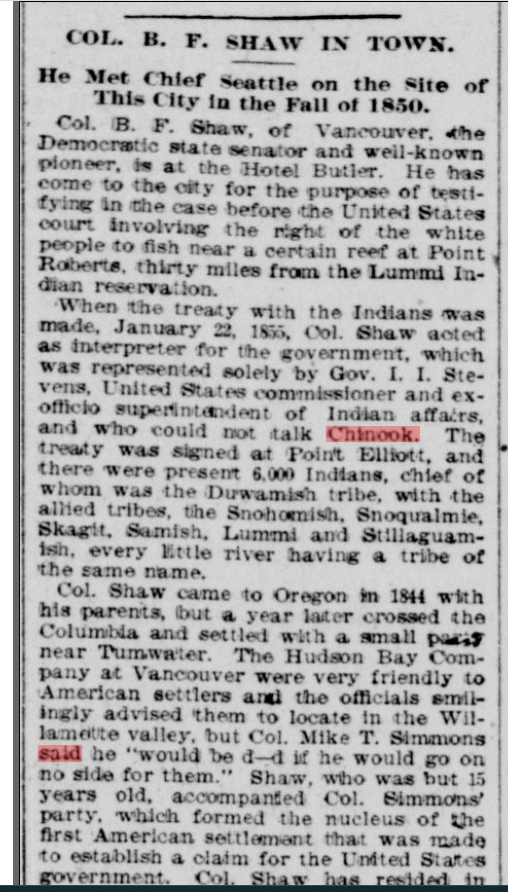

COL. B.F. SHAW IN TOWN.
He Met Chief Seattle on the Site of This City in the Fall of 1850.
Col. B.F. Shaw, of Vancouver [Washington], the Democratic state senator and well-known pioneer, is at the Hotel Butler. He has come to the city for the purpose of testifying in the case before the United States court involving the right of the white people to fish near a certain reef at Point Roberts, thirty miles from the Lummi Indian reservation.
When the treaty with the Indians was made, January 22, 1855, Col. Shaw acted as interpreter for the government, which was represented solely by Gov. I. I. Stevens, United States commissioner and ex officio superintendent of Indian affairs, and who could not talk Chinook. The treaty was signed at Point Elliott, and there were present 6,000 Indians, chief of whom was the Duwamish tribe, with the allied tribes, the Snohomish. Snoqualmie, Skagit, Samish, Lummi and Stillaguamish, every little river having a tribe of the same name.
Col. Shaw came to Oregon in 1844 with his parents, but a year later crossed the Columbia and settled with a small party near Tumwater. The Hudson Bay Company at [Fort] Vancouver were very friendly to American settlers and the officials smilingly advised them to locate in the Willamette valley, but Col. Mike T. Simmons said he “would be d—-d if he would go on no side for them.” Shaw, who was but 15 years old, accompanied Col. Simmons’ party, which formed the nucleus of the first American settlement that was made to establish a claim for the United States government. Col. Shaw has resided in various places in Washington ever since. He was one of the only three men furnished by the territory to make war on the Indians for the Whitman massacre, the others being Sid Ford and Joe Borst. In the fall of 1850 B.F. Shaw, Col. Ebey and a man named Kinsey were going to Whidb[e]y island in a small boat, and as the water was very rough while they were passing Elliott bay they put into the harbor to avoid the dangerous squalls. In speaking of the experience last evening, Col. Shaw said:
“I was reminded of the experience of Tam O’Shanter with the witches. First a few, then hundreds of Indians appeared upon the beach, the woods seeming to be swarming with them, and they made all sorts of signs and contortions. My two companions were a little scared when an old chief who was sitting alone on a log, and who proved to be the famous Seattle, arose and said in Chinook: ‘Have no fears. We are friendly, and wish to salute you as they do in Victoria when a ship comes with white men aboard. We will not harm any of you.’ I replied that we appreciated their friendship and were looking for a location, and that we came from the direction of the rising sun, and that our people being many to their few, could come in such numbers as to exterminate them, but were friendly and would come and erect sawmills and bring stores and barrels of whisky, and all would be happy. The mention of the whisky made such a din of applause that further remarks were inaudible.”
This occurred before any white settlements were made in this vicinity.
— from the Seattle (WA) Post-Intelligencer of June 23, 1895, page 6, column 4
Sources agree that Chief Seattle didn’t speak Chinuk Wawa. It’s perfectly possible that one of his tribe members did, though, and interpreted for him.
Interesting to see Shaw claiming he used some of the menacing claims that were later made by Whites in the process of essentially forcing western Washington tribes to sign treaties.
