1911: Astoria centennial program
Hat tip to Juli in the Discord Chinuk Wawa group, for finding this fun item!
Get ready for some affectionate but rusty Settler-style chinooking in the post-frontier era.
This is the 1911 “Astoria, Oregon Centennial Celebration” program booklet:

Naturally, the oldest pioneer Settlers of northwestern Oregon were honored guests. These people were always associated with Chinook Jargon in the popular mind, so the August 22 reception for them is listed as “Kla-how-yah, kloshe til-li-kum; hi-yu wa-wa, hi-yu he-he” (‘Greetings, good friends; there’ll be lots of talking (and) lots of fun’). That’s some typically Settler-style Jargon, as is the description of the Basket Picnic hosts, the Native Daughters of Astoria, as as “Ok-oke klooch-men tum-tums hy-as skoo-kum” (‘Those women (whose) hearts are very strong’). This latter phrasing is not really fluent, and as the -s suffix on tumtum suggests, it’s awfully English-influenced.
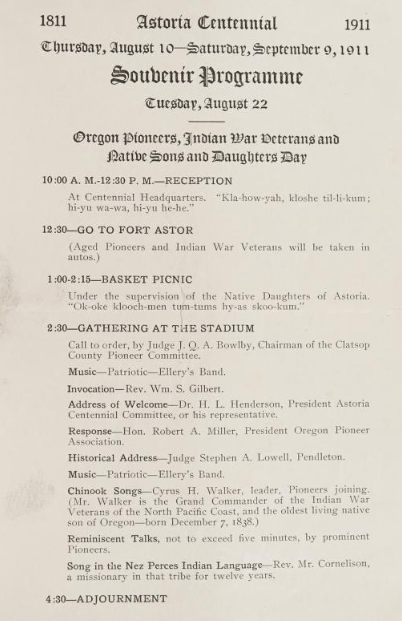
That day’s activities also included “Chinook Songs — Cyrus H. Walker, leader, Pioneers joining. (Mr. Walker is the Grand Commander of the Indian War Veterans of the North Pacific Coast, and the oldest living native son of Oregon — born December 7, 1838.)” I assume those songs included the ones whose lyrics are shown in the program:
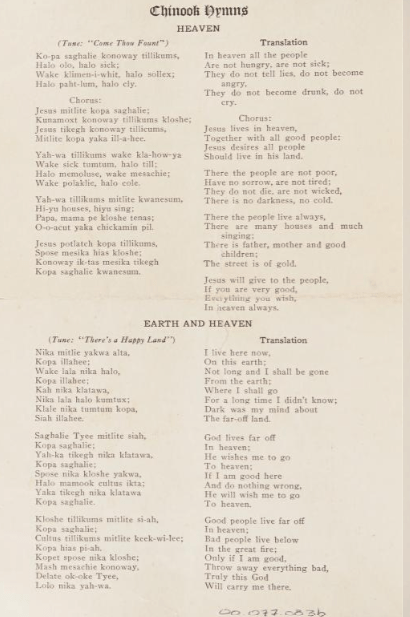
The hymn “Heaven” seems to be a newly discovered Chinuk Wawa song for us; I’ve only found its original (“Come Thou Fount of Every Blessing”) translated into Stó:lō Salish of BC. My typical analysis and opinion of Settler-written songs applies here, that is, I don’t advise talking stilted, English-influenced Jargon like we see in the following:
HEAVEN
(Tune: “Come Thou Fount”) Translation
Ko-pa saghalie konoway tillikums, In heaven all the people
Halo olo, halo sick; Are not hungry, are not sick;
Wake klimen-i-whit, halo sollex; They do not tell lies, do not become angry,
Halo paht-lum, halo cly. They do not become drunk, do not cry.Chorus: Chorus:
Jesus mitlite kopa saghalie; Jesus lives in heaven,
Kunamoxt konoway tillikums kloshe; Together with all good people;
Jesus tikegh konoway tillicums, Jesus desires all people
Mitlite kopa yaka ill-a-hee. Should live in his land.Yah-wa tillikums wake kla-how-ya There the people are not poor,
Wake sick tumtum, halo till; Have no sorrow, are not tired;
Halo memoluse, wake mesachie; They do not die, are not wicked,
Wake polaklie, halo cole. There is no darkness, no cold.Yah-wa tillikums mitlite kwanesum, There the people live always,
Hi-yu houses, hiyu sing; There are many houses and much singing;
Papa, mama pe kloshe tenas; There is father, mother and good children;
O-o-acut yaka chickamin pil. The street is of gold.Jesus potlatch kopa tillikums, Jesus will give to the people,
Spose mesika hias kloshe; If you are very good,
Konoway ik-tas mesika tikegh Everything you wish,
Kopa saghalie kwanesum. In heaven always.
Also of note: This is a radically different text from the original English-language lyrics. It’s common, even normal, that Chinuk Wawa translations diverge enormously from their source texts, given the structural and cultural uniqueness of this language. Here are English lyrics for it from Hymnary.org:
1 Come, thou Fount of every blessing;
tune my heart to sing thy grace;
streams of mercy, never ceasing,
call for songs of loudest praise.
Teach me some melodious sonnet,
sung by flaming tongues above;
praise the mount! I’m fixed upon it,
mount of God’s unchanging love!2 Here I raise my Ebenezer;
hither by thy help I’m come;
and I hope, by thy good pleasure,
safely to arrive at home.
Jesus sought me when a stranger,
wandering from the fold of God;
he, to rescue me from danger,
interposed his precious blood.3 O to grace how great a debtor
daily I’m constrained to be!
Let that grace now, like a fetter,
bind my wandering heart to thee.
Prone to wander, Lord, I feel it,
prone to leave the God I love;
here’s my heart; O take and seal it;
seal it for thy courts above.
The other 1911 reunion song, “Earth and Heaven”, is Rev. Myron Eells’s previously published version in Jargon of “There is a Happy Land”; compare the version in the Stó:lō Methodist hymn book. Therefore I won’t bother with it here — but I will start a new mini-series closely examining Eells’s influential hymns, which have popped up quite a number of times in our past discussions.
