Learning from the Lane learners (Part 5: measurements and more)
I’m finding so many great things to pass along from the amazing Chinuk Wawa community of Oregon…
All of these pointers are in “Chinuk-Wawa: Leyn-Skul, Buk 2”, a wonderful magazine created by Lane Community College’s learners of Chinook Jargon.
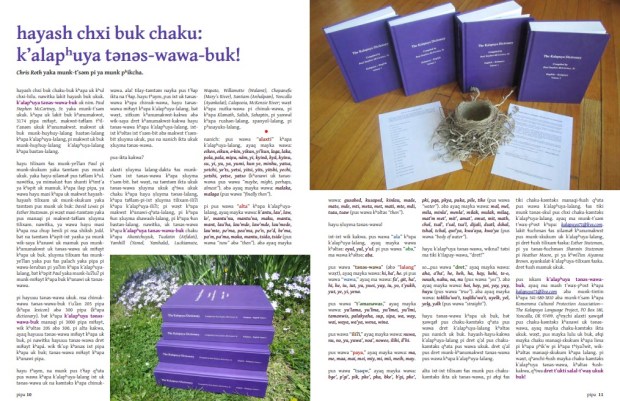
(Download / print it for free from this link.)
In many cases, the stuff I find there gives an opportunity to show how differently the Northern Dialect expresses things from the Southern (Grand Ronde) Dialect of Jargon.
On pages 10 and 11 is Chris Roth’s article, “hayash chxi buk chaku: k’alapʰuya tənəs-wawa-buk!” (I.e. “A Big New Book Has Come Along: The K’alapuya Dictionary!”) There are a number of things that really caught my eye here:
- tʰil-t’anəm is used to express ‘pound(s)’ of weight, discussing this hefty 4-book set. (I own it, it’s massive.) This is saying literally ‘heavy-measure’. Compare wam-kʰul-t’anəm for ‘degree(s)’, which is literally ‘warm-cold-measure’. I like these phrases, they’re nice and clear! Plus, the weight measure could also refer to kilograms 😁
In the Northern Dialect we have pawn(d)(s), from English ‘pound(s)’. For ‘degrees’ in the North, I’ve only found tsum, literally ‘mark(s)’, as in 35 ts’um kikwuli kopa siro = ’35° below zero’. - kʰanumakwst-kakwa is a good phrase to use in either dialect for ‘they’re the same as each other; alike; identical’. It’s literally ‘together they’re the same’ or ‘they’re both like that’.
- Another quite neat innovation in Grand Ronde’s Jargon is t’səm-bit for a ‘letter’ or ‘character’ as we say in computer use. This is literally a ‘writing-piece’, if you take the established bit (‘dime’) in its original English meaning.
In the Northern Dialect, people would just call a letter a ts’um, a ‘mark’. We know that the letters of the Chinuk Pipa (shorthand) alphabet have the same names as the corresponding English letters, ei, bi, ji, em, etc., but we’re going to have to decide what some letters for Indigenous sounds are called…will ts be “si’, will k’ be “k’ei“, will tl be something like “etl”, etc.? - Some of the K’alapuya roots/words that Chris shares are of real interest from a Chinook Jargon perspective. One of the roots corresponding to CJ alaxti is K’alapuya “lag, lak“, which seems like a compelling similarity with the Chinookan source of the Jargon word. For ‘body of water’, the K’alapuya “mal, mel” reminds me of Chinookan too (í-maɬ).
- A useful expression when discussing Indigenous PNW languages is hayash-hayu-kakwa, ‘complex’! That’s literally ‘very-many-like’ or ‘big (and) a lot in nature’.
I don’t know an expression nearly as simple as this for the same concept in the Northern Dialect. We would have to talk our way around the edge of the idea, I suppose, saying things like hayas-til pus kumtuks, ‘very hard to understand’. - Some expressions that a Northern Dialect speaker wouldn’t understand, and that also taxed my brain when I was thinking in Southern Dialect, are the first 3 words in “qʰex̣chi alaxti x̣awqaɬ pus chaku-kəmtəks kʰanawi uk tənəs-wawa…” — “Although it might (probably) be impossible to learn all the words…”
Those little Chinookan “particles” are almost entirely unknown in the Northern Dialect. We don’t know a way to say ‘although’ there, so we’d translate this phrasing like “Tl’onas weik-kata pus chako-kumtuks kanawei okok tenas-wawa…” = “Maybe (I reckon) it’s impossible to learn all those words…” Useful fact: in the North, tl’onas ‘maybe’ is also used to convey ‘I reckon’ about stuff you know is true for sure, e.g. “Wal tl’onas haiyas man naika alta” = “Well I reckon I’m a grown man now!”
