1905 and 1912: Joe Pi(d)geon and “Cariboo Cowboy”
It’s nice, how often we can find more information about folks from the world of Kamloops Wawa.
In Kamloops Wawa #199c (December 1901), on page 98, we find mention of someone with the memorable name of Joe Pigeon.
 Stagecoach at Clinton, BC (image credit: Northern BC Archives)

This comes up during a stagecoach journey in British Columbia, and it turns funny when some cowboys get involved. Here’s the anecdote, humor and all:
Pus stish mash Klinton, nsaika
‘When the stage left Clinton (BC), we’wiht mash Klinton kopa tanas tsiktsik,
‘too left Clinton in a little wagon,’pi pulakli nsaika tlap iht haws, Rafail
‘and in the evening we reached this one house, Raphael’s’iaka haws, pi Rafail mimlus, pi alta mitlait
‘house, but Raphael has passed on, and now there lives’iawa iht man iaka nim Sho Pichon. Ukuk
‘there this one man called Joe Pigeon. This’haws, <27> mail iaka saia kopa Klinton.
‘house is 27 miles away from Clinton.’Ukuk Sho Pichon, iaka tlus tomtom pus
‘This Joe Pidgeon was happy for’lisivik pi mokst liplit slip kopa iaka haws.
‘the bishop and two priests to sleep at his house.’Iaka mamuk tlus makmak kopa nsaika; iaka
‘He made good food for us; he’mitlait iht fat kalkala, iaka nim gus
‘had a fat bird called a goose’pi Fraidi ukuk son, kakwa wik nsaika makmak
‘but that day was a Friday, so we didn’t eat’ukuk kalkala pi klaska mash [Ø] kopa boks
‘that bird and it was put into a box’pus nsaika makmak tanas son: pi ayu
‘for us to eat in the morning; but there were a bunch of’kaw bois mitlait wiht ukuk pulakli kopa
‘cowboys also staying that night at’Sho Pichon iaka haws, pi sitkom pulakli,
‘Joe Pidgeon’s house, and in the middle of the night,’klaska tlap ukuk kalkala, pi klaska makmak
‘they found that bird, and they ate’[Ø] kanawi. Klaska siisim kopa klaska oihat
‘it all up. They reported on their way (out?)’pus klaska makmak lisivik iaka gus. Pi
‘that they may have eaten the bishop’s goose. But’wik nsaika klahawiam kopa ukuk. Mitlait iht
‘we weren’t despondent about this. There was an-‘wiht gus, pi ukuk nsaika makmak
‘other goose, and that’s what we ate’Satyurdi tanas son.
‘on Saturday morning.’Kopit makmak, nsaika mash Pichon iaka
‘After eating, we left Pidgeon’s’haws, <25> mails nsaika kuli…
‘house; we traveled 25 miles…’
When I got curious to know more than this about Joe Pigeon, I was lucky enough to come across an entertaining reminiscence by Harry Marriott, “Cariboo Cowboy”. Still with the cowboy theme, eh…
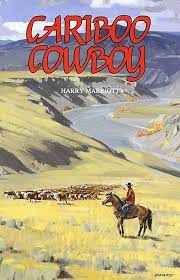
Image credit: Amazon)
Well anyways, this book was published in 1994 by Heritage House of Surrey, BC. Marriott was a cousin (he says on page 73) of “Three against the Wilderness” author Eric Collier. (That’s another highly worthwhile BC read!)
Harry came over from England just after Kamloops Wawa had come to an end, but he knew many of the same people that that newspaper’s editor, JMR Le Jeune, hung around with.
He picked up some Chinook Jargon of course, though he only uses single words of it here and there for effect in his colorful reminiscences. So sometimes you’ll find expressions like “the agricultural tyees” (page 48) or the more English-influenced “klootch” (page 53, defined as “an Indian gal”).
Well, about Joe Pigeon, here’s what Harry Marriott has to tell:
In the late afternoon, we came to a log fence running below the road. In due time we came to a ranch situated at the east end of a long lake, called Meadow Lake, which is at least four miles long. This was a typical ranch, with every building made of jack-pine logs, corrals and fences also.
The ranch belonged to a French-Canadian family named Pidgeon. The head of the family, Joe Pidgeon, was a colourful old-timer, who spoke very broken English, well mixed with French and Chinook Indian words. Old Joe was a real hardy gentleman, and on occasion he was tougher than a boiled owl. He had two sons, one of whom was living at Meadow Lake with his wife and two children.
In later years I had many associations with this old-timer and his descendants. The Pidgeons at that time were running over three hundred head of range cattle, and each year cut many tons of a fine quality of wild hay, known as sugar-cane hay.
(page 18)
By the way, that’s a neat little discovery for us — an explanation of the Cariboo place name, the Sugarcane Indian Reserve. Which also gave us the Sugarcane Tintin (“Sugarcane Bell”), a mini-newspaper in Chinuk Wawa that was published inside a few issues of the Kamloops Wawa!
Here’s a little more about the Pidgeons:
I had two good boys with me at that camp, one named Denis Pidgeon from Trois Rivières in old Quebec…Denis Pidgeon was a nephew of the famous old Joe Pidgeon of Meadow Lake, and like nearly all French Canadians I have ever known and worked with, he was a natural born axe man and a good partner on the end of a crosscut-saw.
(page 29)
Nice to make some historical connections, and piece together a picture of the communities that spoke so much Chinook Jargon in our recent history!
