AF Chamberlain’s field notes of Chinuk Wawa from SE British Columbia (Part 3)
This scarcely known document continues to delight, with its careful pronunciation notes and its accurate matchup with everything else we know about northern-dialect Chinuk Wawa.
That said, there are new discoveries in here as well!
It’s a good thing AF Chamberlain, anthropology student of Franz Boas, took such trouble to carefully describe Chinook Jargon as really spoken in this corner of BC.
One feature that I’ll call your attention to is the entrenched habit of varying between hayu and hayas(h) as an intensifier.
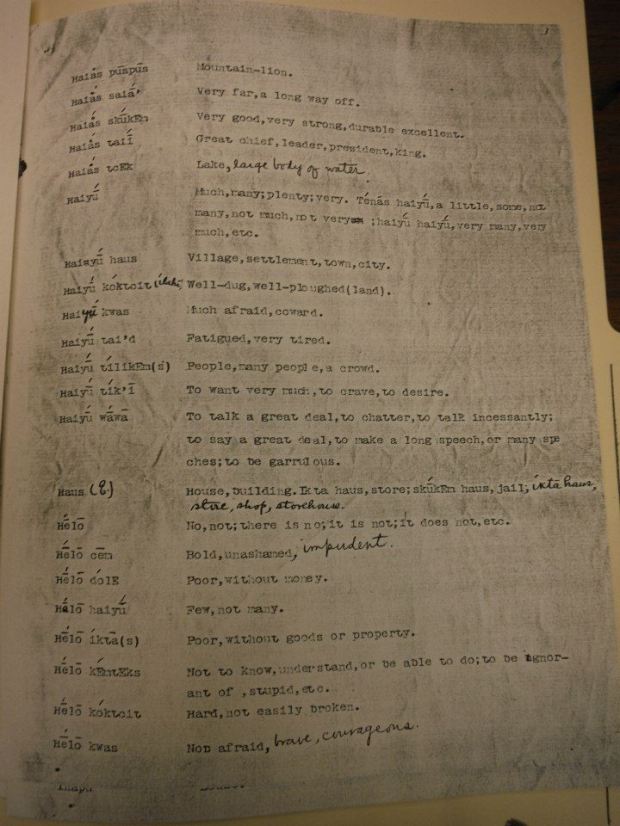
- Haiás pūspūs ‘Mountain-lion.’
(Literally, ‘big cat’.) - Haiä́s saiā́’ ‘Very far, a long way off.’
(Literally, ‘very-far’.) - Haiä́s skū́kEm ‘Very good, very strong, durable(,) excellent.’
(Lit., ‘very-strong’.) - Haiä́s taiī́ ‘Great chief, leader, president, king.’
(Lit., ‘big chief’.) - Haiä́s tcEk ‘Lake, large body of water.’
(Lit. ‘big water’.) - Haiyū́ ‘Much, many; plenty; very.’ Ténäs haiyū́ (lit., ‘a little much’), ‘a little, some, not many, not much, not very’; haiyū́ haiyū́ (lit., ‘many many’), ‘very many, very much, etc.’
- Haiyū́ haus ‘Village, settlement, town, city.’
(Lit., ‘many houses’.) - Haiyū́ kóktcit (ílahī) ‘Well-dug, well-ploughed (land).’
(Lit., ‘much broken’.) - Haiyū́ kwas ‘Much afraid, coward.’
(Lit., ‘much afraid’.) - Haiyū́ tai’d ‘Fatigued, very tired.’
(Lit., ‘much tired’, with a new borrowing from local English.) - Haiyū́ tílikEm(s) ‘People, many people, a crowd.’
(Lit., ‘many people’.) - Haiyū́ tík’ī ‘To want very much, to crave, to desire.’
(Lit., ‘much wanting’.) - Haiyū́ wā́wā ‘To talk a great deal, to chatter, to talk incessantly; to say a great deal, to make a long speech, or many speeches; to be garrulous.’
(Lit., ‘much talking’.) - Haus (E.) ‘House, building.’ Ikta haus (lit., ‘things-house’; a new expression for us), ‘store’; skū́kEm haus (lit., ‘strong house’), ‘jail’; íkta haus, ‘store, shop, storehouse.’
- Hḗlō ‘No, not; there is no; it is not; it does not, etc.’
- Hḗlō cēm ‘Bold, unashamed, impudent.’
(Lit., ‘no shame’.) - Hḗlō dólE ‘Poor, without money.’
(Lit., ‘no money’.) - Hḗlō haiyū́ ‘Few, not many.’
(Lit., ‘not many’.) - Hḗlō íktā(s) ‘Poor, without goods or property.’
(Lit., ‘no things’.) - Hḗlō kÉmtEks ‘Not to know, understand, or be able to do; to be ignorant of, stupid, etc.’
(Lit., ‘not knowing’.) - Hḗlō kóktcit ‘Hard, not easily broken.’
(Lit., ‘not broken’. This sense of the expression is new to us.) - Hḗlō kwas ‘Not afraid, brave, courageous.’
(Lit., ‘not afraid’.)
To see more of A.F. Chamberlain’s work on my website, click this link.
