The 13-moons calendar in Chinuk Wawa
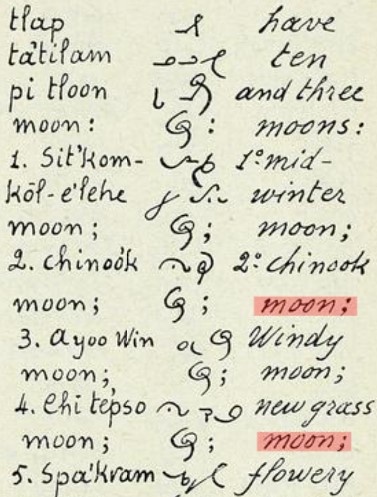
Here’s a northern Chinook Jargon lunar calendar from JMR Le Jeune’s 1924 book, “Chinook Rudiments”:
Various characteristics of this list suggest that it wasn’t very old at the time it was written down. For example:
- The “Chinook moon” clearly refers to the warm westerly “Chinook wind”, an expression that I haven’t found to have been common until 1865 or later.
- The use of the Secwépemc Salish word spakram for ‘flower’ is a newish loan into Jargon.
- The 2 months named by Jargon compounds involving verbs go against the grammatical rules of this language — compounds are typically limited to nouns.
Whether or not this calendar was well recognized in standard BC use (where we know folks normally used the English month names in Jargon), it’s great stuff. It looks to be inspired by the names of the months in local Salish languages, so it reflects Indigenous culture.
If you’ve spent a year in the interior Pacific Northwest, you’ll definitely recognize these phases of the yearly cycle.
So, from page 23 of Le Jeune’s awesome final publication in Chinuk Wawa:
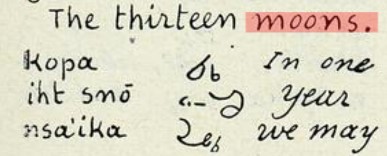
The thirteen moons.
Kopa kopa In one
iht snō iht sno year
nsai’ika nsaika we may
tlap tlap have
ta’tilam tatilam ten
pi tloon pi tlun and three
moon: mun: moons:1. Sit’kom- sitkom 1o mid-
kōl-e’lehe kol ilihi winter
moon; mun; moon;2. Chinoo’k Chinuk 2o Chinook
moon; mun; moon;3. Ayoo Win ayu win Windy
moon; mun; moon;4. Chi te’pso chi tipso new grass
moon; mun; moon;5. Spa’kram spakram flowery
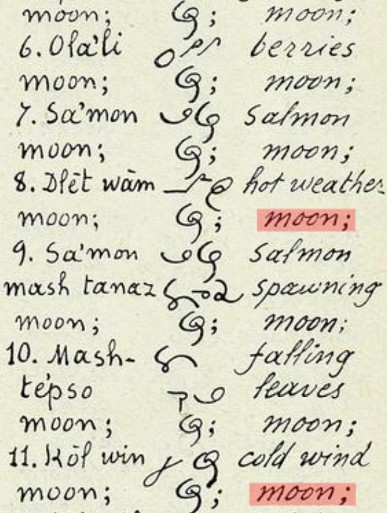
moon; mun; moon;6. Ola’li olali berries
moon; mun; moon;7. Sa’mon samon salmon
moon; mun; moon;8. Dlēt wām drit wam hot weather
moon; mun; moon;9. Sa’mon samon Salmon
mash tanaz mash tanas spawning
moon; mun; moon;10. Mash- mash falling
te’pso tipso leaves
moon; mun; moon;11. Kōl win kol win cold wind
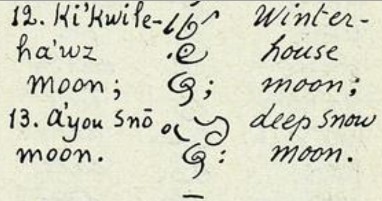
moon; mun; moon;12. Ki’kwile- kikwili Winter-
ha’wz haws house
moon; mun; moon;13. A’you Snō ayu sno deep snow
moon. mun: moon.
Bonus fact:
Le Jeune’s translation of nsaika tlap as ‘we may have’ is inspired!
Why?
Because t’ɬáp, as we spell it in Grand Ronde style, virtually always carries a sense that you were lucky or unlucky enough to ‘catch’ or ‘find’ something, whether it’s:
- a newborn baby,
- an emotion,
- an illness, or
- a punishment.
You have little or no control over t’ɬáp-ing.
Plus, you personally don’t control how many (full) moons show up in the sky during a year!
So, it makes a ton of sense to put this word into English with a modal of possibility (‘may have’), instead of in the declarative mode (*’we get’*).
Brilliant stuff, from a genuine expert speaker who had a half century of practice.
