Temporal sequences in Fort Vancouver CW, and such
‘After’ is the subject of perennial questions from Chinuk Wawa learners.

Image credit: Amazon
The trouble with certain points of CW grammar is, there are very few full sentence examples known to us from fluent speakers during the era when most “Chinook dictionaries” were being published.
(There are many thousands of sentences in the Kamloops Wawa shorthand, 1891 onwards, but most of you haven’t yet learned from me how to read that, have you?)
But here’s a helpful little contribution from the Demers, Blanchet, & St. Onge dictionary of 1871. (That is, info from Fort Vancouver around 1838.)
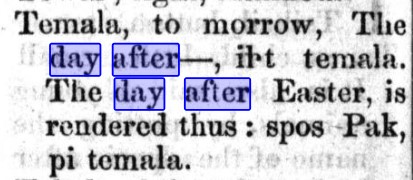
I hope you already knew that temala, as these fellas write it, means both ‘tomorrow’ and ‘next day’. Thus “iHt temala” is ‘the day after tomorrow’, because the word for ‘one’ in Jargon, iHt, also means ‘another, a different one’.
The overlooked, but really useful, note here is: You can say ‘when it’s ___, and (then) the next day’. The example provided to us is “spos Pak, pi temala” to express ‘the day after Easter’. (This uses the French word Pâques for Easter.)
I reckon you can also say ‘the day after tomorrow’ as “spos temala, pi temala”!
I figure it also works well to convey ‘the next X’ this same sort of way. ‘Next year’ can be spos ukuk sno, pi iHt sno. (Literally ‘when it’s this year, and (then) another year.’)
Here’s a good opportunity to highlight yet another strategy that I see used a lot to express ‘after X’, in British Columbia Chinuk Wawa. There, we often hear (pus) kopit X… (literally ‘(when) X is done (happening)…’). The “X” is normally either a noun or a “small clause” having no subject. A commonly heard example is kopit makmak… ‘after eating…(we did such and such)’.
All of the above are classic old CW strategies for expressing a temporal sequence of events. The kopit strategy is confirmed by George Gibbs (1863), who shows us kopet tomalla ‘the day after tomorrow’ and icht, mokst, klone sun kopet Sunday ‘one, two, or three days after Sunday’.
It’s of real interest that another word sometimes used for ‘after’, kímt’á, is typical for Chinook Jargon in that it retains traces of its original meaning from the donor language, Chinookan. There, it meant ‘behind’. In CJ — where it’s an adverb — it still carries primarily that sense. The only expression in Gibbs’s fine dictionary that might show us this word in use as ‘after’ is his kimtah nika nannitsh mika, translated by him as ‘since I saw you’.
I believe Gibbs’s ‘since’ = ‘afterwards’.
Neither kopit nor kimtah are prepositions, in usual Jargon use. This makes them unlike their equivalents in English or French (the non-Indigenous source languages of the Jargon), which let you say ‘after’ + an inflected verb (one that has a subject).
And therefore, the grammar of expressing ‘after’ is really different, and really Indigenous, in Chinuk Wawa. In fact, in say Lower Chinook stories, ‘after’ is usually connoted by expressions like ‘it was a while, and then…’ or ‘three times she dived, and then…’ — which are also extremely frequent in the Jargon.
I feel we should realize this. Maybe it’s not so important to “have a word for after” in Chinook Jargon…if we want to speak it as the elders and ancestors did.
All that I’ve said here applies equally to ‘before’.
Bonus fact #1:
In Franz Boas’s field notes from Bay Center, Washington, while working with Charles Q’ltí (Cultee) around 1890 to make sense of Reverend Myron Eells’s information on Lower Chehalis Salish, there’s an entry pāoteēʹe̳lc ‘day after to-morrow (‘one tomorrow’, not good)’. In our modern way of writing it, this is páw̓ t ʔíl̓əš.
That’s recognizable as a direct translation from Chinuk Wawa’s íxt tumála. Both in Salish and in CW that’s literally ‘one (i.e. another) tomorrow’.
Looks like Q’ltí told Boas that this isn’t good Lower Chehalis, however. I suppose Franz had asked him, in the Jargon that they routinely spoke together, qʰáta mayka wáwa “íxt tumála”? And got this sincere, very literal, grammatically correct, but WRONG answer. 😎
Bonus fact #2:
Another Lower Chehalis expression for ‘day after tomorrow’ was noted by Rev. Eells around 1880 — panʹ-mosl-ko klāc. That’s possibly pán mús t ʔúl̓əš ‘when it’s four tomorrows’. But why?!
