1895: A variety of questions
Now here’s a loaded question …

(Image credit: Impact Communications)
From the days when your local newspaper was the handiest source of information, because libraries were scarce and the editor had access to many other newspapers as “exchanges”:

• • •
• • •
A VARIETY OF QUESTIONS.
Monroe, Wash., Jan. 29.
To the Editors: Please answer the following and oblige:
…
(4) Who taught the siwash Indians the Chinook language? A SUBSCRIBER.
…
(4) The Chinook jargon is a combination of Indian, French and English. It was invented by an employe[e] of the Hudson Bay Company and was taught by the officers of that company to the Indians for convenience in trading with them. It is similar in character to “pigeon English,” being made of native and foreign words, grossly corrupted and often fancifully used.

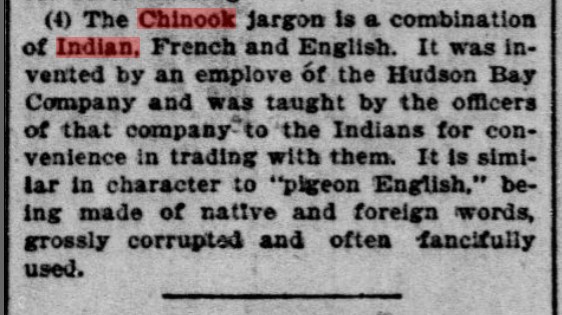
— from the Seattle (WA) Post-Intelligencer of February 9, 1895, page 4, column 4
Noteworthy here is the amount of folklore that had already built up around Chinuk Wawa in a mere century of provable existence. For one thing, the letter writer was under the common mistaken impression that there was a tribe called the Siwash. (This is just the generic word in CW for ‘Native people’.)
The editor of the paper, in this case, didn’t know a lot more than the questioning reader.
But you can tell he had read the incessantly repeated linguistic urban legends about this language having been “invented” by the HBC as a “trading language”.

I couldn’t agree more…aside from the whole “siwash” thing becoming a handy but wildly inaccurate catch-all term for anyone of Indigenous descent, and by that point a distinctly American usage, (and which fell out of favour up here earlier), the HBC as an institution had officially very little to do with who used what for trade purposes. In the early days of the Canadian continental fur trade, the NWC preferred to allow its field agents and post operators to use whatever combination of a Great Lakes-joual creole of sorts (only picking up actual Cree-michif as it went along), and the ubiquitous inter-Nation sign language, bearing in mind that by then a lot of these folks spoke French as their 1st, or 2nd language.
It wasn’t until the HBC showed up late to the party, that we see barely literate Highland Scots conscripts clerking at the posts, madly trying to learn whatever lingua franca was on offer at the moment, while practicing their penmanship and spelling of anglaise (not their first language either). A quick jog through the TRP or Jasper account books shows a habit of early clerks to identify locals who came in to trade, by first where they were from, their assigned representative’s name (often erroneously listed as “chief”), and then “Indian” next to that (an equally erroneous name, given where Indians are actually from). With this field-tested intel in mind, I cannot bring myself to accept that the HBC did anything to facilitate the use of CJ…in fact it may have been Simpson himself who was heard to remark (and then completely ignored) that the business would function much better if the whole lot of them (locals and Scots included) would just learn to speak English!
LikeLiked by 1 person