1889: The Fourth of July at Skokomish
In the final year of Washington Territory and of “the frontier”, Chinook Jargon continued to play a major role in many communities’ lives.
Here you’ll find a number of Chinuk Wawa words in the English article, untranslated because nobody needed help understanding them!
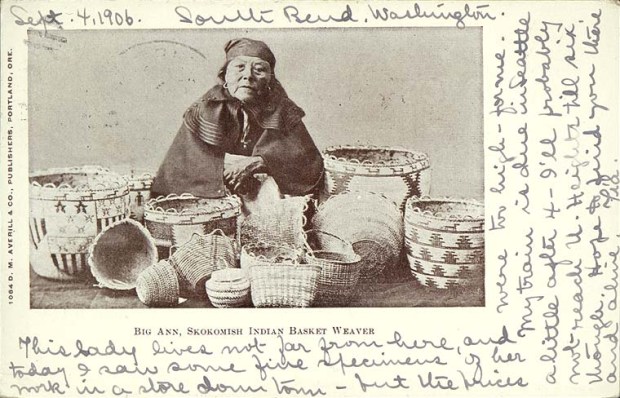
Looks like a Skokomish 4th of July basket on the left (image credit: The Mossback)
The “M.E.” who reported the following with such accuracy and, I daresay, sensitivity was certainly Reverend Myron Eells, who we know as a Jargon expert and pretty much the first non-Native to spend his whole life here.
This is what he said he saw:

The Fourth of July at Skokomish
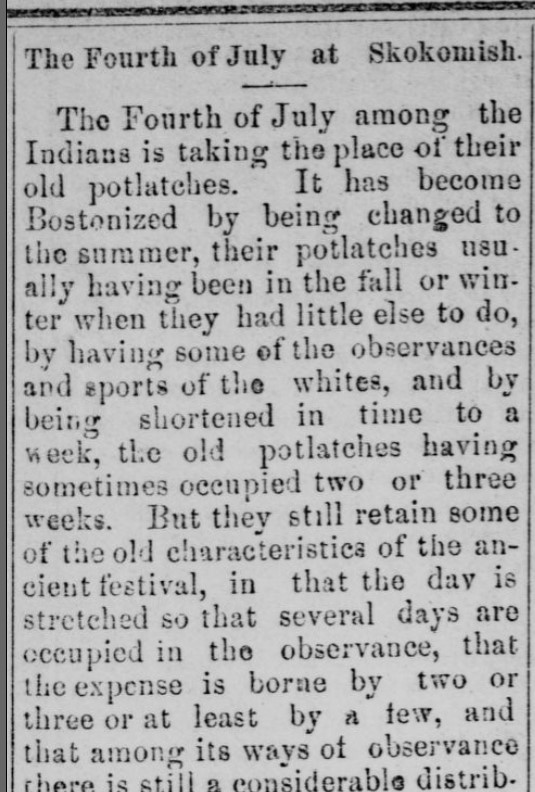
The Fourth of July among the
Indians is taking the place of their
old potlatches [‘giveaways’]. It has become
Bostonized [‘Americanized’] by being changed to
the summer, their potlatches usu-
ally having been in the fall or win-
ter when they had little else to do,
by having some of the observances
and sports of the whites, and by
being shortened in time to a
week, the old potlatches having
sometimes occupied two or three
weeks. But they still retain some
of the old characteristics of the an-
cient festival, in that the day is
stretched so that several days are
occupied in the observance, that
the expense is borne by two or
three or at least by a few, and
that among its ways of observance
there is still a considerable distrib-
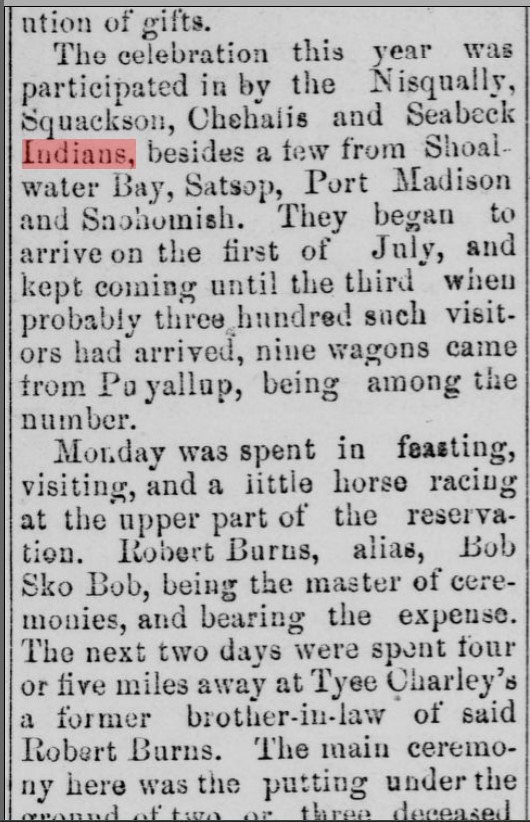
ution of gifts.The celebration this year was
participated in by the Nisqually,
Squackson [Squaxin], [Upper?] Chehalis and Seabeck
Indians, besides a few from Shoal-
water Bay, Satsop, Port Madison
and Snohomish. They began to
arrive on the first of July, and
kept coming until the third when
probably three hundred such visit-
ors had arrived, nine wagons came
from Puyallup, being among the
number.Monday was spent in feasting,
visiting, and a little horse racing
at the upper part of the reserva-
tion. Robert Burns, alias, Bob
Sko Bob, being the master of cere-
monies, and bearing the expense.
The next two days were spent four
or five miles away at Tyee [‘Chief’] Charley’s
a former brother-in-law of said
Robert Burns. The main ceremo-
ny here was the putting under the
ground of two or three deceased
children of Tyee Charley, who died
six or seven years ago and were
then placed in coffins on a platform
about three feet above ground, ov-
er which a small house had been
built. This was really the cause
of the Fourth of July celebration.
At their former potlatches they
often did this with considerable
ceremony,and many years ago
Tyee Charley had intended to
make a potlatch and do this; but
an order having come from govern-
ment forbidding the potlatches, he
changed his plan and determined
on this course, thinking he would
do so a few years ago: Financial
and other troubles however pre-
vented him from doing so then,
and it was put off from year to
year until the present time. Tyee
Charley paid those that did this
work for him a dollar each, and
gave nine old men ten dollars each.
Canoe racing and feasting filled
up the rest of the time. On Wed-
nesday evening Tenas [‘Little / Younger’] Charley gave
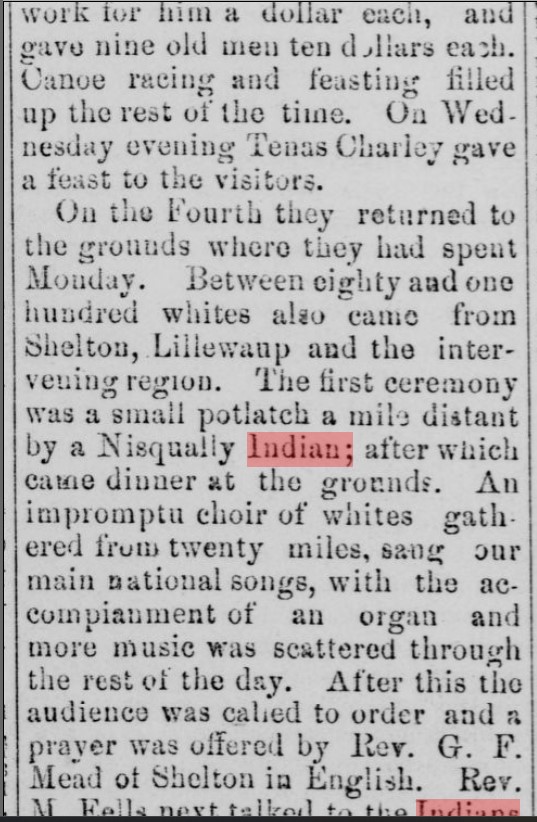
a feast to the visitors.On the Fourth they returned to
the grounds where they had spent
Monday. Between eighty and one
hundred whites also came from
Shelton, Lillewaup and the inter-
vening region. The first ceremony
was a small potlatch a mile distant
by a Nisqually Indian; after which
came dinner at the grounds. An
impromptu choir of whites gath-
ered from twenty miles, sang our
main national songs, with the ac-
compianment [accompaniment] of an organ and
more music was scattered through
the rest of the day. After this the
audience was called to order and a
prayer was offered by Rev. G. F.
Mead of Shelton in English. Rev.
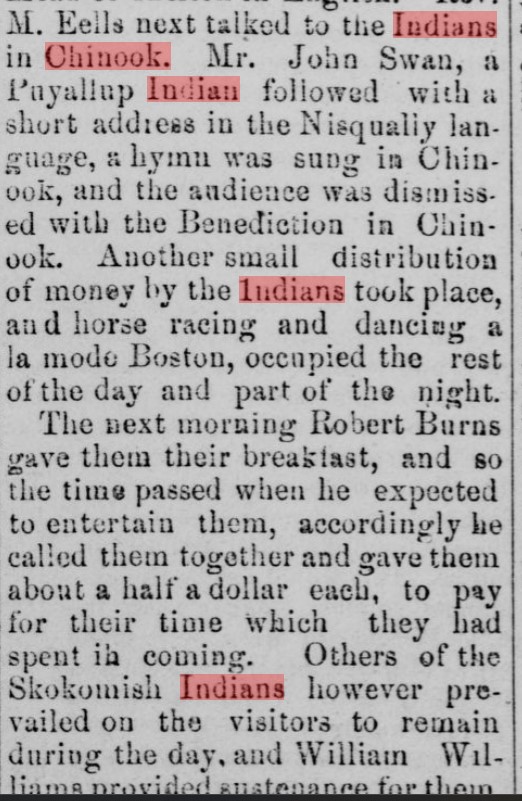
M. Eells next talked to the Indians
in Chinook. Mr. John Swan, a
Puyallup Indian followed with a
short address in the Nisqually lan-
guage, a hymn was sung in Chin-
ook, and the audience was dismiss-
ed with the Benediction in Chin-
ook. Another small distribution
of money by the Indians took place,
and horse racing and dancing a
la mode Boston [‘American / White’], occupied the rest
of the day and part of the night.The next morning Robert Burns
gave them their breakfast, and so
the time passed when he expected
to entertain them, accordingly he
called them together and gave them
about a half a dollar each, to pay
for their time which they had
spent in coming. Others of the
Skokomish Indians however pre-
vailed on the visitors to remain
during the day, and William Wil-
liams provided sustenance for them.
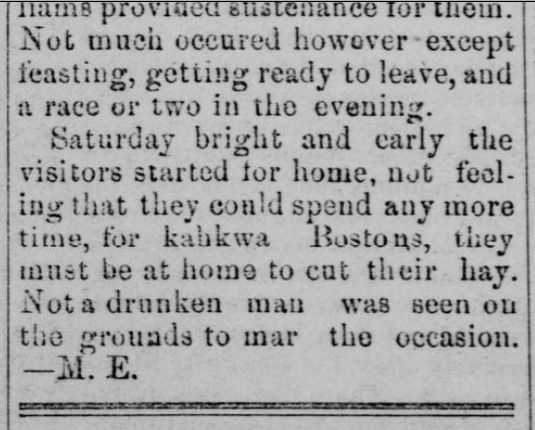
Not much occur[r]ed however except
feasting, getting ready to leave, and
a race or two in the evening.Saturday bright and early the
visitors started for home, not feel-
ing that they could spend any more
time, for kahkwa [‘like’] Bostons, they
must be at home to cut their hay.
Not a drunken man was seen on
the grounds to mar the occasion.
— M. E.
— from the Shelton (Washington Territory) Mason County Journal of July 12, 1889, page 5, column 3
