AF Chamberlain’s field notes of Chinuk Wawa from SE British Columbia (Part 2)
[Link to Part 1.] We can be grateful — Alexander Francis Chamberlain, one of the very first anthropological-linguistics students of Professor Franz Boas, was an early adopter of his teacher’s efforts to create accurate phonetic notation.
The idea was to have a single unique symbol to represent each distinct sound.
Those guys were on the right track! Even though they tended to stick with symbols they had seen in standard European written languages, predominantly Boas’s native German and the influential French, they also came up with novel ways to accurately represent Pacific NW Indigenous sounds such as /ɬ/ and /ə/. (Respectively by “L” and “E”, which work fine except at the beginnings of words…because Chamberlain and Boas held onto the irrelevant European custom of capitalization at the start of sentences and proper names!)
This word list from Chamberlain’s on-the-spot research in Ktunaxa traditional country (the Kootenay region of southeast British Columbia) is apparently the second-earliest document to pretty accurately record Chinuk Wawa’s sounds in a way that shows their difference from Settler colonists’ heritage languages. Horatio Hale’s 1841 research on Fort Vancouver CW, published in the 1846 report of the “US Ex Ex”, was the first.
Even Prof. Boas himself wasn’t so energetic about showing the nuances of CW; his own field notes of stories told circa 1886 by a Tsimshian man largely parrot the English-style spellings found in popular Jargon dictionaries. And the super-productive Father JMR Le Jeune of Kamloops, whose Chinuk Pipa shorthand alphabet boasted of being a “phonography”, fell quite short of capturing exactly what the words sounded like. Even Chamberlain’s own phonetics aren’t as refined as the “Americanist Phonetic Alphabet” or “International Phonetic Alphabet” that are favored by linguists today; he misses the contrast between /q/ and /k/ sounds, and I’m not sure he’s catching all of the /ɬ/ and /t’ɬ/-type sounds.
All in all, though, I’m delighted by the Chamberlain vocabulary. His improved phonetics verify what we have heard in the few audio recordings of northern-dialect speakers, as well as what we’d only been able to infer from the Chinuk Pipa. This stuff is an enormous gift, demonstrating that the distinct northern dialect of Chinuk Wawa indeed had its own pronunciations and stress patterns (as well as the numerous grammatical traits that we’ve already proven to distinguish it from southern CW).
Hayu masi (thanks so much) to my fellow UVic linguist Dale McCreery, for bringing this document to our attention!
Okay, here’s our first installment of the word-list part of Chamberlain’s treasure trove. Any comments by me will be [in italics, in square brackets]:
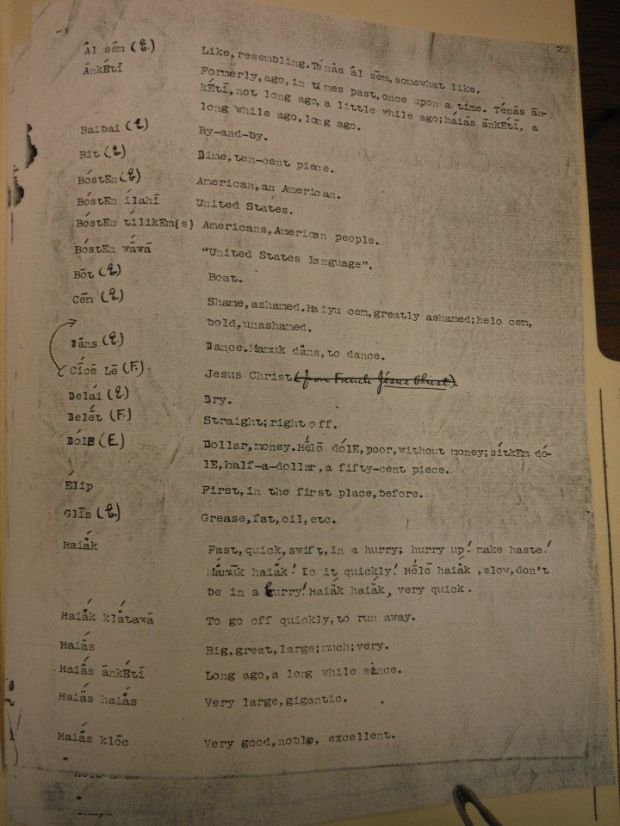
- Âl sēm (E[nglish].) – Like, resembling. [One of the (Chinese) Pidgin English-style words typical of northern CW.] Ténas âl sēm, somewhat like. [A new expression to us!]
- ĀnkÉtī – Formerly, ago, in times past, once upon a time. [Different stress pattern from southern CW, which accents the first syllable.] Ténas ānkÉtī, not long ago, a little while ago; háiās ānkÉtī, a long while ago, long ago.
- Baibai (E) – By-and-by. [More (Chinese) Pidgin English-style vocabulary.]
- Bit (E) – Dime, ten-cent piece.
- BóstEn (E) – American, an American. [I admit I’m skeptical that this was an /o/ sound; I’d expect it might be more like Chamberlain’s “â” in the first item above (especially if British English was a local influencer), or else plain old /a/ as in southern CW. Otherwise Chamberlain was being unduly influenced by standard English spelling. The same applies to DólE et al. below.]
- BóstEn ílahī – United States.
- BóstEn tílikEm(s) – Americans, American people. [With the optional “s” plural from English.]
- BóstEn wā́wā – “United States language”.
- Bōt (E.) – Boat.
- Cēm (E.) – Shame, ashamed. [“C” for the “sh” sound.] Haiyu cem, greatly ashamed, helo cem, bold, unashamed.
- Däns (E.) – Dance. [The first of many words here having the same vowel as in my native English “dance”.] Mamuk däns, to dans.
- Cīcē Lē (F[rench] .) – Jesus Christ. [“L” for the /ɬ/ sound, apparently, which is a fascinating Nativization.]
(from French JésusChrist). - Delái (E.) – Dry.
- Delḗt (F.) – Straight; right off.
- DólE (E.) – Dollar, money. Hḗlō dólE, poor, without money; sítkEm dólE, half-a-dollar, a fifty-cent piece.
- Élip [“É” for the same sound as at the end of “sauté”.] – First, in the first place, before.
- Glīs (E.) – Grease, fat, oil, etc.
- Haiä́k – Fast, quick, swift, in a hurry; hurry up! make haste! Mä́mūk haiä́k! Do it quickly! Hḗlō haiä́k, slow, don’t be in a hurry! Haiä́k haiä́k, very quick. [Not a southern-CW-style productive reduplication, where it would have to mean something like ‘fast all over the place’. Instead, just a way of emphasizing, as in my native English.]
- Haiä́k klä́tawā – To go off quickly, to run away.
- Haiä́s – Big, great, large; much; very.
- Haiä́s ānkÉtī – Long ago, a long while since.
- Haiä́s haiä́s – Very large, gigantic. [Again, just a way of emphasizing by repeating the word. Not southern-CW-style productive (distributive action/”pluractional”) reduplication.]
- Haiä́s klōc – Very good, noble, excellent.
