Harry Guillod’s journal of a trip to Cariboo, 1862
Harry/Henry Guillod (1838-1906) came from Britain to BC in the Cariboo gold rush of 1862, and wrote about it charmingly.
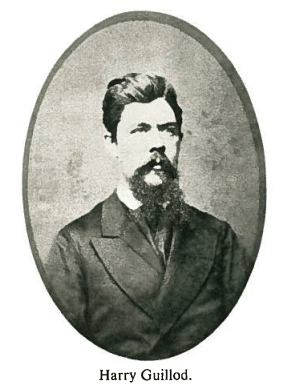
Dorothy Blakey Smith edited Guillod’s amusing journal of that trip and published it in the British Columbia Historical Quarterly in 1955.
It’s worded as a letter-diary addressed to a loved one, with plenty of good humor.
Clear from many textual clues is that it was written, or re-written, some time after the events narrated; for instance Guillod sometimes overtly refers in one day’s entry to a specific event quite some time in the future that he couldn’t yet have known of.
There’s very little Chinuk Wawa here, as Guillod had just reached the BC Coast from England when he immediately went inland to the Cariboo region.
He couldn’t have learned must of the language yet, unless he possessed written learning materials that he gives no sign of.
On page 198 it’s purely a coincidence that a BC merchant, who later became Mayor of Victoria, was named Selim Franklin! Sélim is BC Chinook Jargon for ‘sell’, as opposed to mákuk ‘buy’.
Page 200 — apparently at Douglas [Lake] on the mainland (thus Lower St’át’imc a.k.a. Lillooet Salish lands), we have the first use of Chinook Jargon in Guillod’s journal:

…the papoose [papus, ‘baby’] has on an apology for a shirt which I suppose has once been white; (I am not very clear on the subject of its clothing, but I remember it was as little as possible and very dirty:) the girl, who I suppose was the daughter of a Tyce [tayi] or chief, had armlets and anklets of plain brass, like twisted stair-rods and a very dirty blanket twisted round her.
Page 201’s entry for July 11 has a footnote explaining that Guillod is currently at Tenas Lake a.k.a. Little Lillooet Lake. That’s a purely Jargon place name, tənəs-leyk, ‘little lake’.
From page 204 and elsewhere following, we see that there were already Chinese miners present in mainland BC in 1862. This helps us understand why a number of Chinese Pidgin English-like words show up in northern-dialect Chinuk Wawa.
Page 227, on October 7th, near Scotty’s House between Loon Lake & the Thompson River (near Bonaparte Lake?), “some half-breed women” are amused by watching Guillod’s party crossing “a particularly slight bridge” over a creek. I’m not really sure this refers to Métis people as a cultural group. The location isn’t particularly close to the old fur-trade brigade routes or forts, as far as I’m aware.
Page 228, October 10th, near Cooks Ferry BC:

My moccasins had now pretty well taken themselves off bodily and for some days past I had had to collect pieces of rag &c in my march, with which to tie them up, so that, as a squaw compassionately observed my feet look “hy-you sick”; in fact, with a little starving I should have made a first-rate beggar for London Streets[.]
“Hy-you sick” = hayu-sik, literally ‘much-sick’, with a frequent northern-dialect blurriness between hayu and the intensifying prefix hayas- ‘very’.
Page 230-231 tell us a number of Jargon expressions and some of the most well-known customs connected with northern-dialect Jargon use:
. . .

. . .

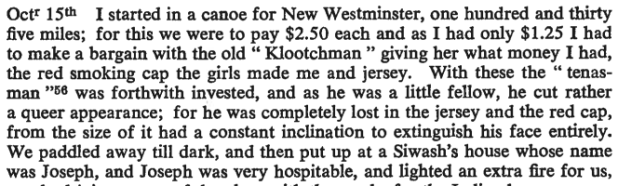
I started in a canoe for New Westminster, one hundred and thirty five miles; for this we were to pay $2.50 each and as I had only $1.25 I had to make a bargain with the old “Klootchman” [ɬúchmən, ‘woman’] giving her what money I had, the red smoking cap the girls made me and jersey. With these the “tenas-man” [tənəs-mán ‘boy’] was forthwith invested, and as he was a little fellow, he cut rather a queer appearance…We paddled away till dark, and then put up at a Siwash‘s house [sáwásh ‘Native person’] whose name was Joseph…[There were an] oldish good-natured looking chap; a wrinkled old woman all skin and bone who was very ill apparently dying; a young man with his “Klootchman” and several papooses. Joseph got out a lot of papers he had had from different Englishmen testifying that he was “a jolly good fellow”, “kind and obliging to white people”[,] “honest” &c[.] These were all carefully preserved with his marriage certificate and one or two little religious prints although he could not read a word of them himself. We also gave him a testimonial signed by the whole party. These people were Roman Catholics, and before settling for the night all went into a corner and recited their prayers, as I suppose, men, women and children joining in a monotonous chant…After witnessing the peculiar ablutions of the squaw and papooses and when the family had again performed their prayers, we shook hands all round[,] a ceremony of which they think a great deal, and again got under way.
Guillod is hitting all the main points here, telling us about skookum papers, the Native style of chanting prayers that we have audio recordings of in Chinook Jargon, and the shik-hants ‘shake-hands’ ceremony that visitors encountered all over CJ-speaking British Columbia.
All told, this is just enough to sharpen your appetite and get to click that link above. Go read Guillod’s journal!
