1933 doggerel: “Chinook and Chinee”
This post-frontier poem amounts to a southeast Alaska variation on the classic Pacific Northwest “sitkum dolla” joke!
It’s an improvement thereupon, in the sense that it plays with not just one, but two, pidgin languages being misunderstood, while the narrator ties it all together in standard English.
The characters here are:
- a male Chinese immigrant, who to my surprise talks older-fashioned Chinese Pidgin English instead of the usual newer West Coast style, but still uses a Chinook Jargon loanword;
- and a coastal Native man, a Lingít (Tlingit) judging from the geography, his name, and the fact that he speaks northern-dialect Chinook Jargon, accurately laced with recent informal-English loanwords.
Do you really need me here to point out that this is going to be some heavily racialized, blunt, working-class humor from the past?
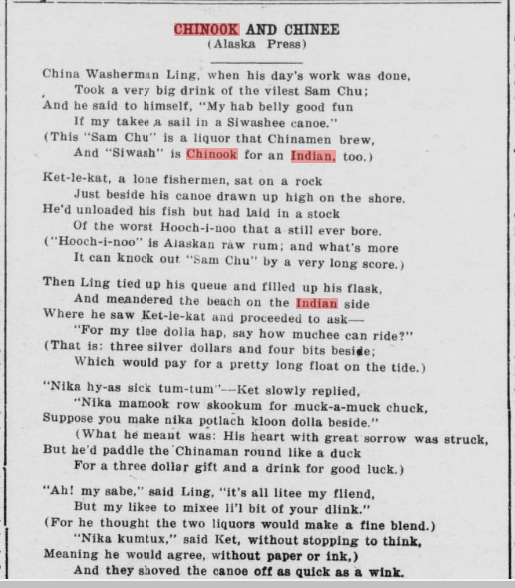

CHINOOK AND CHINEE
([Juneau,] Alaska Press)China Washerman Ling, when his day’s work was done,
Took a very big drink of the vilest Sam Chu;
And he said to himself, “My hab belly good fun
If my takee a sail in a Siwashee canoe.”
(This “Sam Chu” is a liquor that Chinamen brew,
And “Siwash” is Chinook for an Indian, too.)Ket-le-kat, a lone fishermen [sic], sat on a rock
Just beside his canoe drawn up high on the shore.
He’d unloaded his fish but had laid in a stock
Of the worst Hooch-i-noo that a still ever bore.
(“Hooch-i-noo” is Alaskan raw rum; and what’s more
It can knock out “Sam Chu” by a very long score.)Then Ling tied up his queue and filled up his flask,
And meandered the beach on the Indian side
Where he saw Ket-le-kat and proceeded to ask —
“For my tlee dollar hap, say how muchee can ride?”
(That is: three silver dollars and four bits beside;
Which would pay for a pretty long float on the tide.)“Nika hy-as sick tum-tum” — Ket slowly replied,
“Nika mamook row skookum for muck-a-muck chuck,
Suppose you make nika potlach kloon dolla beside.”
(What he meant was: His heart with great sorrow was struck,
But he’d paddle the Chinaman round like a duck
For a three dollar gift and a drink for good luck.)“Ah! my sabe,” said Ling, “it’s all litee my fliend,
But my likee to mixee li’l bit of your dlink.”
(For he thought the two liquors would make a fine blend.)
“Nika kumtux,” said Ket, without stopping to think,
[(]Meaning he would agree, without paper or ink,)
And they shoved the canoe off as quick as a wink.So they paddled and sailed till far out on the Bay.
Each one drank a big drink of his favorite “booze,”
And they touched their cups, too, in a civilized way
With the compliments high-toned Americans use,
(Such as: “Since you invite me I cannot refuse;”
“Here’s the hair off your head” and “Here’s death to the blues.”)Then they blended sam shu and the hooch-i-noo, too; —
But, alas! in a second — ’twas fearful to see —
Shot a huge sheet of flame from that fated canoe
With a sudden sharp sound, — and nowhere on the sea
Was a trace to be found of that terrible spree
In the Siwash canoe of Chinook and Chinee.— J.S.B.
— from the Wrangell (AK) Sentinel of August 4, 1933, page 2, columns 3 & 4
Being published so long after Chinuk Wawa and Chinese Pidgin English were universally understood in the Northwest, naturally a translation is provided.
Do you understand what went on in this poem?
