1892: Les Crees ilihi
Is this “les Cris” (the Crees)?
I’m accustomed to seeing those folks called Kri (from the English word) in northern Chinuk Wawa:
Iaka shanti kopa nsaika iht iht shanti kopa Kri lalan.g: iht shanti iaka kakwa:
‘He sang for us this & that song in the Cree language: one song went like this:’Sasii manito awasis / aiisiininak* wichihiwi / sasii manito awasis / pitlihimik nitawikyu
— Kamloops Wawa #137 (February 1896), page 36
(Hey readers — if you know that Cree hymn, please let me know the lyrics & meaning!)
Wiht mokst liplit shako kanamokst iaka…iht iaka nim Pir Lakomb, iaka mamuk kopa Kri tilikom.
‘Two more priests came along with him…one was named Pere Lacombe, who works with the Cree people.’
— Kamloops Wawa #118b (July 1894), page 131
So I was surprised to realize that the following is a lapse into French, about which I’ll say more below:
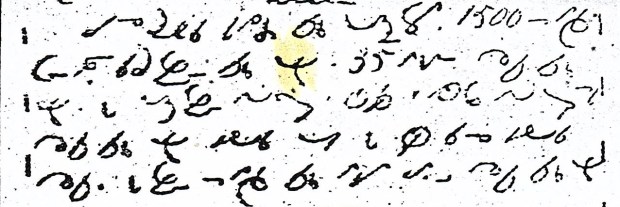
Alta nsaika kilapai kopa Sin Mari. < 1 500 > tilikom
‘Then we went back to Saint Mary’s. There were 1,500 people’mitlait kanamokst kopa SM. < 35 > liplit chako kopa
‘gathered together at St. M’s. There were 35 priests that came to’SM, pi sinmokst lisivik. Ukuk xlwima lisivik tiki
‘St. M’s, and seven bishops. Those other bishops who wanted’chako kopa SM klaska sik pi wik kata klaska
‘to come to St. M’s were sick and couldn’t’chako, pi mokst tilikom kopa Likri ilihi chako kopa SM.
‘come there, but two people from the Crees’ country came to St. M’s.’
— from Kamloops Wawa #29[b], 12 June 1892, page 151
Why is this so worthy of comment?
J.M.R. Le Jeune, the editor and writer of most of the Kamloops Wawa newspaper, did not characteristically drop French words into his Chinuk Wawa.
Once in a great while, he’d say some CW words that were influenced by his childhood language, European French. For example, there are a few instances of him writing e.g. pus naika to mean ‘for me’. Compare French pour moi, and contrast this with northern CW kopa naika. (Unlike southern CW, the north doesn’t use pus to mean ‘for’ a person.)
But he almost never slipped up & used actual French words while talking Jargon.
So I think this Likri is locally common Métis French of southern interior British Columbia. I’ve shown many times that plenty of fluent Chinook Jargon speakers in that region also spoke Métis “French of the Mountains”. FOTM influenced the area’s tribal languages and CJ. And FOTM should be expected to have a common word for ‘Cree’, considering that the recent fur trade era in BC had brought numerous part-Cree Métis people to BC, who formed lasting communities there.
It’s funny that until today, I don’t think I had ever looked for the Michif (Métis mixed Cree-French) language’s word for ‘Cree’! I’m surprised to not find a word for it in the 3 major online dictionaries. But in the Turtle Mountain, North Dakota dictionary (kichi-maarsi to Dr. Dale McCreery for a copy of it!), I find < li Cree, en Cree, awn Cree > for ‘the Cree (language), a Cree (person), in Cree’.
That’s a good match.
The alternative hypothesis, that Le Jeune’s Chinuk Wawa word Likri is him talking “formal” French, seems a far reach. When talking Jargon & writing in Kamloops Wawa, he was explicitly talking to Native people. Formal French was a language he used with other White priests and a few White Settlers. But he always made clear that French as spoken by local Indigenous people was a completely different form of speech, and that those folks wouldn’t understand his formal French.
So my analysis is, Likri is a BC Chinuk Wawa word that comes from Métis French.
Bonus fact:
Where is this Likri ilihi? For Le Jeune as an Oblate (Catholic) missionary in British Columbia, he’s most likely speaking of nearby portions of what were then called the North-West Territories of Canada…modern Alberta and Saskatchewan.
