1922: The Indian Shaker religion
There is very good information here about Indian Shaker Church use of Chinuk Wawa…

John Slocum (image credit: Squaxin Island Tribe)
It’s from a (standard variety) Christian missionary, so it shows a number of prejudices, but it also reports accurate personal experience of the I.S.C.
So here you have it:
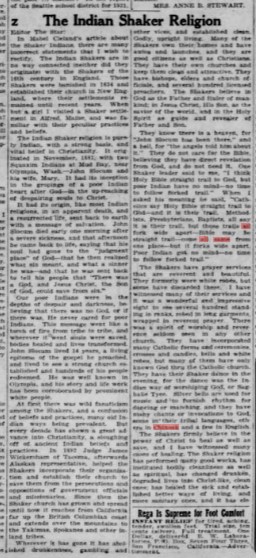
The Indian Shaker Religion
Editor The Star:
In Mabel Cleland’s article about the Shaker Indians, there are many incorrect statements that I wish to rectify. The Indian Shakers are in no way connected (neither did they originate) with the Shakers of the 16th century in England. Those Shakers were banished in 1634 and established their church in New England, where their settlements remained until recent years. When but a girl I visited a Shaker settlement in Alfred, Maine, and was familiar with their peculiar practices and beliefs.
The Indian Shaker religion is purely Indian, with a strong basis, and vital belief in Christianity. It originated in November, 1881, with two Squaxim [Squaxin] Indians at Mud Bay, near Olympia, Wash. — John Slocum and his wife, Mary. It had its inception in the gropings of a poor Indian heart after God — in the up-reaching of despairing souls to Christ.
It had its origin, like most Indian religions, in an apparent death, and a resurrected life, sent back to earth with a message of salvation. John Slocum died early one morning after a severe sickness, and that afternoon he came back to life, saying that his soul had gone to the “judgment place” of God — that he then realized what sin meant, and what a sinner he was — and that he was sent back to tell his people that “There was a God, and Jesus Christ, the Son of God, could save from sin.”
Our poor Indians were in the depths of despair and darkness, believing that there was no God, or if there was, He never cared for poor Indians. This message went like a torch of fire from tribe to tribe, and wherever it went souls were saved, bodies healed and lives transformed. John Slocum lived 14 years, a living epitome of the gospel he preached, and lived to see a strong church established and hundreds of his people redeemed. He was well known in Olympia, and his story and life work has been corroborated by prominent white people.
At first there was wild fanaticism among the Shakers, and a confusion of beliefs and practices, many old Indian ways being prevalent. But every decade has shown a great advance into Christianity, a sloughing off of ancient Indian beliefs and practices. In 1892 Judge James Wickersham of Tacoma, afterwards Alaskan representative, helped the Shakers incorporate their organization and establish their church to save them from the persecutions and oppositions of government officials and missionaries. Since then the Shaker church has grown and spread far up the British Columbian coast and extends over the mountains to the Yakimas, Spokanes and other inland tribes.
Wherever it has gone it has abolished drunkenness, gambling and other vices, and established clean, Godly, upright living. Many of the Shakers own their homes and have autors and launches, and they are good citizens as well as Christians. They have their own churches and keep them clean and attractive. They have bishops, elders and church officials, and several hundred licensed preachers. The Shakers believe in God as the Father and Ruler of mankind; in Jesus Christ, His Son, as the savior of the world, and the Holy Spirit as guide and revealer of Father and Son.
They know there is a heaven, for “John Slocum has been there,” and a hell, for “the angels told him about it.” They do not care for the Bible, believing they have direct revelation from God, and do not need it. One Shaker leader said to me, “I think Holy Bible straight trail to God, but poor Indian have no mind — no time to follow forked trail.” When I asked his meaning he said, “Catholics say Holy Bible straight trail to God — and it is their trail. Methodists, Presbyterians, Baptists, all say it is their trail, but those trails all fork wide apart — Bible may be straight trail — come all same from one place — but it forks wide apart. Poor Indian got no mind — no time to follow forked trail.”
The Shakers have prayer services that are reverent and beautiful. They formerly wore white robes, but some have discarded these. I have witnessed many of their services and it was a wonderful and impressive sight to see several hundred standing in ranks, robed in long garments, wrapped in reverent prayer. There was a spirit of worship and reverence seldom seen in any other church. They have incorporated many Catholic forms and ceremonies, crosses and candles, bells and white robes, but many of them have only known God thru the Catholic church. They have their Shaker dance in the evening, for the dance was the Indian way of worshiping God, or Saghalie Tyee. Silver bells are used for music and to furnish rhythm for dancing or marching, and they have many chants or invocations to God, some in their tribal languages, others in Chinook and a few in English.
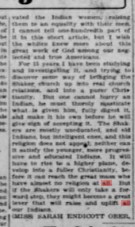
The Shakers firmly believe in the power of Christ to heal as well as save, and I have witnessed many cases of healing. The Shaker religion has performed many good works, has instituted bodily cleanliness as well as spiritual, has changed drunken, degraded lives into Christ-like, clean ones; has healed the sick and established better ways of living, and more sanitary ones, and it has elevated the Indian women, raising them to an equality with their men. I cannot tell one-hundredth part of it in this short article, but I wish the whites knew more about this great work of God among our neglected and true Americans.
For 15 years I have been studying and investigating it, and trying to discover some way of bringing the Shaker church up into real church relations, and into a purer Christianity. But one cannot hurry an Indian, he must thoroly masticate what is given him, fully digest it, and make it his own before he will give any signs of accepting it. The Shakers are mostly uneducated, and old Indians, but intelligent ones, and this religion does not appeal; neither can it satisfy the younger, more progressive and educated Indians. It will have to rise to a higher plane, develop into a fuller Christianity, before it can reach the great mass who have almost no religion at all. But if the Shakers will only take a forward step, they might become a great lever that will raise and uplift all our Indians.
(MISS) SARAH ENDICOTT OBER.
— from the Seattle (WA) Star of April 15, 1922, page 7, columns 3-5
Some of those elements like the downplaying of Bible-reading and the ritual use of bells, robes, and such sound very strongly influenced by Catholicism as we know it to have been presented to the southern Puget Sound Native people by Chinuk Wawa-speaking missionaries starting circa 1840.
