Lempfrit’s legendary, long-lost linguistic legacy (Part 12)
Can you explain to me why
isik ‘paddle’ is translated as
fondu ‘melted’?
Oh, a more important point — I’ve been underlining all material that Lempfrit has, that the Anonymous (Pinart) 1849 version lacks.
YOU CAN UNDERLINE THIS ENTIRE BLOG POST .
Once again Lempfrit’s manuscript is quite the little treasure!
12th pair of pages
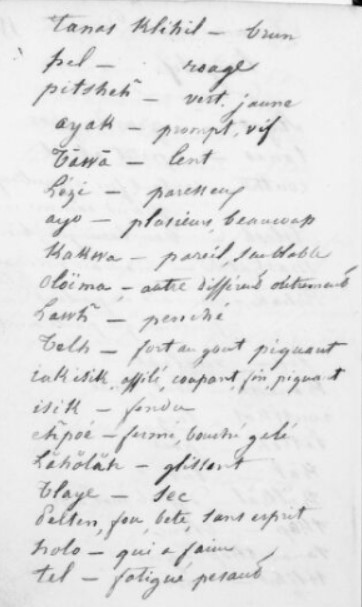
tanas klihil – brun
‘brown’
(Literally, ‘little black’.) pel – rouge
‘red’pitsheh̃ = vert, jaune
‘green, yellow’ayak – prompt, vif
‘quick, lively’Tāwā [SIC] – lent
‘slow’Lézi – paresseux
‘lazy’ayo – plusieurs, beaucoup
‘several, many/much’kakwa – pareil, semblable
‘same, similar’oloïma – autre(,), différent(,), outrement*
‘other, different, besides*’Lawh̃ – penché
‘leaning’Telh* [SIC] – fort au* gout piquant
‘strong with a spicy taste’iakisik [SIC], affilé, coupant, fin, piquant
‘filed sharp, sharp enough to cut with, fine, stabbingly sharp’isik – fondu*
‘melted*’ (!)eh̃poé – fermé, bouché*, gelé
‘closed, plugged, frozen’Lăh̃olăh – glissant
‘slippery’Tlaye – sec
‘dry’Pelten , fou, bete, sans esprit
‘crazy, dumb, mindless’Holo – qui a faim
‘hungry’tel – fatigué(,) pesant
‘tired, heavy’
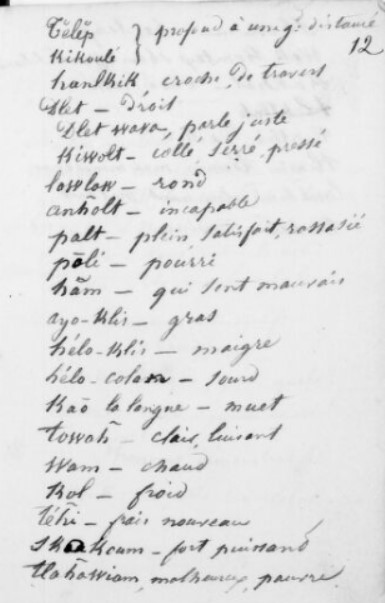
Tĕlĕp } profond à une gᵈ distance Kikoulé }hanlkik, croche, de travers ‘crooked, awry’Dlet – droit ‘straight’Dlet wava [SIC], parle juste ‘speaks right’kiwolt – collé, serré , pressé ‘glued, clamped, pressed’lowlow – rond ’round’anh̃olt [SIC] – incapable ‘unable’palt – plein, satisfait, rassasié ‘full, satisfied, satiated’pōli – pourri ‘rotten’hăm – qui sent mauvais ‘stinky’ayo-klis – gras ‘fat’ (fleshy)(Literally, ‘much-grease’.) hélo-klis – maigre ‘skinny’(Literally, ‘no-grease’.) hélo-colan – sourd ‘deaf’(Literally, ‘no-ear(s)’.) kaō la langue – muet ‘mute’(Literally, ‘tongue is tied up’.) towah̃ – clair, luisant ‘bright, shining’wam – chaud ‘warm’kol – froid ‘cold’Téh̃i [SIC] – frais(,) nouveau ‘fresh, new’skoukoum – fort(,) puissant ‘strong, powerful’tlah̃awiam, malheureux, pauvre ‘unfortunate, poor’
qʰata mayka təmtəm? What do you think?