“Pom-pom” and púmpum(-t’əmànəwas)
As a general US English word around 1900, “pompom” (or pompon) meant a certain sort of decoration to ladies’ hats and slippers.

“Interior of a tule-mate longhouse, with Puck Hyah Toot (prophet of the Dreamer Religion and nephew of Smohalla). The Washat or Seven Drums Longhouse Way, practiced today by the Columbia River Sahaptan peoples, was strongly influence by Smohalla. Wanapum near Priest River Rapids.” (Image credit: Rodney Frey’s pages at University of Idaho)
In the Boer War in South Africa, it seems to have been a type of big gun.
As people did in that era, a reader wrote to a newspaper editor for clarification about all of this, and the following explanation was published, showing a further sense of this noun as “an Indian dance”:

— from the Washington (DC) Evening Star of April 20, 1927, page 8, column 7
Relatedly, I’ve seen “pom-pom” / “pom pom” / “pompom” used in that time for the sound of — specifically — Native drums. This may be one of those widespread North American English terms related to Native people, a set that includes “papoose” and “tipi”, that could’ve wound up in Chinook Jargon from Settler speech.
Here an advertisement for a civic 4th of July celebration in Yakima that lists among the “doings” a parade including “pom poms” along with “Indians” and soldiers — so I’m not sure whether it’s meant as military guns or Indigenous-style drumming:

— from the Kennewick (WA) Courier of June 27, 1913, page 8, columns 4-5
Around a certain stretch of the Columbia River drainage here in the Pacific Northwest, several sources have claimed, and evidence indicates, that the sense of “an Indian dance”, as it was phrased above, also existed in Chinook Jargon, but with the more specific meaning of a Native religious ritual. See the entry for púmpum in the superb 2012 dictionary from the Confederated Tribes of Grand Ronde. As I understand things, this spiritual practice is also known as the Seven Drums religion or Washat.
In that Inland area, we find plenty of occurrences of this word in print, both by itself and as part of larger phrases. (One piece of fiction set among the Yakamas speaks of “the Pom-Pom house” where “medicine-men” are curing someone. The Chinook Jargon in that story isn’t the best, so I’m not confident inferring there was a CJ phrase púmpum-hàws.)
Here’s a Native “pom pom / pom pom dance” being given the synonyms “Chinook dance” (which we’ve seen before on my site) and “grass dance”:
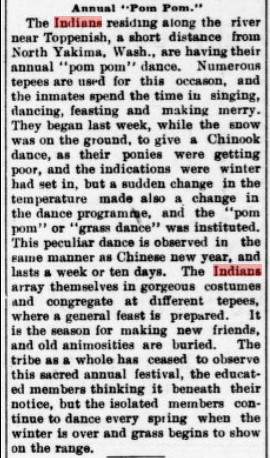
— from the Friday Harbor (WA) San Juan Islander of March 8, 1900, page 4, column 2
Here “pom pom” is used to label the curing ceremonies associated with this kind of dancing, synonymized as “pom-pom ta-mah-na-mus” and as a specific kind of the thing generally known as “ta-mah-na-mus” (right-click to open this image in a separate window, to zoom in on it):

— from the Pendleton (Oregon) East Oregonian of January 21, 1908, page 2, column 5
And here “a pompom” means the overall ceremony, not just the dancing, praying, or curing:

— from the Olympia (WA) Washington Standard of June 30, 1893, page 3, column 6
This article, too, uses the word for the entire religious observation — I kind of like the sub-headline “red men worship the earth” –:
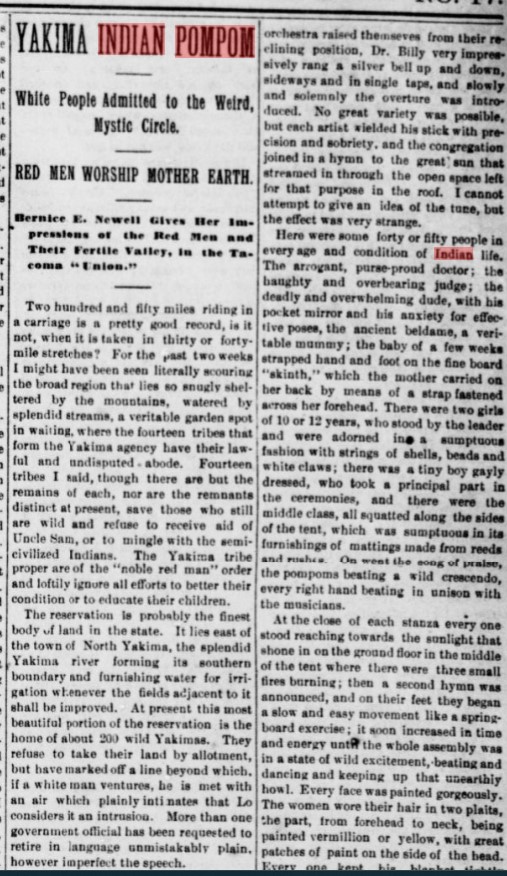
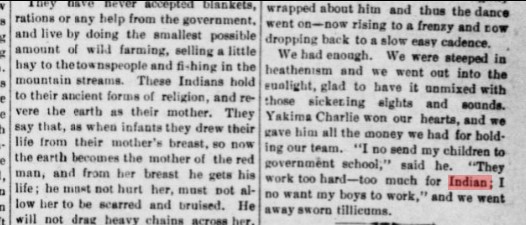

— from the Yakima (WA) Herald of May 17, 1894, page 1, column 7
The evidence indicates that local Settlers used this word in English, but also that it had to be explained sometimes.
In this vein, you can see that Settlers were not always clear about how to understand “pompom”, applying it to cultural practices that some would consider entirely distinct from each other: dances to encourage the warm Chinook wind to come, healing ceremonies, observations connected with the salmon runs, and so forth.
“Pompom” is certainly found in association with Chinuk Wawa, as we see above.
