1892: Shorthand Chinook in Oregon courts
The tone of today’s news clipping is flippant.
But its timing is fascinating.
This little squib was published in Oregon when the Kamloops Wawa newspaper up in British Columbia was starting to become somewhat famous for its own shorthand Chinuk Wawa contents:
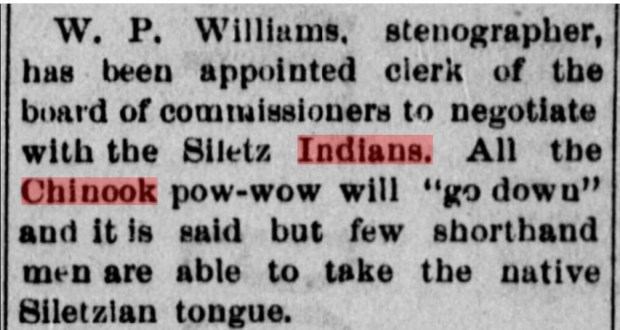
W.P. Williams, stenographer, has been appointed clerk of the board of commissioners to negotiate with the Siletz Indians. All the Chinook pow-wow will “go down” and it is said but few shorthand men are able to take the native Siletzian tongue.
— from the Salem (OR) Evening Capital Journal of October 12, 1892, page 3, column 5
It’s somewhat doubtful that anyone would’ve been taking detailed notes of what was said, except in English…experience shows us this.
What’s connected with reality about the above is that whatever those negotiations were about, they almost certainly happened via the medium of Chinook Jargon.
Any secretary involved probably knew and used one of the styles of shorthand common in American business circles — Gregg or Pitman, let’s say — although not the Duployan of Kamloops Wawa.
W.P. Williams also had the then-specialized professional skill of typewriting, as this ad shows:

— from the same newspaper, September 2, 1889, page 1, column 1
As for the “native Siletzian tongue”, this could be any of several, if it doesn’t seriously mean CJ.
Siletz Reservation, like Grand Ronde, was an amalgam of numerous tribal peoples.
Perhaps the most widely spoken Indigenous language was Tolowa / Siletz Dee-ni / Oregon Coast Athabaskan, which in 2023 still has speakers & is being vigorously promoted.
There are free lessons & videos, and an online Talking Dictionary.
