“The Coming of the Chinook”
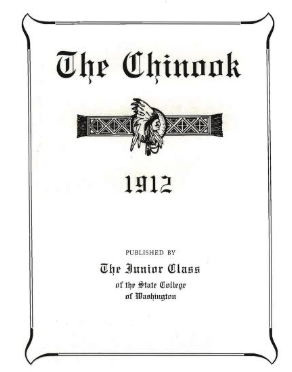
From the eponymous “Wazzu” yearbook.
It’s a bookish little piece, not quite a story but more an essay on the Chinook wind…
Its Jargon is pretty good, with the somewhat rare feature of using < kopa > like an existential copula “there is…” It’s plausible that the writer had in mind what we now find in the 2012 Grand Ronde dictionary as kʰapá ‘there’ — an adverb — plus a “null” be-verb. We can’t quite tell, and because < kopa > is almost always a preposition (within this same story it’s used to mean ‘for; with’ etc.), my treatment below takes the simplest possible approach: assuming that a handwritten draft had its punctuation messed up in the typesetting process. In other words, I’m treating some of the periods as commas, in order to make the most sense of the Chinuk Wawa.
Below, I’ve added some other information between the lines of Jargon and English, plus footnotes.
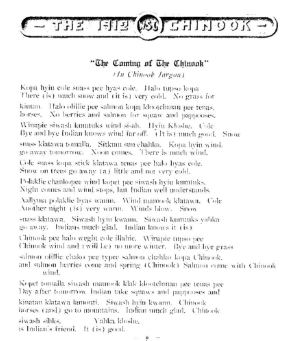
“The Coming of The Chinook”
(In Chinook Jargon)Kopa hyiu cole snass pee hyas cole. Halo tupso [1] kopa
kʰapa háyú kʰúl-snás pi háyás kʰúl, hílu tə́psu kʰapa
There (is) much snow and (it is) very cold. No grass forkiutan. Halo olillie pee salmon kopa klootchman pee tenas.
kʰíyutən, hílu úlali pi sámən kʰapa łúchmən pi tənás.
horses. No berries and salmon for squaw and pappooses.Winapie [2] siwash kumtuks wind [3] si-ah. Hyiu Kloshe. Cole
wínapi (?) sáwásh kə́mtəks wín sayáaa. hayu-łúsh. kʰúl-
Bye and bye Indian knows wind far off. (It is) much good. Snowsnass klatwa tomalla. Sitkum sun chahka. Kopa hyiu wind.
snás łátwa tumála. sítkum-sán cháku. kʰapa háyú wínt.
go away tomorrow. Noon comes. There is much wind.Cole snass kopa stick klatawa tenas [4] pee halo hyas cole.
kʰúl̓-snás kʰapa stík łátwa tánas (?) pi hílu hayas-kʰúl.
Snow on trees go away (a) little and not very cold.Polaklie chankopee wind kopet pee siwash hyiu kumtuks.
púlakʰli cháku pi wínt kʰapít pi sáwásh hayu-kə́mtəks.
Night comes and wind stops, but Indian well understands.Aallyma polaklie hyas waum. wind mamook klatawa [5]. Cole
x̣lúyma púlakʰli hayas-wám. wín mamuk-ɬátwa. kʰúl-
Another night (is) very warm. Winds blow. Snowsnass klatawa Siwash hyiu kwann [6]. Siwash kumtuks yahka [7]
snás ɬátwa. sáwásh hayu-q’wə́n (?). sáwásh kə́mtəks yáka
go away. Indians much glad. Indian knows it (is)Chinook pee halo weght cole illahie. Winapie tupso pee
chinúk pi hílu wə́x̣t kʰúl-ílihi. wínapi (?) tə́psu pi
Chinook wind and (will be) no more winter. Bye and bye grasssalmon olillie chako pee typee salmon chahko kopa Chinook.
sámən-úlali cháku pi táyí-sámən cháku kʰapa chinúk.
and salmon berries come and spring (Chinook) Salmon come with Chinook wind.Kopet tomalla siwash mamook klak [8] klootchman pee tenas pee
kʰapít tumála sáwaásh mamuk-łáq łúchmən pi tənás pi
Day after tomorrow Indian take squaws and pappooses andkiuatan klatawa lamonti. Siwash hyiu kwann. Chinook
kʰíyutən łátwa Ø [9] lamətáy. sáwásh hayu-q’wə́n (?). chinúk
horses (and) go to mountains. Indian much glad. Chinooksiwash sihks [10]. Yahka kloshe.
sáwásh-síks. yáka łúsh.
is Indian’s friend. It (is) good.
— The Washington State College Chinook yearbook, 1912, page 224
FOOTNOTES:
[1] < tupso > is a well-documented alternate pronunciation of < tipso >.
[2] < winapie > is an infrequent Jargon word, whose exact pronunciation we don’t quite know. It’s one of the oldest Chinuk Wawa words, having come in from the Nootka Jargon of coastal British Columbia. There it originated from the Nuuchahnulth language, which has wiinapi ‘stop; pause’. Obviously the meaning has shifted!
[3] < wind > might reflect just an English-speaking writer’s habits, or an actual pronunciation differing from the common wín. Or both.
[4] < tenas > : I’m curious to know how to pronounce this adverb. At Grand Ronde, there’s a distinctive pronunciation tunús for this meaning of ‘a little bit’.
[5] < mamook klatawa > technically ought to have a causative meaning, ‘make go; send’. The writer appears to use < mamook > as a generic verb-former…keep reading.
[6] < kwann > : here’s another well-documented early Jargon word whose pronunciation we don’t technically know. I have a belief that this word comes from Southwest Washington Salish, likely Lower Chehalis. Although we haven’t yet found a match for it in that language, the sister languages are “close enough for jazz”: ‘happy’ in Cowlitz is ʔac-q̓ʷól̓-ł, in Upper Chehalis ʔac-q̓ʷó·l-ł, in Quinault q̓ʷó·l-ł. Those all share a root q̓ʷó(·)l that could match < kwann > because there’s a frequent variation between L’s and N’s in the local pronunciation habits of Lower Chinook / Shoalwater / Clatsop / Lower Chehalis country. (This etymology has not to my knowledge been suggested before.)
[7] < yahka > in the most grammatical Jargon ought to refer to a human. A typical workaround, then, to express a subject ‘it’, would be ukuk ‘this/that’.
[8] < mamook klak > is another verb used in a slightly unusual way; it normally means ‘to remove something inanimate’. Seeing the word with a human direct object is odd to me.
[9] < klatawa Ø lamonti > : Here is a definite example of a “null” preposition: ‘go ___ mountain(s)’.
[10] < sawash sihks > : This is an established variant way of expressing “close” (inalienable) possession, usually seen with kinship words or priceless possessions like houses. Instead of the general pattern, which would give you < sawash yahka sihks > (‘Indian his friend’), you just say ‘Indian friend’.

Pingback: I’m afraid this won’t be a very tame post… | Chinook Jargon