“Carryall”, Jargon sleighs, & French influence
It seems that I’ve written and written about newfound Chinuk Wawa words for “sleigh”.
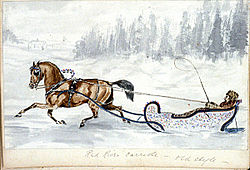
In a current project of databasing Father Louis-Napoléon St-Onge‘s handwritten dictionary, I encounter his entry under an English word “carryall“.
That sounds like a piece of luggage to me, but something made me look in old dictionaries for clues. (That something is the fact that St-Onge’s English vocabulary is simultaneously antiquated and recondite.)
Glad I checked. “Carry-all” is said to be a folk-etymology based off a loan from Canadian French, “carriole“ — which I recognize as Canadian for “sleigh”.
Proving this, and thereby increasing our number of newly identified Jargon words for it, he gives the CJ equivalent as aias sle (big sleigh).
For at least some French speakers, carriole also means a kind of horse-drawn wheeled cart. Evidently this was so for St-Onge, who gives an alternative translation aias tsik-tsik (big wagon).
There is so much Chinuk Wawa documentation yet to be given a thorough study that it’s easy to learn something new about this language every day…

Indeed Standard French la carriole is a kind of horse-drawn carriage. Given the necessity of adapting to the Canadian climate, it must have acquired the meaning of ‘horse-drawn sleigh’ in Canada.
LikeLike
The “stage sleigh” in your previous post (on the travelling KW) looks more like a “carriole” (as I know it) than does the one-horse sleigh with its single passenger in this particular post.
LikeLike
For French pictures of a carriole, google the word. The nicest and to me most typical one is a painting by the folk painter Rousseau, showing a family in their carriole.
When I was a child (after WWII) country people came to the weekly market in our small town in carrioles.
LikeLike