The great Fraser River flood of 1894
The great Fraser River flood of 1894 impressed those affected sufficiently for it to get immediately labeled as “the big flood”.
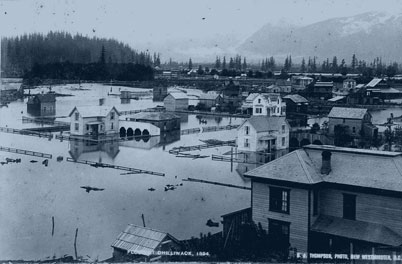
On the bright side, settlement was still pretty sparse so deaths were limited — but the 1894 inundation is considered the “flood of record”, its scale calculated as occurring only about twice in a thousand years.
This flood happened at another peak: the zenith of Chinook Jargon speaking and writing in shorthand, in the heartland thereof.
So, we have in this language an eyewitness document of a major historical occurrence — an account that (like so many other materials in Chinuk Wawa) I guarantee has never before been accessed by historians.
From Kamloops Wawa #118b, July 1894, page “16”:

<Big flood of 1894>
Pus tilikom kilapai kopa
When the people returned [from Head of the [Okanagan] Lake reserve] to
Shushwap pi kopa Kamlups klaska
Shuswap and to Kamloops, their
chako halak klaska siahus
eyes came open [wide.]
Drit ayu chok mitlait, pi chok
There was really a lot of water, and the water
kwanisim chako sahali.
kept rising.Stim kar iaka kopit kuli, pi klaska
The trains stopped running, and itchako komtaks oihat shako
came to be clear that the [rail]way had beenkakshit kanawi kah[.] Kanawi
damaged all over the place. All of thebrich kopa rilrod shako
railroad bridges gotkakshit. Wiht Savona brich
broken. Even the Savona bridgekakshit, pi Ashkroft brish kakshit
collapsed, and the Ashcroft bridge brokepi Spinsis Brich iaka kakshit
and Spences Bridge brokepi kimta wiht Liton brich
and then also the Lytton bridgeiaka kakshit, pi chok kwanisim
was destroyed, and the water keptchako sahali. Chako wawa
getting higher. Coming to speakkopa kikuli, kanawi ilihi patl
chok. Ilo kansih tilikom
with water. People had nevernanish ayu chok kakwa. Ayu
seen so much water. Manyhaws klatwa kopa chok, ayu
houses went into the water, lotsmusmus mimlus, ayu tipso
of cattle died, lots of haypi ayu iktas shako lost kopa
and lots of property were lost inchok. Kopa Kamlups chok
the water. At Kamloops the waterklatwa drit kopa Sondi haws
went right to the church’siaka laport, pi wiht kimta
door, and also out back ofkopa Sondi haws mitlait shok.
the church there was water.Nsaika iskom knim kopa tawn pi nsaika
We [i.e. Father Le Jeune] got a canoe from town and wek’o kopa knim kopa Sondi haws inatai.
got by canoe to the church on the other side.
As I’ve said before, such a description of a vivid real-life experience is full of rich language that’s very useful for giving us a picture of how people actually spoke Chinook.
My focus today is not on the grammar and expressions used here, but if you spend a few minutes examining this text, you’re liable to come away with your mind fertilized by the deposits of history’s sweep.
[With apologies for ending on a purple metaphor!]
