1894, WA: A judge who knows Chinuk Wawa knows “King George’s Men” is gender-neutral
Chinook Jargon was crucial in one judge’s decision in 1894.
The newspaper reporter of the following fouled up a historical detail: the American Fur Company played a pretty small role in how things got to be the way they were, compared with previous maritime fur traders and the succeeding Hudson Bay Company.
But assuming the reporting is accurate, Judge Emery (any connection with Eva Emery Dye?) understood kʰinchóch-mán and bástən-mán, accurately, as not fundamentally gendered.
These Jargon phrases have long been conventionalized, almost as though each were a single word, denoting nationality more than gender.
That’s relatively easy to do in a language such as this one, which just plain lacks grammatical gender.
With this in mind, you can take in a kind of remarkable legal decision that was consistent with loopholes in the US laws of the time, and as racist as the wording of the following article.
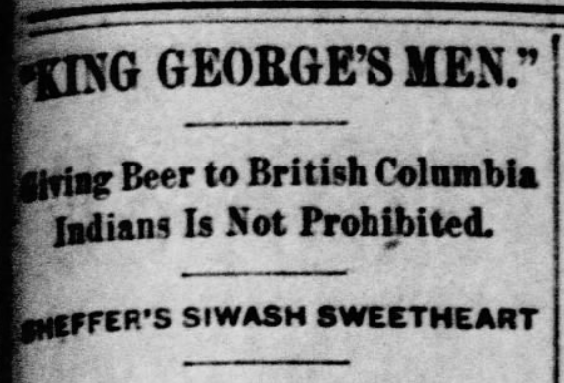
H. W. Sheffer was given a hearing be-
fore United States Commissioner Emery
yesterday and acquitted on the charge of
giving beer to Indians. Sheffer, while
entertaining three siwash squaws in his
room in the Whitechapel district, sent out
for a kettle of beer, and they all got
gloriously drunk and were arrested. At
the trial yesterday Judge Emery discov-
ered that the Indians belonged in British
Columbia, and therefore Sheffer had not
violated the Federal statute, which pro-
vides that no one shall sell or give beer,
wine or liquor to Indians in charge of an
agent or belonging to a reservation, and
when not otherwise shown, an Indian is
assumed to belong to a reservation.
Judge Emery, during his twenty-one
years’ experience on Puget sound, has
become more or less acquainted with
siwash languages, customs and traits of
character, and it did not take him long,
when the squaws were put upon the stand,
to discover that they were “King George’s
men” and not “Boston men.” In the
olden time, when the first white traders
pierced the Northwestern wilderness in
search of furs, the Hudson Bay Company
proclaimed themselves to the natives as
King George’s men, and the traders of the
American Fur Company on the Columbia
river, whose headquarters were Boston,
habitually spoke of their superiors as Bos-
ton men. In course of time the In-
dians who attached themselves to the
interests of one company or other got
to calling themselves “King George’s
men” and “Boston men,” and to this
day this distinction is the one known as
separating the tribes north and south of
the boundary line. King George’s men
are a handsomer race of people than the
Boston men and also more amiable.
Among many of the tribes up there the
custom of tattooing the person prevails,
while it is unknown among the southern
tribes, and when the squaws told the judge
that their home was among King George’s
men judicial notice was taken of the cor-
roborative evidence furnished by their
tattooing.
— “King George’s Men”, in the Seattle (WA) Post-Intelligencer of April 26, 1894, page 5, column 1
