Grant Smith 1996 on CJ place names
I read what other scholars have said about Chinook Jargon…
So you don’t have to!
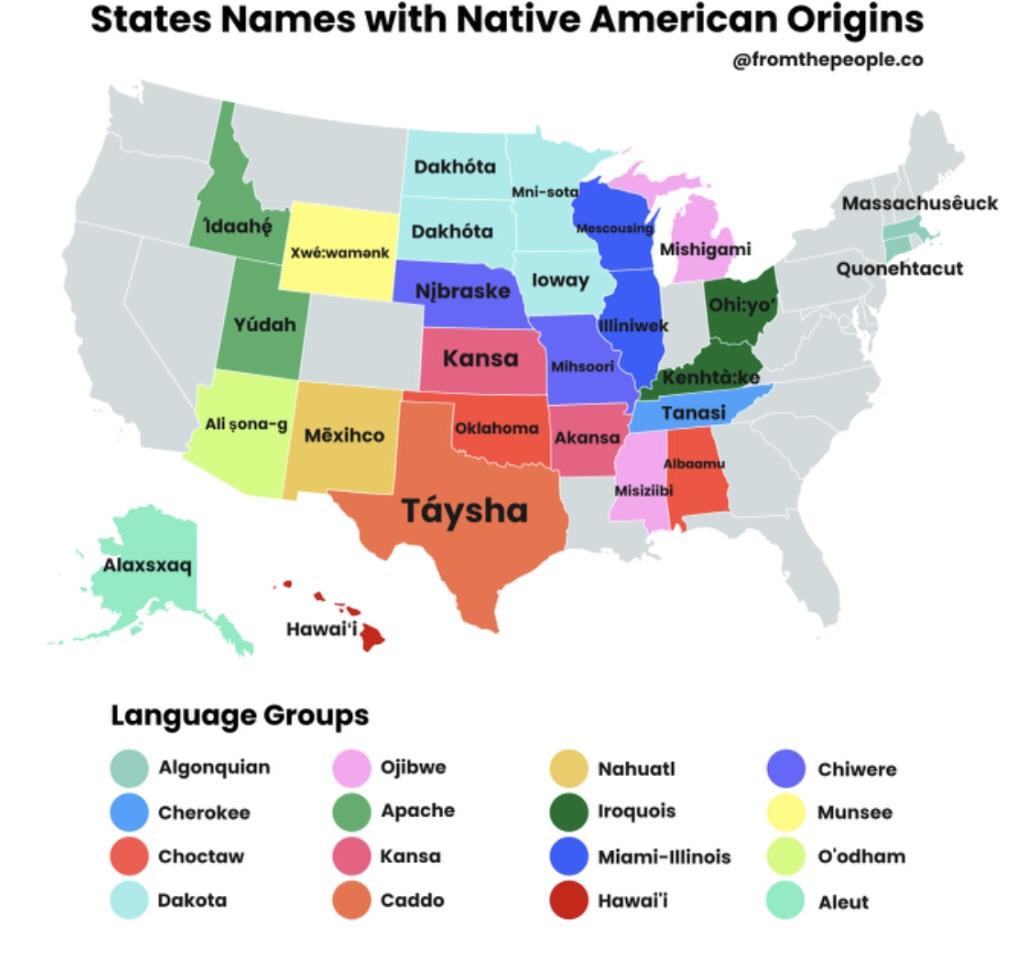
Image credit: Reddit
Today I’m having a look at “Amerindian Place Names: A Typology Based on Meaning and Form“, by Grant Smith (Onomastica Canadiana 78(2):53-64, 1996).
asdf
riddled with errors including not just CW but
Page 57 “Mogilian” => Mobilian.
Smith’s discussion involving Chinook Jargon (pages 57+) has points that bring it above the usual level of nonspecialist scholars’ talk about this language. I appreciate his observing that CJ also includes Salish words, for instance (page 58).
I’m not so sure I agree with his evaluation that “Probably the best recorded and most significant in terms of impact on regional place names is the Chinook Jargon (same page), considering that 6 of the most important cities in Washington state are Seattle, Tacoma, Spokane, Pasco, Walla Walla, and Yakima, and that they’re far from the only tribal-language-derived names regular folks are familiar with.
Also on page 58 is Smith’s claim that somehow due to being words from a pidgin (and, I’ll add, a creole) language, Chinook Jargon place names “are also simple in their types of reference”. He seems to be thinking that because his example words skookum chuck and camas recur frequently, they must have especially generic reference. This is hard to support when we take into account the similar frequency of English words such as river or little on our maps!
Not so much due to Smith’s or his editors’ mistake is his mistaken claim that camas “is probably derived from the Nootka [Nuu-chah-nulth] word chamass, meaning “sweet”…’ (page 58). It’s actually been proved by linguists to have come from a Sahaptian language such as Nez Perce, Yakama, or Umatilla, where it just meant “camas”.
Throughout his discussion of Chinuk Wawa, Smith is inconsistent in whether to see the language as Indigenous or as White folks’ communication with Natives. So on page 58 he says siwash was “Borrowed back from indigenous usage…” We could wish he would split the difference in favor of this language’s typical function as an intercultural language.
On pages 58-59 Smith claims “Many of the terms in Chinook Jargon have an onomatopoeic ring”, with tumtum being his example. In fact extremely few of the actual ideophones of (Central and Southern) CJ have made their way into official place name status, so we find few or no locations designated as *whim, *klugh, *klimmenklimmen, and so forth. (I used old-style dictionary spellings there, which most government-recognized place names from the Jargon do as well.)
I’m skeptical of Smith’s elaborate theory that Eloika Lake near my home of Spokane, WA (pages 60-61) blends Hebrew El ‘God’ with “the Greek feminine genitive oika” meaning ‘place’. Ancient Greek οἶκος ‘house; dwelling place’ is a masculine noun, lacking any genitive or other inflected form *oika. And other sources report Eloika as Salish, which seems possible to me given the weird ways Whites are wont to write the sounds of that language.
About Chief Spokane Garry (page 62) — his Salish name, as far as I’ve heard in classes or can tell from the latest edition of the Spokane dictionary, did not mean ‘youngest son’ as Smith says, but was instead the same as his father’s: ‘Chief Sun’/’Chief Spokane’, just spelled differently by different Whites.
I’ll forthrightly explain that I’m not viciously trashing Smith’s research. The fact is that published research on Indigenous languages of our region has blossomed since 1996. Smith wouldn’t have had much access to the kinds of reference works, and published articles, that we’ve now got, which in some cases he overtly notes.
My point, instead, is that we need to use previously published work with very careful thought, especially when it’s reporting other scholarship at second- or third-hand.
Beyond that, as a scholar of onomastics (proper names) myself, I will observe that Smith’s proposed typology of Indigenous-derived place names has not to my knowledge taken hold. Publishing small articles that purport to revamp this little corner of “historical linguistics”, as Smith sees it on page 53, is an eternal cottage industry. Without it, names studies would wither 😁.
