1909: “Histoire Générale de la Sténographie” + Kamloops Wawa
Among the takeaways from today’s find are a couple of senior Catholic officials who supposedly were Chinook Jargon pen pals with Indigenous people of BC…
I hadn’t heard of Fathers Dozois or Dontenwill in this capacity before. I’m reasonably skeptical of the accuracy of this claim, because they almost certainly would’ve been mentioned in the pages of “Kamloops Wawa” as exchanging letters with Native folks.
There’s at least one other point in this article that’s questionable, the seeming reference to General George Armstrong Custer, who played no role in the history of BC.
At any rate, the selection that I reproduce below does give some interesting information from Father Le Jeune of Kamloops, who really did help popularize Chinook Jargon literacy in the 1890s.
This excerpt comes from an excellent reference book, “Histoire Générale de la Sténographie” (‘General History of Shorthand’) by Albert Navarre (1909), pages 786-787. I’ll supply a lightly corrected Google Translate version of it in English, and I invite my readers to send in a better translation:


La sténographie chez les sauvages.
Parmi les adaptations qui ont eté faites du système Duploye, l’une
d’elles mérite une mention particulière pour sa véritable originalité et
pour les curieux resultats obtenus.Nous voulons parler de l’adaptation du R. P. Le Jeune au chinook,
dont un récent et superbe ouvrage, consacre a l’œuvre des mission-
naires dans les deux continents, parle en ces termes dans le chapitre
sur la Colombie britannique signé du général Custar :Deux missionnaires, chacun dans la sphère qui lui est propre, ont puis-
samment contribue a faciliter l’instruction des sauvages. Il y a une dizaine
d’annees que le R. P. Le Jeune eut l’heureuse idee d’appliquer à l’ecriture
du jargon chinook la stenographie des freres Duploye et de l’enseigner
aux sauvages de la race séliche. Ce mode d’écriture se propagea parmi
nombre de tribus avec d’autant plus de rapidite que les mots qui composent
cet ineffable jargon étant très peu nombreux, leur fréquente repétition n’en
rendait que plus facile la maniere de les transcrire et de les lire. Le P. Le
Jeune se fit alors editeur et redacteur de journal; un grand nombre de livres
populaires : Histoire Sainte, catechisme, prieres, chants sacres, etc., furent
par ses soins imprimes en caractères stenographiques et distribues parmi
les sauvages du sud du diocèse, tandis qu’une revue chinook, le Kamloops
Wawa (la parole de Kamloops) entretenait l’intéret des sauvages pour cette
nouvelle science en meme temps qu’elle augmentait considerablement la
somme de leurs connaissances.Le journal français le Monde (10 juillet 1893) a publié une intéressante
lettre du P. Le Jeune disant comment il fut amene en 1890 à enseigner[PHOTO]
Ce cliche represente le R. P. Le Jeune, missionnaire, auteur de l’adaptation
Duploye au chinook, ayant a ses cotes deux indigenes de Kamloops, qui l’aident
a instruire les sauvages au moyen de la stenographie.[page 787]
la sténographie aux sauvages qu’il évangélisait et quels résultats il
obtenait après trois ans d’essai :A l’heure qu’il est, ecrivait-il, plus de 300 sauvages, dissemines par tout
le pays, peuvent lire la stenographie Duploye; ils s’ecrivent les uns les
autres, ils peuvent deja lire et relire 8o pages d’Histoire Sainte dernièrement
imprimées et plus de 300 pages de lectures variées.Parlerai-je de 112 pages de prières et de catéchisme shushwap, apprises
par les sauvages dans les soirées de l’hiver dernier à Kamloops, a Shushwap,
au Nord Thompson? A Spuzzum, a Douglas-Lake, a Harrison River, a Lytton,
à O’Kanaga, partout vous trouverez des sauvages avides de s’instruire et
s’instruisant effectivement à l’aide de la stenographie.Le R. P. Le Jeune a appris cette stenographie, non seulement aux
sauvages, mais aussi à quelques Européens, parmi lesquels plusieurs[PHOTO]
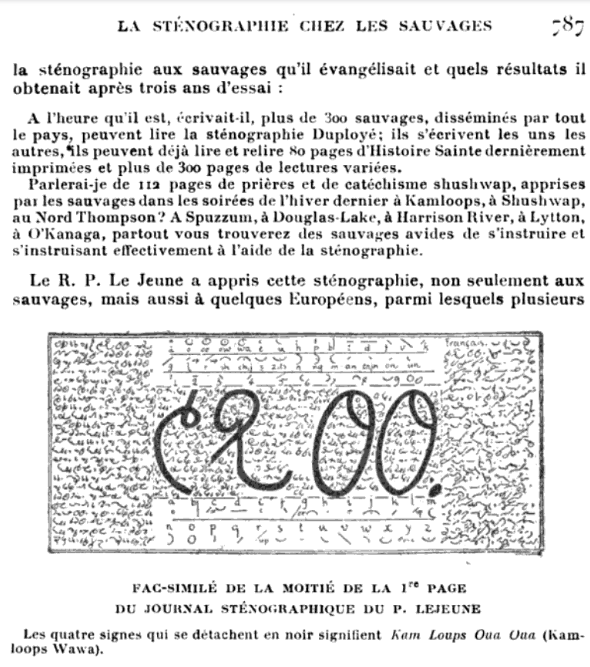
FAC-SIMILÉ DE LA MOITIÉ DE LA 17e PAGE
DU JOURNAL STÉNOGRAPHIQUE DU P. LEJEUNE
Les quatre signes qui se détachent en noir signifient Kam Loups Oua Oua (kam-
loops Wawa).missionnaires. Le P. Dozois, assistant, et Mer Dontenwill, archeveque
de Vancouver, supérieur de la Congrégation à laquelle appartient le
missionnaire sténographe, la connaissent et l’écrivent parfaitement;
ils correspondent avec les sauvages à l’aide de cette écriture.A titre de document curieux nous reproduisons un fac-similé de la
première page du Kamloops Wawa et, d’après « la Lumière », le portrait
du R. P. Le Jeune, un Français (de la Bretagne) ayant auprès de lui les
deux chefs indiens qu’il a conduits en France lors de son dernier
voyage en 1904.
Translated into English:
Shorthand among the Native people.
Among the adaptations that have been made of the Duployé system, one
of them deserves a particular mention for its true originality and
for the curious results obtained.We want to talk about the adaptation of R. P. Le Jeune to Chinook,
including a recent and superb work, devoted to the work of the mission-
naries in both continents, speaks in these terms in the chapter
on British Columbia signed by General Custar [Custer?!]:Two missionaries, each in his own sphere, were able to
greatly contribute to facilitating the education of savages. There are ten
years that R. P. Le Jeune had the happy idea of applying to writing
chinook jargon the stenography of the Duployé brothers and teaching it
to the Native people of the Salish race. This mode of writing spread among
number of tribes with all the more rapidity as the words which compose
this ineffable jargon being very few in number, their frequent repetition does not
made it easier to transcribe and read them. Fr.
Le Jeune then became a newspaper publisher and editor; a large number of books
popular: Holy History, catechism, prayers, sacred chants, etc., were
by him printed in stenographic characters and distributed among
the savages of the south of the diocese, while a chinook magazine, the Kamloops
Wawa (the word of Kamloops) kept the savages interested in this
new science at the same time as it considerably increased the
sum of their knowledge.The French newspaper Le Monde (July 10, 1893) published an interesting
letter from Father Le Jeune telling how he came to teach in 1890[PHOTO]
This photo shows Father Le Jeune, missionary, author of the adaptation
Duploye to Chinook, with two natives from Kamloops at his side, who help him to
instruct the savages by means of shorthand.[page 787]
stenography to the Native people he was evangelizing and what results he
obtained after three years of trying:At the present time, he wrote, more than 300 Native people, scattered throughout
the country, can read Duployé shorthand; they write to each other, they can already read and reread 80 pages of Holy History recently printed and more than 300 pages of varied readings.Shall I speak of 112 pages of Shushwap prayers and catechism, learned
by the Native people in the evenings of last winter at Kamloops, at Shushwap,
at North Thompson? At Spuzzum, at Douglas-Lake, at Harrison River, at Lytton,
at O’Kanaga [Okanagan], everywhere you will find Native people eager to learn and
effectively learning with the aid of shorthand.Rev. Father Le Jeune taught this shorthand, not only to
the Native people, but also to some Europeans, among whom several[PHOTO]
FAC-SIMILE OF HALF OF THE 17TH PAGE
OF THE STENOGRAPHIC JOURNAL OF FATHER LEJEUNE
The four signs which stand out in black signify Kam Loups Oua Oua (kam-
loops Wawa).missionaries. Father Dozois, assistant, and Monsignor Dontenwill, archbishop
of Vancouver, superior of the Congregation to which the
missionary stenographer belongs, know it and write it perfectly;
they correspond with the Native people using this writing.As a curious document we reproduce a facsimile of the
first page of the Kamloops Wawa and, according to “La Lumière”, the portrait
of Rev. Father Le Jeune, a Frenchman (from Brittany) having with him the
two Indian chiefs whom he led to France during his last
trip in 1904.
This article cites “Le Monde” of July 10, 1893, but the French newspaper that we now know by that name didn’t start publication until decades later, so…?

The Le Monde article: https://gallica.bnf.fr/ark:/12148/bpt6k6716293c
LikeLike
The Le Monde article: https://gallica.bnf.fr/ark:/12148/bpt6k6716293c
LikeLike