1800s: Why “Boston man” accidentally makes it harder to research Chinook Jargon
In the 1800’s, there were large numbers of mentions of a “Boston man” (and “Boston men”?) in newspapers …

Image credit: Boston Man magazine
…These were typically filler material, stereotyping jokes about the glibness / slickness / sense of superiority of people in what was for a long time the biggest, wealthiest city in the USA.

E.g. this one: “A Boston man has recently had his tongue amputated, but can talk nearly as well as ever”, just to give an 1881 Oregon example.
There were enough of these jokes, as well as serious references to actual fellas from Boston, Mass., that it’s rather difficult to use tools like the US Library of Congress’s “Chronicling America: Historic American Newspapers” archive to research the history of this Chinook Jargon phrase. (bástən-mán, ‘American person’ or ‘White person’.)
A rare exception that’s actually Chinuk Wawa, and thus worth reporting today, is in the Seattle (WA) Post-Intelligencer of August 8, 1885, page 1, column 1.
It’s this late-frontier-era news of western Washington’s Skokomish Indian Reservation and “Hood’s” (Hood) Canal area:
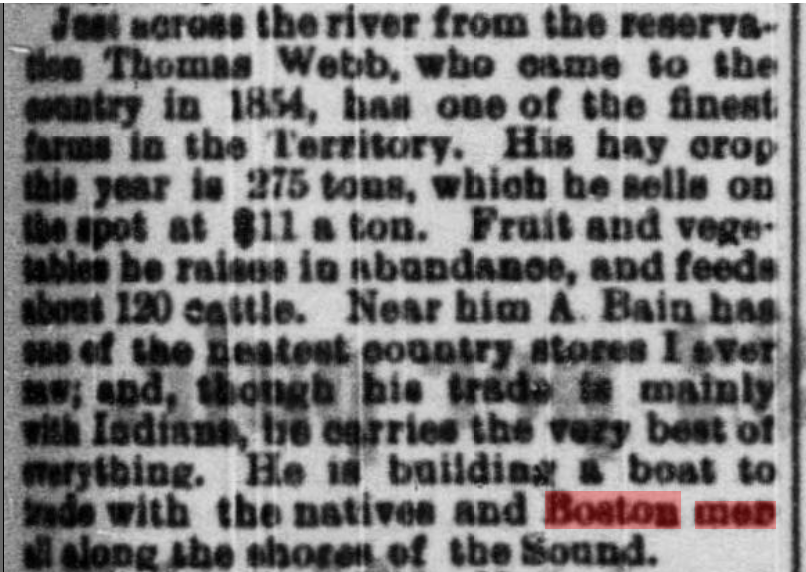
Just across the river from the reserva-
tion Thomas Webb, who came to the
country in 1854, has one of the finest
farms in the Territory. His hay crop
this year is 275 tons, which be sells on
the spot at $11 a ton. Fruit and vege-
tables be raises in abundance, and feeds
about 120 cattle. Near him A. Bain has
one of the neatest country stores I ever
saw; and, though his trade is mainly
with Indians, be carries the very best of
everything. He is building a boat to
trade with the natives and Boston men
all along the shores of the Sound.
