“The Survey of Vancouver English”: Part 1 — saltchuck
“The Survey of Vancouver English” is subtitled “A Sociolinguistic Study of Urban Canadian English”.
(Click for all installments in this series.)
It was published in 2004 by RJ Gregg et al. by Queen’s University in Kingston, ON, Canada. (Strathy Language Unit Occasional Papers number 5.)
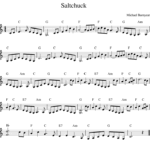
“Saltchuck” (image credit: North Atlantic Tune List)
Beginning on page 67 is an examination of “Vocabulary: Local Words” considered to be characteristic of Vancouver, BC. I’m going to do a mini-series of 4 of these words, because these ones come from Chinook Jargon.
Today, let’s look at the introductory wording, and then our first Vancouverism, saltchuck!

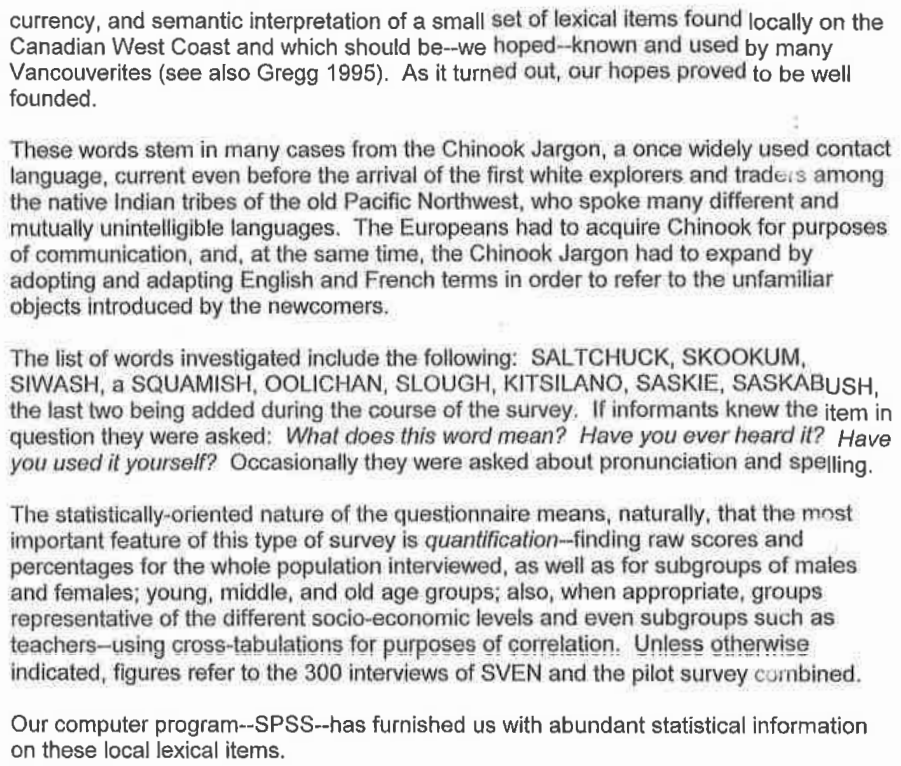
4. VOCABULARY
4.1 Local words
Among all the parts of the SVEN questionnaire that were concerned with vocabulary
section V is of particular interest, as its purpose was to investigate the survival,currency, and semantic interpretation of a small set of lexical items found locally on the
Canadian West Coast and which should be — we hoped-known and used by many
Vancouverites (see also Gregg 1995). As it turned out, our hopes proved to be well
founded.These words stem in many cases from the Chinook Jargon, a once widely used contact
language, current even before the arrival of the first white explorers and traders among
the native Indian tribes of the old Pacific Northwest, who spoke many different and
mutually unintelligible languages. The Europeans had to acquire Chinook for purposes
of communication, and, at the same time, the Chinook Jargon had to expand by
adopting and adapting English and French terms in order to refer to the unfamiliar
objects introduced by the newcomers.The list of words investigated include the following: SALTCHUCK, SKOOKUM,
SIWASH, a SQUAMISH, OOLICHAN, SLOUGH, KITSILANO, SASKIE, SASKABUSH,
the last two being added during the course of the survey. If informants knew the item in
question they were asked: What does this word mean? Have you ever heard it? Have
you used it yourself? Occasionally they were asked about pronunciation and spelling.The statistically-oriented nature of the questionnaire means, naturally, that the most
important feature of this type of survey is quantification-finding raw scores and
percentages for the whole population interviewed, as well as for subgroups of males
and females; young, middle, and old age groups; also, when appropriate, groups
representative of the different socio-economic levels and even subgroups such as
teachers-using cross-tabulations for purposes of correlation. Unless otherwise
indicated, figures refer to the 300 interviews of SVEN and the pilot survey combined.Our computer program — SPSS — has furnished us with abundant statistical information
on these local lexical items.
Right, now to saltchuck! It’s really fascinating to get a good sampling of what coastal BC people think about this word…
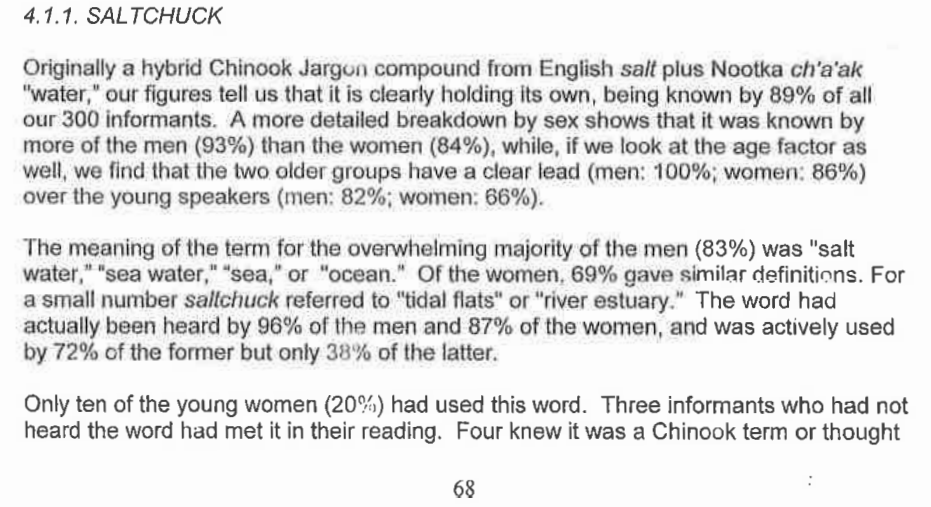

4.1.1. SALTCHUCK
Originally a hybrid Chinook Jargon compound from English salt plus Nootka ch’a’ak
“water,” our figures tell us that it is clearly holding its own, being known by 89% of all
our 300 informants. A more detailed breakdown by sex shows that it was known by
more of the men (93%) than the women (84%), while, if we look at the age factor as
well, we find that the two older groups have a clear lead (men: 100%; women: 86%)
over the young speakers (men: 82%; women: 66%).The meaning of the term for the overwhelming majority of the men (83%) was “salt
water,” “sea water,” “sea,” or “ocean.” Of the women, 69% gave similar definitions. For
a small number saltchuck referred to “tidal flats” or “river estuary.” The word had
actually been heard by 96% of the men and 87% of the women, and was actively used
by 72% of the former but only 38% of the latter.Only ten of the young women (20%) had used this word. Three informants who had not
heard the word had met it in their reading. Four knew it was a Chinook term or thought68
it had come from an Indian language. Eleven called it a fishing or sailing term. Some
8% thought its reference was restricted to the Vancouver area.Thus, in brief, saltchuck is a man’s word rather than a woman’s, well preserved among
the old group but losing ground among the young, especially the young women.
