1911, WA: An Unique Salutation, gestures + grimaces, and Settler non-fluency
Sometimes we hear that the speaking of Chinook Jargon was accompanied by “sign language”.
There already existed, in Pacific Northwest frontier times, the “sign language” taught to Deaf children back East. It was a source of endless fascination in the newspapers of the time — just do a search in the “Chronicling America” database of US newspapers.
Image credit: Amazon
So the phrase “sign language” was on everyone’s lips.
And lots of folks knew that there existed another, Indigenous sign language used on the northern Great Plains. Some of the PNW pioneers had seen it used, although probably few learned it, since they were only passing through on their way to the Pacific Coast region.
So when “sign language” is connected with Chinuk Wawa, it’s a pretty safe bet that it meant something more like the wild gesticulations & grimaces remembered below as having been typical of Settlers who were talking Jargon.
I’ve come to think that those great physical efforts substituted for true fluency in CW.
There are abundant other indications that I’ve shared over the years on this site which indicate that Settlers sort of settled. That is, they were content to see their own first language, English, as superior and as the most useful, while also being proud to have picked up the Jargon to communicate with Native people of many linguistic backgrounds.
The “impartial mixture of both languages” noted below memorializes Settler language practices resulting from those attitudes, I believe. As does the remembrance of abundant gesturing and exaggerated facial expressions accompanying the Jargon in frontier times.
See what you think, and see if you can decipher the editor’s admittedly rusty Chinook:
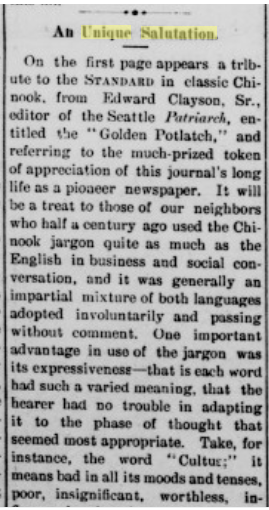

An Unique Salutation.
On the first page appears a trib-
ute to the STANDARD in classic Chi-
nook, from Edward Clayson, Sr.,
editor of the Seattle Patriarch, en-
titled the “Golden Potlatch,” and
referring to the much-prized token
of appreciation of this journal’s long
life as a pioneer newspaper. It will
be a treat to those of our neighbors
who half a century ago used the Chi-
nook jargon quite as much as the
English in business and social con-
versation, and it was generally an
impartial mixture of both languages
adopted involuntarily and passing
without comment. One important
advantage in use of the jargon was
its expressiveness — that is each word
had such a varied meaning, that the
hearer had no trouble in adapting
it to the phase of thought that
seemed most appropriate. Take, for
instance, the word “Cultus;” it
means bad in all its moods and tenses,
poor, insignificant, worthless, in-
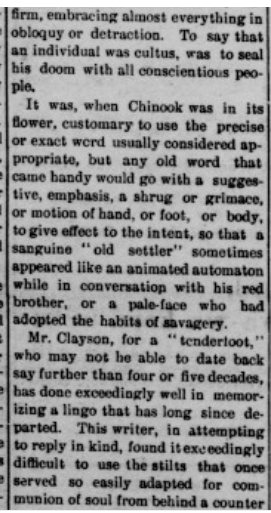
firm, embracing almost everything in
obloquy or detraction. To say that
an individual was cultus, was to seal
his doom with all conscientious peo-
ple.It was, when Chinook was in its
flower, customary to use the precise
or exact word usually considered ap-
propriate, but any old word that
came handy would go with a sugges-
tive, emphasis, a shrug or grimace,
or motion of hand, or foot, or body,
to give effect to the intent, so that a
sanguine “old settler” sometimes
appeared like an animated automaton
while in conversation with his red
brother, or a pale-face who had
adopted the habits of savagery.Mr. Clayson, for a “tenderfoot,”
who may not he able to date back
say further than four or five decades,
has done exceedingly well in memor-
izing a lingo that has long since de-
parted. This writer, in attempting
to reply in kind, found it exceedingly
difficult to use the stilts that once
served so easily adapted for com-
munion of soul from behind a counter
in the first store in Olympia.Delate hyas klahoya, nika owe?
Nika klosh kumtux okoke delate wa-
wa.The card received is about a foot
square, printed in fine display. It
has been framed and graces a place
in the cozy nook along with the
presentation cup and the expressive
resolutions of pioneers, publishers,
printers and other appreciative
friends.
— from the Olympia (WA) Washington Standard of December 29, 1911, page 2, column 3
