Lempfrit’s legendary, long-lost linguistic legacy (Part 24: Signum Crucis and Pater Noster)
And now for some rare old Chinook Jargon texts!
The 24th pair of pages (mis-numbered as “23” on the original page) from this precious document again brings us plenty of stuff worth knowing about Chinook Jargon — this time moving from lists of words into texts.
(Here’s a link to the other posts in this mini-series.)
From today’s installment onward, Alphonse Pinart’s “Anonymous 1849” copy (read it for free online) lacks any pages that correspond to what we’re seeing from Lempfrit.
Where you see [le]tters in square brackets, they’re not visible on the page copy that I’m working from, but we infer that they really are there!
By the way, the notation ___ means that the preceding entry is repeated in that position, along with some additional word(s).
See if you recognize words in these unusual spellings! I think we have a couple more small discoveries today, again showing the value of examining every Chinuk Wawa document — even those that appear to be straight copies of each other!
Beginning with today’s textual materials, we have the rewarding experience of seeing how a French-speaker (in the pre-Anthropology era, no less) conceptualized the word-to-word flow of spoken Jargon. Lempfrit’s “glosses” of each Chinook Jargon word might be pretty different from how you think of each word’s meaning!
If you need some quick proof that Chinook Jargon is an Indigenous language, take a look at how different Lempfrit’s French, and the conventional English lines, are from what the Jargon here is literally — and fluently — saying.
When I say that this Chinuk Wawa is fluent, I’m saying that it’s totally characteristic stuff in what I’ve now come to call the Central Dialect. That’s the oldest variety of the language, the early-creolized Jargon associated with Fort Astoria and Fort Vancouver. The document we’re looking at here was created before the Northern or Southern dialects (associated with British Columbia and with Oregon’s Grand Ronde Reservation, respectively) even existed.
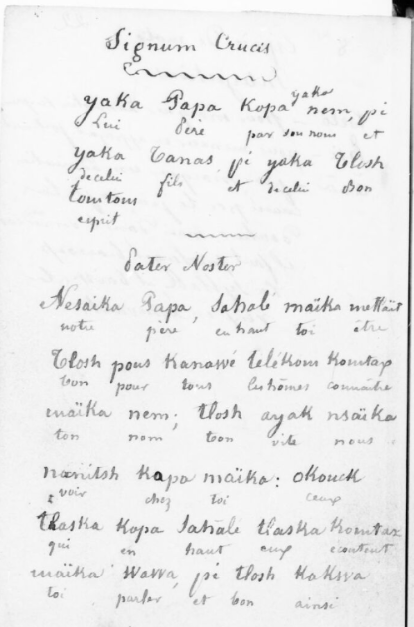
Signum Crucis
[The Sign of the Cross]yaka Papa kopa yaka nem, pi
Lui Père par son nom et
him father by his name and
[Literally:] ‘By the name of his father, and’
[Conventionally:] ‘In the name of the father, and’yaka tanas, pi yaka Tlosh
de celui fils et de celui Bon
of.that.one son and of.that.one good
‘his son, and his good’
‘the son, and the holy’tomtom
esprit
spirit
‘spirit.’
‘spirit.’Pater Noster
[The Our Father]Nesaika Papa, Sahalé maïka metlaït
notre père en.haut toi être
our father in above you to.be
[Literally:] ‘Our father, it’s in the sky that you are (located);’
[Conventionally:] ‘Our father who art’Tlosh pous kanawé télékom komtax
bon pour tous les hommes connaître
good for all the.people to.be.familiar.with
‘everyone should know’
‘in heaven, hallowed be’maïka nem; tlosh ayak nsaïka
ton nom; bon vite nous
your name; good quickly we
‘your name; we should quickly’
‘thy name; thy kingdom’nanitsh kopa maïka; okouck
voir chez toi ceux
to.see ~with you those.ones
‘look to you; those’
‘come, thy will’tlaska kopa sah̃ale tlaska komtax
qui en haut ceux écoutent
who in above those.ones they.hear
‘who are in the sky hear’
‘be done,’maïka wawa, pi tlosh kakwa
toi parler et bon ainsi
you to.speak and good like.that
‘your words, and like that is how’
‘on earth’
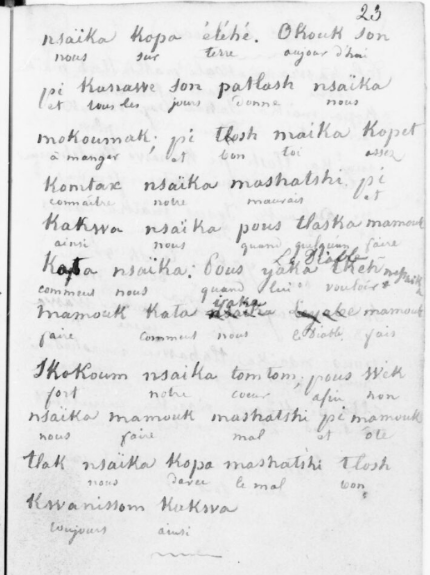
nsaïka kopa éléhé. Okouk son
nous sur terre aujourd’hui
us on earth today
[literally:] ‘we should be on earth. Today’
[conventionally:] ‘as it is in heaven. Give’
pi kanawe son patlash nsaïka
et tous.les jours donne nous
and all.the days give us
‘and every day give us’
‘us this day our’
mokoumak; pi tlosh maika kopet
à.manger et bon toi assez
to.eat and good you enough
‘food; and please for-‘
‘daily bread, and forgive’
komtax nsaïka mashatshi, pi
connaître notre mauvais et
be.familiar.with our bad and
‘get our bad things (that we do), and’
‘us our trespasses,’
kakwa nsaïka pous tlaska mamouk
ainsi nous quand quelqu’un faire
like.that we when somebody to.do
‘we’ll be like that when anyone does’
‘as we forgive those who tres-‘
kata nsaïka: Pous [written above: Le Diable] yaka tkeh̃ nsaïka*
comment nous quand [Le Diable] lui vouloir [nous]*
how/like us when [the devil] him to.want [us]*
‘us wrong; if [the devil] wants us*’
‘pass against us, and lead us not’
mamouk kata iaka*
nsaïka Leyabemamouk
faire comment [lui]*nous le Diablefais*
to.do like/how himwe the.devilyou.make*
‘to do like himus the devil, make’
‘into temptation, but’
Skokoum nsaika tomtom, pous wék
fort notre coeur afin non
strong our heart in.order.to not
‘our hearts strong, so that we don’t’
‘deliver us from’
nsaïka mamouk mashatshi pi mamouk
nous faire mal et ôté
we to.do bad(ly) and removed
‘do bad things, and se-‘
‘evil.’
tlak nsaïka kopa mashatshi tlosh
nous d’avec le.mal bon
us away.from the.evil good
‘parate us from bad things; may it’
‘A-‘
kwanissom kakwa
toujours ainsi
always like.that
‘always be like that.’
‘men.’
