Didactic dialogues in CW dictionaries, part 7B: Shaw’s “examples” 2nd installment
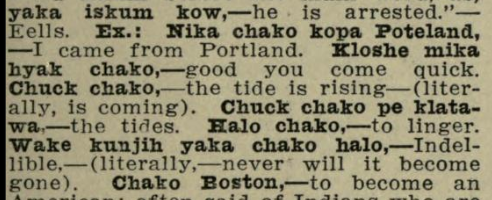
Page 3 of George Coombs Shaw’s northern-dialect dictionary of 1909 brings us another serving of full sentences to learn from.
(All installments in this mini-series.)
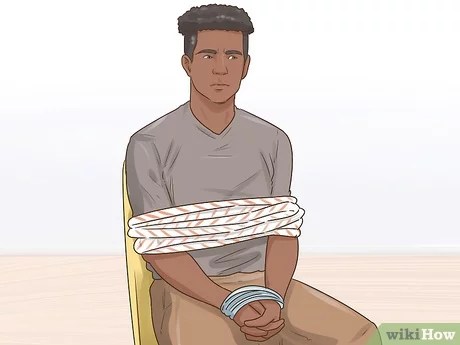 Image credit: WikiHow

- Yaka chako pahtlum — ‘he is drunk’
(yaka chaku-páɬlam ‘(S)he’s gotten drunk; (s)he got drunk’) - nika chako keekwulee — ‘I am degraded’
(nayka chaku-kíkwəli ‘I’ve come down; I’ve gotten low’) - yaka chako stone — ‘it is petrified.’
( (yaka) chaku-stún ‘(she/he) has turned to stone; (she/he) turned to stone’.
It’s not usual to say yaka if you mean ‘it’; English speakers often make this odd word choice, though.)
- yaka iskum kow — ‘he is arrested.’
(yaka ískam-k’áw ~’he got himself tied up’.
The dictionary discusses Reverend Myron Eells’s report that ískam ‘pick out, choose, pick up, take on purpose’ can be used as a helping verb similar to chaku-; it seems to me that such a use of ískam has the unique overtone of intentionally entering into a situation, so I’m translating it as ‘he got himself arrested’, etc. K’aw ‘tied up [in handcuffs]’ is a widely used Indigenous metaphor for ‘arrested’.) - Nika chako kopa Poteland — ‘I came from Portland.’
(nayka cháku kʰapa pʰóɬən ‘I come from Portland; I came from Portland’) - Kloshe mika hyak chako — ‘good you come quick.’
(ɬúsh mayka (h)áyáq cháku ‘you should come quick; please come quick’) - Chuck chako — ‘the tide is rising-(literally, is coming).’
(tsə́qw cháku ‘the water is coming’) - Chuck chako pe klatawa, — ‘the tides.’
(tsə́qw cháku pi ɬátwa ‘the water comes and goes’) - Wake kunjih yaka chako halo — ‘Indellible [indelible],-(literally,-never will it become gone).’
(wik-qʰə́nchi(x̣) (yaka) chaku-hílu ‘(s)he will never disappear’)

- Chako kunamokst nika. — ‘come with me.’
(cháku kʰánumákwst nayka ‘come with me’)
…
- Chee nika ko — ‘I have just arrived.’
(chxí nayka q’úʔ ‘I’ve just arrived’)

- Nika hyas tikegh chikamin — ‘I very much wish money.’
(nayka hayas-tíki chíkʰəmin ‘I really want money; I love money’)

- Nika chako kopa chikchik — ‘I came in a wagon.’
(nayka cháku kʰapa ts’íkts’ik ‘I came in a wagon’)

- Mika kumtux Chinook wawa? — ‘Do you understand the Chinook language?’
(mayka kə́mtəks chinúk-wáwa? ‘Do you understand Chinook (Jargon)?’)
