Pentland “French loanwords in Cree”
David Pentland wrote a good article on “French Loanwords in Cree” that points out several things we can recognize in Chinook Jargon.
This study is in the Kansas Working Papers in Linguistics, where it came out in 1982.
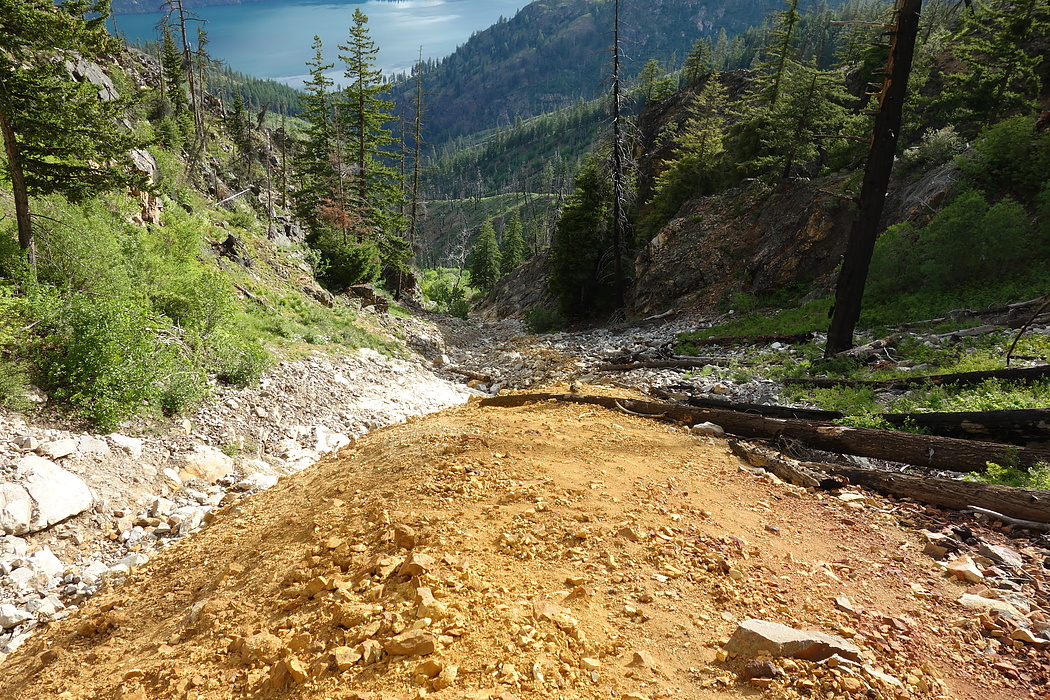
Skookum Puss Mountain, Chelan County, Washington state, USA (image credit: Mindat)
Page 106 on a couple of words for White people that we’ve seen on my site as moniasses and saganaz:

Sometimes the traders’ own words (not always perfectly understood)
were used instead of coining a new term: the place name [moreal] Mont-
real was borrowed as *moliyawa ‘Frenchman’ (> Cree moniyaw, Ojibwa moni-
ya), but Menomini preserves the older meaning ‘main city of the Europeans
in muniyak ‘New York City’ (borrowed from Fox or Ojibwa in its locative
form). The French plural [lezagle] les Anglais ‘the English’ was adopted
as *(s)akalahsiwa ‘Englishman’ (singular), whence Cree akanasiw and Ojib-
wa sākanāhs ~ šākanāhš (the latter with pejorative š for s); Menomini
sākanās is a loan from Ojibwa.
Page 111 tells us of a Plains Cree ‘cougar’ expression that’s parallel to one we find in Chinook Jargon:

maci- ‘bad’ + minos ‘cat’ forms maci-minos ‘cougar’ (replacing Cree misi-
pisiw ‘big lynx’).
Compare that with the Jargon’s < hyas pusspuss > (‘big cat’), as well as its < skookum puss > (~’strong/monster cat’).
On page 114, Pentland makes really apt comments on the non-documentation of English and French loans (in Cree), virtually identical with what I’ve long said about the weird absence of such words in a lot of 1800s dictionaries of Chinuk Wawa:

English loanwords in Cree have seldom been recorded.
because they are lacking, but because relatively unassimilated loanwords
(those that are easily recognized as English or French) tend not to be
written down, even by professional linguists. Even assimilated loanwords
are often ignored by those who are familiar with the source language:
therefore the only words that are usually recorded are those so drastic-
ally altered that the collector does not recognize his own language, or
those from languages with which the collector is less familiar, so that
English loans tend to be ignored in the west while French loans are us-
ually ignored in Quebec. There are, however, important lessons to be
learned from such borrowings, and those studying Indian languages should
increase their efforts to obtain samples of them.
Anohter interesting point is on page 116, noting the Cree Yes/No question marker =na, occurring in dialects that don’t use =chi(n). Around Forts George/Astoria and Vancouver, for a long time there were fur-trade employees who were familiar with a large variety of Cree dialects…

Most Cree dialects have a question marker na (which
follows the first word in the clause), but all Plains Cree dialects have
substituted the (early?) French loanword ci…
adsf
