“Memories of White Salmon and Its Pioneers”
One of the earliest places in what’s now Washington state where Settlers put down stakes was White Salmon, in Klickitat County.
That’s on the Columbia River just opposite Hood River, Oregon.

Image credit: Community Partners BWS
White Salmon’s first non-Indigenous residents (from 1853 on) are memorialized in an article titled “Memories of White Salmon and Its Pioneers” by Albert J. Thompson (April 1923, Washington Historical Quarterly 14(2):108-126).
Page 109 says the first Settler in the area bought land from Indigenous people, paying them with hyas ictas, which means ‘big things’ — probably intending to say hyu ictas, ‘lots of things’:

Mr. Joslyn’s ideals were high, and he dealt squarely and
honestly with white man and Indian alike. He first called in
their chief men and bought his land outright, paying them in
blankets, flour, cloth and “hyas ictas,” “many things dear to their
childish fancy”.
Page 113 mentions one of many places in the Pacific Northwest known as Camas Prairie.
Page 114, recalling 1868:

I have not space to tell all I would like of that memorable
summer’s experiences; of those hundreds of Indians, with their
thousands of horses; their wierd [weird] songs and dances, their funerals
and religious rites; of their desire to trade for cloth, sugar, flour
and a hundred other “iktas” (things) ; their passion for gambling,
and horse racing. All this, along with the, to me, uncouth Indian
and Chinook language, was a new experience, as was also the
free open air life, the cooking over a camp fire, and sleeping out
under the stars at night on account of the musquitos [mosquitoes].
Pages 115-116, about one of the hundreds of people who had a Chinook Jargon name, Cultus (‘no-good’) Charlie:
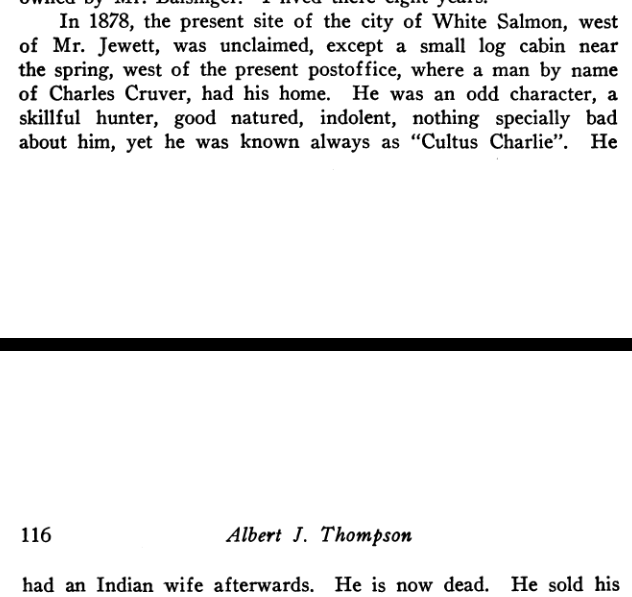
In 1878, the present site of the city of White Salmon, west
of Mr. Jewett, was unclaimed, except a small log cabin near
the spring, west of the present postoffice, where a man by name
of Charles Cruver, had his home. He was an odd character, a
skillful hunter, good natured, indolent, nothing specially bad
about him, yet he was known always as “Cultus Charlie”. He116
had an Indian wife afterwards. He is now dead.
Page 120 tells of Native acquaintances who helped Thompson learn Chinuk Wawa:
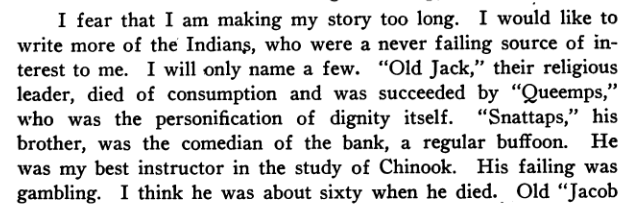
I fear that I am making my story too long. I would like to
write more of the Indians, who were a never failing source of in-
terest to me. I will only name a few. “Old Jack,” their religious
leader, died of consumption and was succeeded by “Queemps,” [Quaempts]
who was the personification of dignity itself. “Snattaps,” his
brother, was the comedian of the bank, a regular buffoon. He
was my best instructor in the study of Chinook. His failing was
gambling. I think he was about sixty when he died.
Pages 120-121 tell a memory of a Native man known as Johnson in a CW conversation:

“Yallup” and
121
“Johnson” were brothers, and “Christian Indians”, and always to
be trusted. Once a cavilling white man asked the latter: “John-
son, where do you think you will go when you die?” to which
Johnson replied, quick as a flash: “Chee nika memaloose, chee
nika kumtux.” (“As soon as I die, so soon I know.”) Could
any theologian have given a better answer?
Well now,
